

56
2 One Magnetic Center
E(cm −1 )
| 3
2 , − 3
2 | 3
2 , − 1
2 | 3
2 , 1
2 | 3
2 , 3
2
Ψ ′
1
0.00
0.007808 +
0.008516i
0.058561 +
−0.068873i
−0.207583 +
−0.246313i
−0.709453 +
0.620169i
Ψ ′
2
0.00
0.942302 +
0.000087i
0.005791 +
0.322067i
−0.089417 +
−0.013321i
0.000274 +
−0.011550i
Ψ ′
3
32.47
0.090185 +
−0.002021i
−0.000628 +
0.012098i
0.934946 +
0.117457i
−0.034599 +
0.320311i
Ψ ′
4
32.47
0.255568 +
−0.196167i
−0.586647 +
−0.737404i
0.010006 +
−0.006830i
−0.045185 +
−0.078075i
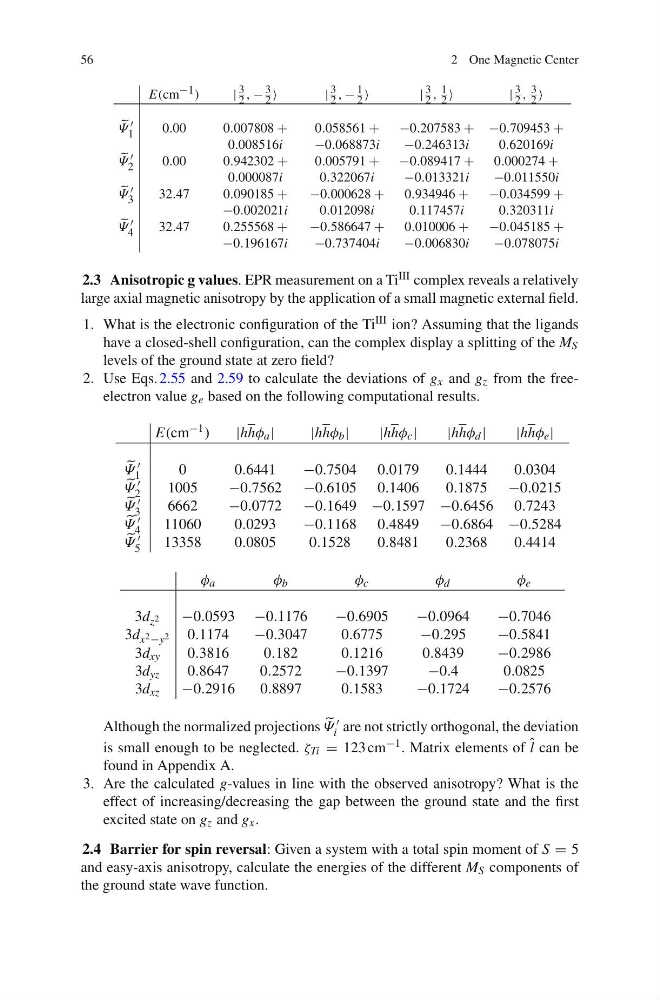
2.3 Anisotropic g values. EPR measurement on a Ti III complex reveals a relatively
large axial magnetic anisotropy by the application of a small magnetic external field.
1. What is the electronic configuration of the Ti III ion? Assuming that the ligands
have a closed-shell configuration, can the complex display a splitting of the M S
levels of the ground state at zero field?
2. Use Eqs. 2.55 and 2.59 to calculate the deviations of g x and g z from the freeelectron value g e based on the following computational results.
E(cm −1 )
|hhφ a || hhφ b || hhφ c || hhφ d || hhφ e |
Ψ ′
1
00 .6441
−0.7504 0.0179
0.1444
0.0304
Ψ ′
2
1005
−0.7562 −0.6105 0.1406
0.1875 −0.0215
Ψ ′
3
6662
−0.0772 −0.1649 −0.1597 −0.6456 0.7243
Ψ ′
4
11060
0.0293
−0.1168 0.4849 −0.6864 −0.5284
Ψ ′
5
13358
0.0805
0.1528
0.8481
0.2368
0.4414
φ a
φ b
φ c
φ d
φ e
3d z 2
−0.0593 −0.1176
−0.6905
−0.0964
−0.7046
3d x 2 −y 2 0.1174
−0.3047
0.6775
−0.295
−0.5841
3d xy
0.3816
0.182
0.1216
0.8439
−0.2986
3d yz
0.8647
0.2572
−0.1397
−0.40 .0825
3d xz −0.2916
0.8897
0.1583
−0.1724
−0.2576
Although the normalized projections
Ψ ′
i are not strictly orthogonal, the deviation
is small enough to be neglected. ζ Ti = 123 cm −1 . Matrix elements of ˆ l can be
found in Appendix A.
3. Are the calculated g-values in line with the observed anisotropy? What is the
effect of increasing/decreasing the gap between the ground state and the first
excited state on g z and g x .
2.4 Barrier for spin reversal: Given a system with a total spin moment of S = 5
and easy-axis anisotropy, calculate the energies of the different M S components of
the ground state wave function.
2 One Magnetic Center
E(cm −1 )
| 3
2 , − 3
2 | 3
2 , − 1
2 | 3
2 , 1
2 | 3
2 , 3
2
Ψ ′
1
0.00
0.007808 +
0.008516i
0.058561 +
−0.068873i
−0.207583 +
−0.246313i
−0.709453 +
0.620169i
Ψ ′
2
0.00
0.942302 +
0.000087i
0.005791 +
0.322067i
−0.089417 +
−0.013321i
0.000274 +
−0.011550i
Ψ ′
3
32.47
0.090185 +
−0.002021i
−0.000628 +
0.012098i
0.934946 +
0.117457i
−0.034599 +
0.320311i
Ψ ′
4
32.47
0.255568 +
−0.196167i
−0.586647 +
−0.737404i
0.010006 +
−0.006830i
−0.045185 +
−0.078075i
2.3 Anisotropic g values. EPR measurement on a Ti III complex reveals a relatively
large axial magnetic anisotropy by the application of a small magnetic external field.
1. What is the electronic configuration of the Ti III ion? Assuming that the ligands
have a closed-shell configuration, can the complex display a splitting of the M S
levels of the ground state at zero field?
2. Use Eqs. 2.55 and 2.59 to calculate the deviations of g x and g z from the freeelectron value g e based on the following computational results.
E(cm −1 )
|hhφ a || hhφ b || hhφ c || hhφ d || hhφ e |
Ψ ′
1
00 .6441
−0.7504 0.0179
0.1444
0.0304
Ψ ′
2
1005
−0.7562 −0.6105 0.1406
0.1875 −0.0215
Ψ ′
3
6662
−0.0772 −0.1649 −0.1597 −0.6456 0.7243
Ψ ′
4
11060
0.0293
−0.1168 0.4849 −0.6864 −0.5284
Ψ ′
5
13358
0.0805
0.1528
0.8481
0.2368
0.4414
φ a
φ b
φ c
φ d
φ e
3d z 2
−0.0593 −0.1176
−0.6905
−0.0964
−0.7046
3d x 2 −y 2 0.1174
−0.3047
0.6775
−0.295
−0.5841
3d xy
0.3816
0.182
0.1216
0.8439
−0.2986
3d yz
0.8647
0.2572
−0.1397
−0.40 .0825
3d xz −0.2916
0.8897
0.1583
−0.1724
−0.2576
Although the normalized projections
Ψ ′
i are not strictly orthogonal, the deviation
is small enough to be neglected. ζ Ti = 123 cm −1 . Matrix elements of ˆ l can be
found in Appendix A.
3. Are the calculated g-values in line with the observed anisotropy? What is the
effect of increasing/decreasing the gap between the ground state and the first
excited state on g z and g x .
2.4 Barrier for spin reversal: Given a system with a total spin moment of S = 5
and easy-axis anisotropy, calculate the energies of the different M S components of
the ground state wave function.