

54
2 One Magnetic Center
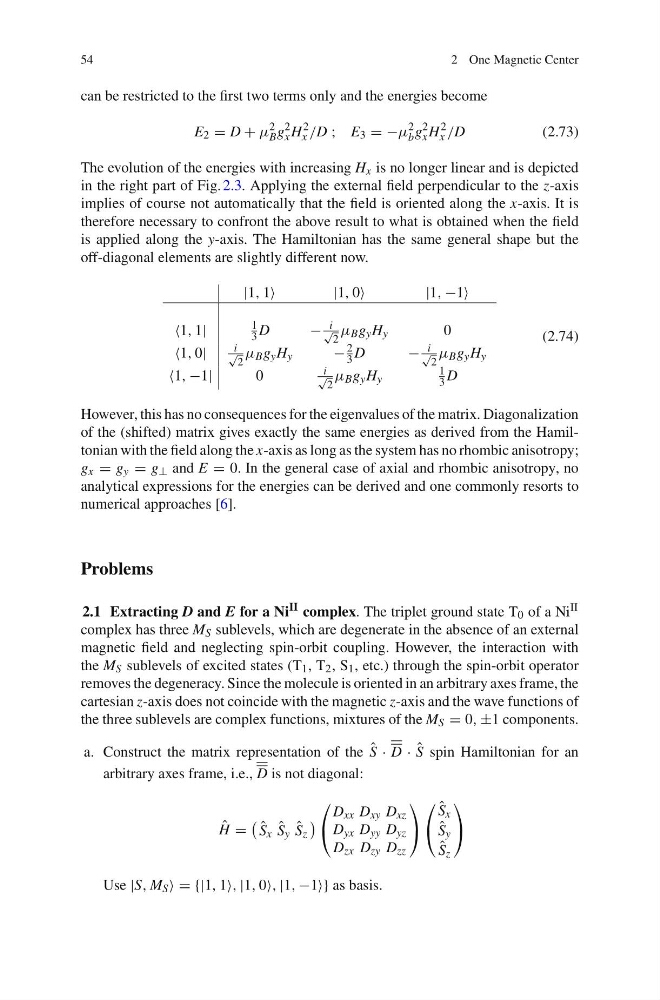
can be restricted to the first two terms only and the energies become
E 2 = D + μ
2
B g
2
x H
2
x /D ; E 3 =−μ
2
b g
2
x H
2
x /D
(2.73)
The evolution of the energies with increasing H x is no longer linear and is depicted
in the right part of Fig. 2.3. Applying the external field perpendicular to the z-axis
implies of course not automatically that the field is oriented along the x-axis. It is
therefore necessary to confront the above result to what is obtained when the field
is applied along the y-axis. The Hamiltonian has the same general shape but the
off-diagonal elements are slightly different now.
|1, 1| 1, 0| 1, −1
1, 1|
1
3 D
−
i
√
2
μ B g y H y
0
1, 0|
i
√
2
μ B g y H y
−
2
3 D
−
i
√
2
μ B g y H y
1, −1|
0
i
√
2
μ B g y H y
1
3 D
(2.74)
However, this has no consequences for the eigenvalues of the matrix. Diagonalization
of the (shifted) matrix gives exactly the same energies as derived from the Hamiltonian with the field along the x-axis as long as the system has no rhombic anisotropy;
g x = g y = g ⊥ and E = 0. In the general case of axial and rhombic anisotropy, no
analytical expressions for the energies can be derived and one commonly resorts to
numerical approaches [6].
Problems
2.1 Extracting D and E for a Ni
II complex. The triplet ground state T 0 of a Ni II
complex has three M S sublevels, which are degenerate in the absence of an external
magnetic field and neglecting spin-orbit coupling. However, the interaction with
the M S sublevels of excited states (T 1 ,T 2 ,S 1 , etc.) through the spin-orbit operator
removes the degeneracy. Since the molecule is oriented in an arbitrary axes frame, the
cartesian z-axis does not coincide with the magnetic z-axis and the wave functions of
the three sublevels are complex functions, mixtures of the M S = 0, ±1 components.
a. Construct the matrix representation of the ˆ
S · D · ˆ
S spin Hamiltonian for an
arbitrary axes frame, i.e., D is not diagonal:
ˆ
H =
ˆ
S x ˆ
S y ˆ
S z
⎛
⎝
D xx D xy D xz
D yx D yy D yz
D zx D zy D zz
⎞
⎠
⎛
⎝
ˆ
S x
ˆ
S y
ˆ
S z
⎞
⎠
Use |S, M S ={|1, 1, |1, 0, |1, −1} as basis.
2 One Magnetic Center
can be restricted to the first two terms only and the energies become
E 2 = D + μ
2
B g
2
x H
2
x /D ; E 3 =−μ
2
b g
2
x H
2
x /D
(2.73)
The evolution of the energies with increasing H x is no longer linear and is depicted
in the right part of Fig. 2.3. Applying the external field perpendicular to the z-axis
implies of course not automatically that the field is oriented along the x-axis. It is
therefore necessary to confront the above result to what is obtained when the field
is applied along the y-axis. The Hamiltonian has the same general shape but the
off-diagonal elements are slightly different now.
|1, 1| 1, 0| 1, −1
1, 1|
1
3 D
−
i
√
2
μ B g y H y
0
1, 0|
i
√
2
μ B g y H y
−
2
3 D
−
i
√
2
μ B g y H y
1, −1|
0
i
√
2
μ B g y H y
1
3 D
(2.74)
However, this has no consequences for the eigenvalues of the matrix. Diagonalization
of the (shifted) matrix gives exactly the same energies as derived from the Hamiltonian with the field along the x-axis as long as the system has no rhombic anisotropy;
g x = g y = g ⊥ and E = 0. In the general case of axial and rhombic anisotropy, no
analytical expressions for the energies can be derived and one commonly resorts to
numerical approaches [6].
Problems
2.1 Extracting D and E for a Ni
II complex. The triplet ground state T 0 of a Ni II
complex has three M S sublevels, which are degenerate in the absence of an external
magnetic field and neglecting spin-orbit coupling. However, the interaction with
the M S sublevels of excited states (T 1 ,T 2 ,S 1 , etc.) through the spin-orbit operator
removes the degeneracy. Since the molecule is oriented in an arbitrary axes frame, the
cartesian z-axis does not coincide with the magnetic z-axis and the wave functions of
the three sublevels are complex functions, mixtures of the M S = 0, ±1 components.
a. Construct the matrix representation of the ˆ
S · D · ˆ
S spin Hamiltonian for an
arbitrary axes frame, i.e., D is not diagonal:
ˆ
H =
ˆ
S x ˆ
S y ˆ
S z
⎛
⎝
D xx D xy D xz
D yx D yy D yz
D zx D zy D zz
⎞
⎠
⎛
⎝
ˆ
S x
ˆ
S y
ˆ
S z
⎞
⎠
Use |S, M S ={|1, 1, |1, 0, |1, −1} as basis.