

34
2 One Magnetic Center
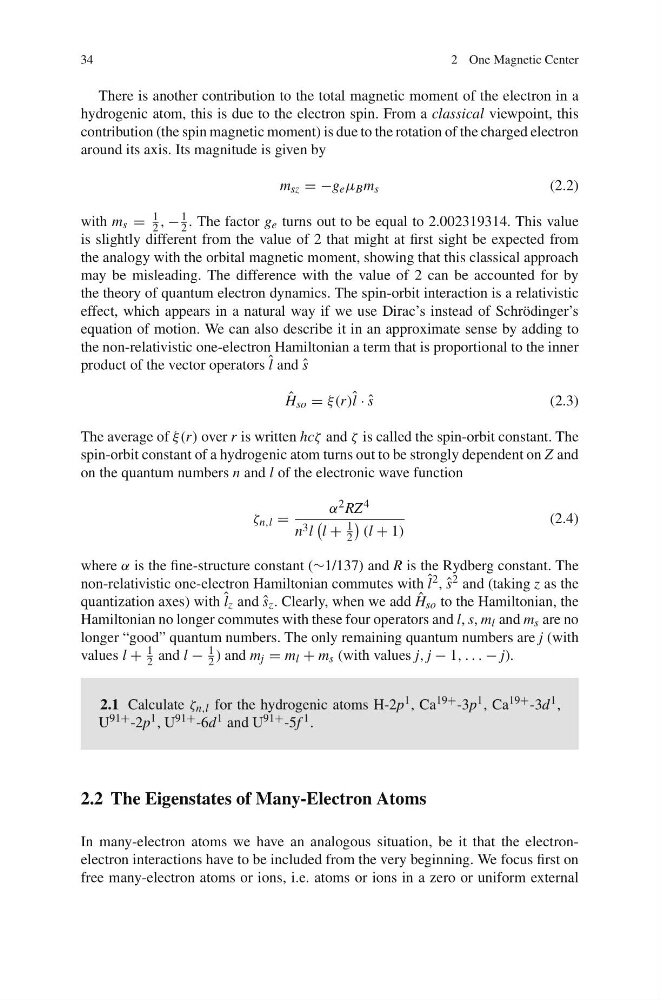
There is another contribution to the total magnetic moment of the electron in a
hydrogenic atom, this is due to the electron spin. From a classical viewpoint, this
contribution (the spin magnetic moment) is due to the rotation of the charged electron
around its axis. Its magnitude is given by
m sz =−g e μ B m s
(2.2)
with m s =
1
2 , −
1
2 . The factor g e turns out to be equal to 2.002319314. This value
is slightly different from the value of 2 that might at first sight be expected from
the analogy with the orbital magnetic moment, showing that this classical approach
may be misleading. The difference with the value of 2 can be accounted for by
the theory of quantum electron dynamics. The spin-orbit interaction is a relativistic
effect, which appears in a natural way if we use Dirac’s instead of Schrödinger’s
equation of motion. We can also describe it in an approximate sense by adding to
the non-relativistic one-electron Hamiltonian a term that is proportional to the inner
product of the vector operators ˆ l and ˆ
s
ˆ
H so = ξ(r) ˆ l ·ˆ s
(2.3)
The average of ξ(r) over r is written hcζ and ζ is called the spin-orbit constant. The
spin-orbit constant of a hydrogenic atom turns out to be strongly dependent on Z and
on the quantum numbers n and l of the electronic wave function
ζ n,l =
α 2 RZ 4
n 3 l
l +
1
2
(l + 1)
(2.4)
where α is the fine-structure constant (∼1/137) and R is the Rydberg constant. The
non-relativistic one-electron Hamiltonian commutes with ˆ l 2 , ˆ
s 2 and (taking z as the
quantization axes) with ˆ l z and ˆ
s z . Clearly, when we add ˆ
H so to the Hamiltonian, the
Hamiltonian no longer commutes with these four operators and l, s, m l and m s are no
longer “good” quantum numbers. The only remaining quantum numbers are j (with
values l +
1
2 and l −
1
2 ) and m j = m l + m s (with values j, j − 1,...− j).
2.1 Calculate ζ n,l for the hydrogenic atoms H-2p 1 ,C a 19+ -3p 1 ,C a 19+ -3d 1 ,
U 91+ -2p 1 ,U 91+ -6d 1 and U 91+ -5f 1 .
2.2 The Eigenstates of Many-Electron Atoms
In many-electron atoms we have an analogous situation, be it that the electronelectron interactions have to be included from the very beginning. We focus first on
free many-electron atoms or ions, i.e. atoms or ions in a zero or uniform external
2 One Magnetic Center
There is another contribution to the total magnetic moment of the electron in a
hydrogenic atom, this is due to the electron spin. From a classical viewpoint, this
contribution (the spin magnetic moment) is due to the rotation of the charged electron
around its axis. Its magnitude is given by
m sz =−g e μ B m s
(2.2)
with m s =
1
2 , −
1
2 . The factor g e turns out to be equal to 2.002319314. This value
is slightly different from the value of 2 that might at first sight be expected from
the analogy with the orbital magnetic moment, showing that this classical approach
may be misleading. The difference with the value of 2 can be accounted for by
the theory of quantum electron dynamics. The spin-orbit interaction is a relativistic
effect, which appears in a natural way if we use Dirac’s instead of Schrödinger’s
equation of motion. We can also describe it in an approximate sense by adding to
the non-relativistic one-electron Hamiltonian a term that is proportional to the inner
product of the vector operators ˆ l and ˆ
s
ˆ
H so = ξ(r) ˆ l ·ˆ s
(2.3)
The average of ξ(r) over r is written hcζ and ζ is called the spin-orbit constant. The
spin-orbit constant of a hydrogenic atom turns out to be strongly dependent on Z and
on the quantum numbers n and l of the electronic wave function
ζ n,l =
α 2 RZ 4
n 3 l
l +
1
2
(l + 1)
(2.4)
where α is the fine-structure constant (∼1/137) and R is the Rydberg constant. The
non-relativistic one-electron Hamiltonian commutes with ˆ l 2 , ˆ
s 2 and (taking z as the
quantization axes) with ˆ l z and ˆ
s z . Clearly, when we add ˆ
H so to the Hamiltonian, the
Hamiltonian no longer commutes with these four operators and l, s, m l and m s are no
longer “good” quantum numbers. The only remaining quantum numbers are j (with
values l +
1
2 and l −
1
2 ) and m j = m l + m s (with values j, j − 1,...− j).
2.1 Calculate ζ n,l for the hydrogenic atoms H-2p 1 ,C a 19+ -3p 1 ,C a 19+ -3d 1 ,
U 91+ -2p 1 ,U 91+ -6d 1 and U 91+ -5f 1 .
2.2 The Eigenstates of Many-Electron Atoms
In many-electron atoms we have an analogous situation, be it that the electronelectron interactions have to be included from the very beginning. We focus first on
free many-electron atoms or ions, i.e. atoms or ions in a zero or uniform external