

240
Appendix E: Solutions
the expectation value due to orthogonality. −J
8
i=1,j=i+1
ˆ
S z (i) ˆ
S z (j)αβαβαβαβ =
−J · 8 ·
1
2 ·−
1
2 αβαβαβαβ and the expectation value = 2J.F r o mE q .6.73 one
gets
1
2 · 8 · 2(
1
2 ) 2 J = 2J.( c )αββααβαβ. The energy expectation value has
again only contributions from the product of ˆ
S z operators and reads: −J(−1/4 +
1/4 − 1/4 + 1/4 − 1/4 − 1/4 − 1/4 − 1/4) = J.( d )−
1
2 J ˆ
S + (3) ˆ
S − (4) is the
only terms that can contribute to the interaction matrix element of Φ 0 and Φ 1 .
−
1
2 J ˆ
S + (3) ˆ
S − (4)αββααβαβ =−
1
2 αβαβαβαβ. The matrix element is −
1
2 J.
Problem 6.1 E(D) =−
1
2 t +
3
2 J; E(Q) =−t. The doublet is the ground state when
J < −
1
3 t. That is, when it becomes more “antiferromagnetic” than 1/3 t.
Problem 6.2 Replacing the p x and p y orbitals on the bridge by an orbital of s symmetry activates the superexchange and semi covalent exchange between the half-filled
orbitals, both favoring antiferromagnetic interaction. The semi covalent exchange
between filled d-orbitals of t 2g character and the half-filled orbitals can no longer
take place because there is zero overlap with the s function. The semi covalent
exchange involving the filled d(e g ) orbital gives a small ferromagnetic contribution.
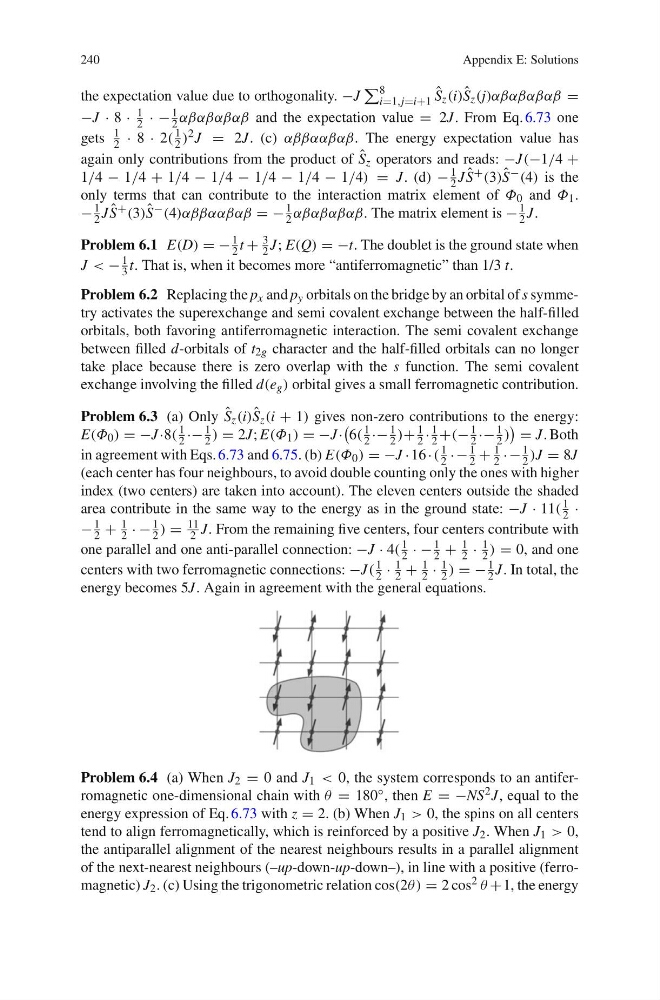
Problem 6.3 (a) Only ˆ
S z (i) ˆ
S z (i + 1) gives non-zero contributions to the energy:
E(Φ 0 ) =−J ·8(
1
2 ·−
1
2 ) = 2J; E(Φ 1 ) =−J ·
6(
1
2 ·−
1
2 )+
1
2 ·
1
2 +(−
1
2 ·−
1
2 )
= J.Both
in agreement with Eqs. 6.73 and 6.75.(b)E(Φ 0 ) =−J · 16 · (
1
2 ·−
1
2 +
1
2 ·−
1
2 )J = 8J
(each center has four neighbours, to avoid double counting only the ones with higher
index (two centers) are taken into account). The eleven centers outside the shaded
area contribute in the same way to the energy as in the ground state: −J · 11(
1
2 ·
−
1
2 +
1
2 ·−
1
2 ) =
11
2 J. From the remaining five centers, four centers contribute with
one parallel and one anti-parallel connection: −J · 4(
1
2 ·−
1
2 +
1
2 ·
1
2 ) = 0, and one
centers with two ferromagnetic connections: −J(
1
2 ·
1
2 +
1
2 ·
1
2 ) =−
1
2 J. In total, the
energy becomes 5J. Again in agreement with the general equations.
Problem 6.4 (a) When J 2 = 0 and J 1 < 0, the system corresponds to an antiferromagnetic one-dimensional chain with θ = 180 ◦ , then E =− NS 2 J, equal to the
energy expression of Eq. 6.73 with z = 2. (b) When J 1 > 0, the spins on all centers
tend to align ferromagnetically, which is reinforced by a positive J 2 . When J 1 > 0,
the antiparallel alignment of the nearest neighbours results in a parallel alignment
of the next-nearest neighbours (–up-down-up-down–), in line with a positive (ferromagnetic) J 2 . (c) Using the trigonometric relation cos(2θ) = 2 cos 2 θ +1, the energy
Appendix E: Solutions
the expectation value due to orthogonality. −J
8
i=1,j=i+1
ˆ
S z (i) ˆ
S z (j)αβαβαβαβ =
−J · 8 ·
1
2 ·−
1
2 αβαβαβαβ and the expectation value = 2J.F r o mE q .6.73 one
gets
1
2 · 8 · 2(
1
2 ) 2 J = 2J.( c )αββααβαβ. The energy expectation value has
again only contributions from the product of ˆ
S z operators and reads: −J(−1/4 +
1/4 − 1/4 + 1/4 − 1/4 − 1/4 − 1/4 − 1/4) = J.( d )−
1
2 J ˆ
S + (3) ˆ
S − (4) is the
only terms that can contribute to the interaction matrix element of Φ 0 and Φ 1 .
−
1
2 J ˆ
S + (3) ˆ
S − (4)αββααβαβ =−
1
2 αβαβαβαβ. The matrix element is −
1
2 J.
Problem 6.1 E(D) =−
1
2 t +
3
2 J; E(Q) =−t. The doublet is the ground state when
J < −
1
3 t. That is, when it becomes more “antiferromagnetic” than 1/3 t.
Problem 6.2 Replacing the p x and p y orbitals on the bridge by an orbital of s symmetry activates the superexchange and semi covalent exchange between the half-filled
orbitals, both favoring antiferromagnetic interaction. The semi covalent exchange
between filled d-orbitals of t 2g character and the half-filled orbitals can no longer
take place because there is zero overlap with the s function. The semi covalent
exchange involving the filled d(e g ) orbital gives a small ferromagnetic contribution.
Problem 6.3 (a) Only ˆ
S z (i) ˆ
S z (i + 1) gives non-zero contributions to the energy:
E(Φ 0 ) =−J ·8(
1
2 ·−
1
2 ) = 2J; E(Φ 1 ) =−J ·
6(
1
2 ·−
1
2 )+
1
2 ·
1
2 +(−
1
2 ·−
1
2 )
= J.Both
in agreement with Eqs. 6.73 and 6.75.(b)E(Φ 0 ) =−J · 16 · (
1
2 ·−
1
2 +
1
2 ·−
1
2 )J = 8J
(each center has four neighbours, to avoid double counting only the ones with higher
index (two centers) are taken into account). The eleven centers outside the shaded
area contribute in the same way to the energy as in the ground state: −J · 11(
1
2 ·
−
1
2 +
1
2 ·−
1
2 ) =
11
2 J. From the remaining five centers, four centers contribute with
one parallel and one anti-parallel connection: −J · 4(
1
2 ·−
1
2 +
1
2 ·
1
2 ) = 0, and one
centers with two ferromagnetic connections: −J(
1
2 ·
1
2 +
1
2 ·
1
2 ) =−
1
2 J. In total, the
energy becomes 5J. Again in agreement with the general equations.
Problem 6.4 (a) When J 2 = 0 and J 1 < 0, the system corresponds to an antiferromagnetic one-dimensional chain with θ = 180 ◦ , then E =− NS 2 J, equal to the
energy expression of Eq. 6.73 with z = 2. (b) When J 1 > 0, the spins on all centers
tend to align ferromagnetically, which is reinforced by a positive J 2 . When J 1 > 0,
the antiparallel alignment of the nearest neighbours results in a parallel alignment
of the next-nearest neighbours (–up-down-up-down–), in line with a positive (ferromagnetic) J 2 . (c) Using the trigonometric relation cos(2θ) = 2 cos 2 θ +1, the energy