

Appendix E: Solutions
235
element hhab| ˆ
H|aapb is not equal to hhaa| ˆ
H|aapb the diagonal matrix elements
of Φ I and Φ J are shifted non-uniformly.
Exercise 4.10 First, ˆ
S 2 ααββ = 2ααββ +αβαβ +βααβ+αββα +βαβα. With this
φ 1 φ 2 φ 3 φ 4 | ˆ
S 2 |φ 1 φ 2 φ 3 φ 4 == φ 1 φ 2 φ 3 φ 4 |2φ 1 φ 2 φ 3 φ 4 − φ 1 φ 3 φ 2 φ 4 − φ 3 φ 2 φ 1 φ 4 −
φ 1 φ 4 φ 3 φ 2 − φ 4 φ 2 φ 3 φ 1 =2 −−φ 2 |φ 3 2 −−φ 1 |φ 3 2 −−φ 2 |φ 4 2 −−φ 1 |φ 4 2 = 2,
taking into account that φ i |φ j =δ ij .
Problem 4.1 In the first place, columns three and four have to be converted to
Kelvins by multiplying with 315647.5. Next the values have to substituted in Eq. 4.18.
Then, J is 1.8, 17.7, 17.9 −5.3 −47.2 K for θ = 85 ◦ ...105 ◦ . As expected, J is maximally ferromagnetic around 90 ◦ and becomes antiferromagnetic for larger angles.
Practically the same tendency is observed when the entries in the second and third
column are replaced by the average value: J to 3.0, 22.6, 20.7, −6.8 and −55.7 K.
Problem 4.2 To calculate the contribution to the total coupling of the two ligands
one has to perform two separate calculations in which only one bridge is active.
This can be achieved by dividing the molecule in three fragments: bridging ligand
A, bridging ligand B, and the rest of the molecule with the two magnetic centers
and the external ligands. Orbitals are optimized for the three fragments. In the first
calculation one superposes the charge distributions of the three fragments and relaxes
the orbitals in the field of the frozen charge distribution of the ligand B. J A is calculated
by calculating the energy difference of the relevant spin states. Subsequently, the
orbitals are optimized in the field of the frozen charge distribution of the ligand
A and J B is calculated. Finally, J tot from the calculation of the relevant spin states
without restrictions on the orbital optimizations and the counter-complementarity is
quantified by comparing J tot to the sum of J A and J B .
Problem 4.3 (a) Yamaguchi: −281, −275 and −77 cm −1 for Cu, Ni and Mn.
Noodleman: −284, −276, −77 cm −1 . Ruiz: −142, −184, −65 cm −1 . The difference between the different expressions becomes smaller for larger spin moment
and will be irrelevant for polynuclear complexes typically used in single-molecule
magnets. (b) Using the spin densities gives J =−280 cm −1 for Cu.
Exercises and Problems of Chap. 5
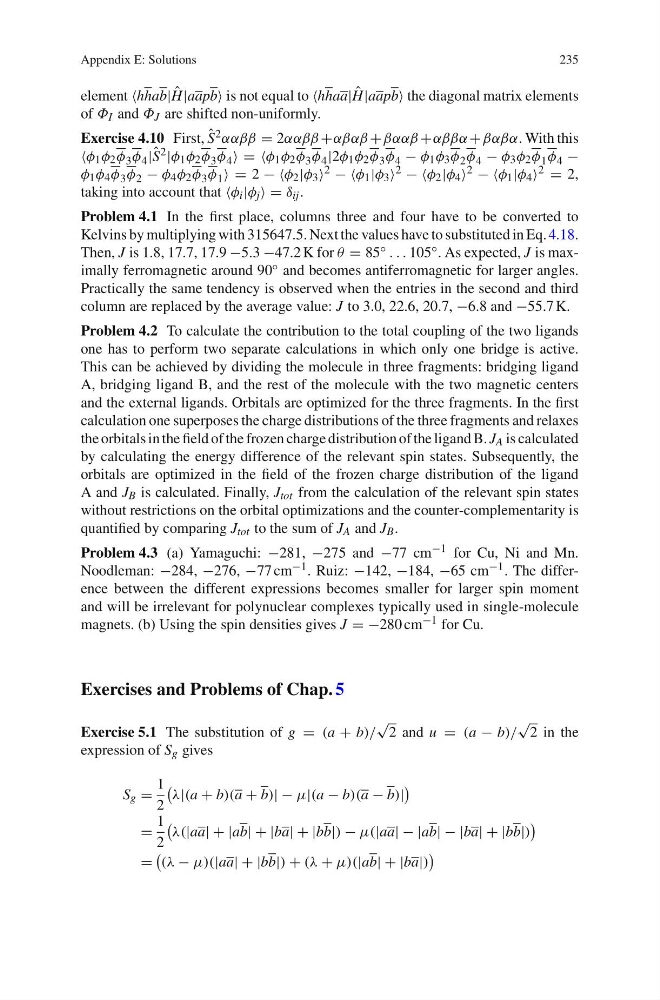
Exercise 5.1 The substitution of g = (a + b)/
√
2 and u = (a − b)/
√
2i nt h e
expression of S g gives
S g =
1
2
λ|(a + b)(a + b)|−µ|(a − b)(a − b)|
=
1
2
λ(|aa|+|ab|+|ba|+|bb|) − µ(|aa|−|ab|−|ba|+|bb|)
=
(λ − µ)(|aa|+|bb|) + (λ + µ)(|ab|+|ba|)
235
element hhab| ˆ
H|aapb is not equal to hhaa| ˆ
H|aapb the diagonal matrix elements
of Φ I and Φ J are shifted non-uniformly.
Exercise 4.10 First, ˆ
S 2 ααββ = 2ααββ +αβαβ +βααβ+αββα +βαβα. With this
φ 1 φ 2 φ 3 φ 4 | ˆ
S 2 |φ 1 φ 2 φ 3 φ 4 == φ 1 φ 2 φ 3 φ 4 |2φ 1 φ 2 φ 3 φ 4 − φ 1 φ 3 φ 2 φ 4 − φ 3 φ 2 φ 1 φ 4 −
φ 1 φ 4 φ 3 φ 2 − φ 4 φ 2 φ 3 φ 1 =2 −−φ 2 |φ 3 2 −−φ 1 |φ 3 2 −−φ 2 |φ 4 2 −−φ 1 |φ 4 2 = 2,
taking into account that φ i |φ j =δ ij .
Problem 4.1 In the first place, columns three and four have to be converted to
Kelvins by multiplying with 315647.5. Next the values have to substituted in Eq. 4.18.
Then, J is 1.8, 17.7, 17.9 −5.3 −47.2 K for θ = 85 ◦ ...105 ◦ . As expected, J is maximally ferromagnetic around 90 ◦ and becomes antiferromagnetic for larger angles.
Practically the same tendency is observed when the entries in the second and third
column are replaced by the average value: J to 3.0, 22.6, 20.7, −6.8 and −55.7 K.
Problem 4.2 To calculate the contribution to the total coupling of the two ligands
one has to perform two separate calculations in which only one bridge is active.
This can be achieved by dividing the molecule in three fragments: bridging ligand
A, bridging ligand B, and the rest of the molecule with the two magnetic centers
and the external ligands. Orbitals are optimized for the three fragments. In the first
calculation one superposes the charge distributions of the three fragments and relaxes
the orbitals in the field of the frozen charge distribution of the ligand B. J A is calculated
by calculating the energy difference of the relevant spin states. Subsequently, the
orbitals are optimized in the field of the frozen charge distribution of the ligand
A and J B is calculated. Finally, J tot from the calculation of the relevant spin states
without restrictions on the orbital optimizations and the counter-complementarity is
quantified by comparing J tot to the sum of J A and J B .
Problem 4.3 (a) Yamaguchi: −281, −275 and −77 cm −1 for Cu, Ni and Mn.
Noodleman: −284, −276, −77 cm −1 . Ruiz: −142, −184, −65 cm −1 . The difference between the different expressions becomes smaller for larger spin moment
and will be irrelevant for polynuclear complexes typically used in single-molecule
magnets. (b) Using the spin densities gives J =−280 cm −1 for Cu.
Exercises and Problems of Chap. 5
Exercise 5.1 The substitution of g = (a + b)/
√
2 and u = (a − b)/
√
2i nt h e
expression of S g gives
S g =
1
2
λ|(a + b)(a + b)|−µ|(a − b)(a − b)|
=
1
2
λ(|aa|+|ab|+|ba|+|bb|) − µ(|aa|−|ab|−|ba|+|bb|)
=
(λ − µ)(|aa|+|bb|) + (λ + µ)(|ab|+|ba|)