

1.2 Generation of Many Electron Spin Functions
9
1.2.1 Many Electron Spin Functions by Projection
In general the spin eigenfunction of a 2S + 1 spin multiplet is a linear combination
of N -electron Slater determinants that all have the same M S quantum number
2S+1 Ψ =
L
c L Φ L
(1.28)
with ˆ
S z Φ L = M S Φ L for all L.I f{Ψ i } is a complete set of M eigenfunctions of
ˆ
S 2 with the same M S , i.e. ˆ
S 2 Ψ i = S i (S i + 1)Ψ i and ˆ
S z Ψ i = M S Ψ i for i = 1, M,
then any of the determinants Φ L can be written as a linear combination of these
spin eigenfunctions. In other words, any determinant Φ L can be seen as a linear
combination of different spin eigenfunctions Ψ i and to obtain the expression of a
proper spin eigenfunction one should eliminate all the undesired terms from the
sum. A natural way to proceed is to apply projection techniques. Since the spin
eigenvalue of Ψ i is equal to S i (S i + 1), the operator
ˆ
P
e
L =
ˆ
S
2 − S L (S L + 1)
(1.29)
eliminates the L-component from the determinant Φ. Hence the subsequent application of ˆ
P e
i , ˆ
P e
j ,... ˆ
P e
M (except ˆ
P e
k ) preserves the k-component and leads to 2S k +1 Ψ k .
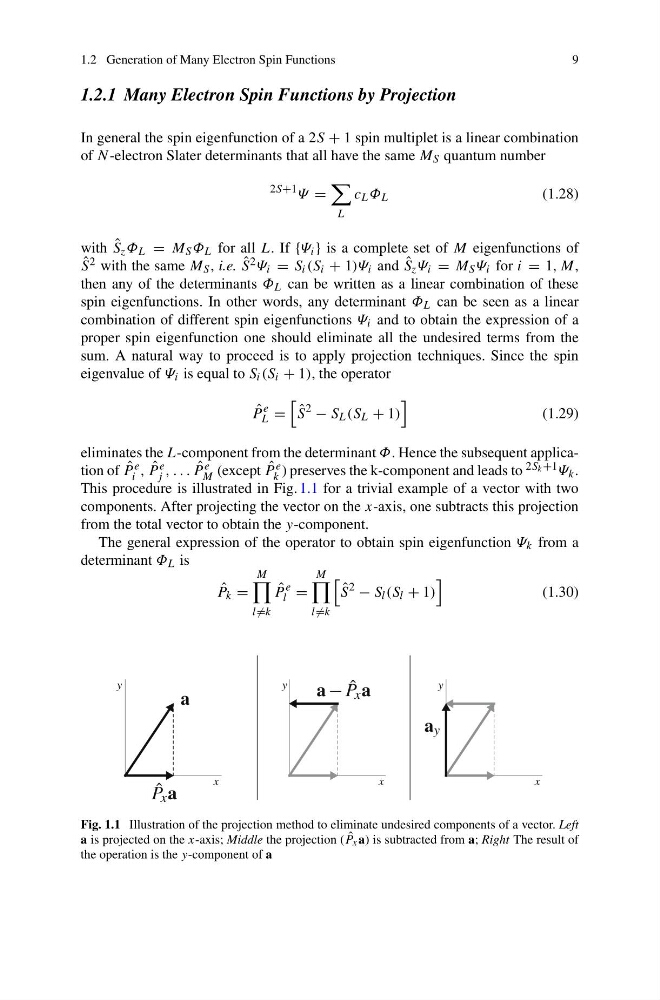
This procedure is illustrated in Fig. 1.1 for a trivial example of a vector with two
components. After projecting the vector on the x-axis, one subtracts this projection
from the total vector to obtain the y-component.
The general expression of the operator to obtain spin eigenfunction Ψ k from a
determinant Φ L is
ˆ
P k =
M
l =k
ˆ
P
e
l =
M
l =k
ˆ
S
2 − S l (S l + 1)
(1.30)
Fig. 1.1 Illustration of the projection method to eliminate undesired components of a vector. Left
a is projected on the x-axis; Middle the projection ( ˆ
P x a) is subtracted from a; Right The result of
the operation is the y-component of a
9
1.2.1 Many Electron Spin Functions by Projection
In general the spin eigenfunction of a 2S + 1 spin multiplet is a linear combination
of N -electron Slater determinants that all have the same M S quantum number
2S+1 Ψ =
L
c L Φ L
(1.28)
with ˆ
S z Φ L = M S Φ L for all L.I f{Ψ i } is a complete set of M eigenfunctions of
ˆ
S 2 with the same M S , i.e. ˆ
S 2 Ψ i = S i (S i + 1)Ψ i and ˆ
S z Ψ i = M S Ψ i for i = 1, M,
then any of the determinants Φ L can be written as a linear combination of these
spin eigenfunctions. In other words, any determinant Φ L can be seen as a linear
combination of different spin eigenfunctions Ψ i and to obtain the expression of a
proper spin eigenfunction one should eliminate all the undesired terms from the
sum. A natural way to proceed is to apply projection techniques. Since the spin
eigenvalue of Ψ i is equal to S i (S i + 1), the operator
ˆ
P
e
L =
ˆ
S
2 − S L (S L + 1)
(1.29)
eliminates the L-component from the determinant Φ. Hence the subsequent application of ˆ
P e
i , ˆ
P e
j ,... ˆ
P e
M (except ˆ
P e
k ) preserves the k-component and leads to 2S k +1 Ψ k .
This procedure is illustrated in Fig. 1.1 for a trivial example of a vector with two
components. After projecting the vector on the x-axis, one subtracts this projection
from the total vector to obtain the y-component.
The general expression of the operator to obtain spin eigenfunction Ψ k from a
determinant Φ L is
ˆ
P k =
M
l =k
ˆ
P
e
l =
M
l =k
ˆ
S
2 − S l (S l + 1)
(1.30)
Fig. 1.1 Illustration of the projection method to eliminate undesired components of a vector. Left
a is projected on the x-axis; Middle the projection ( ˆ
P x a) is subtracted from a; Right The result of
the operation is the y-component of a