

6.5 Spin Waves for Ferromagnets
211
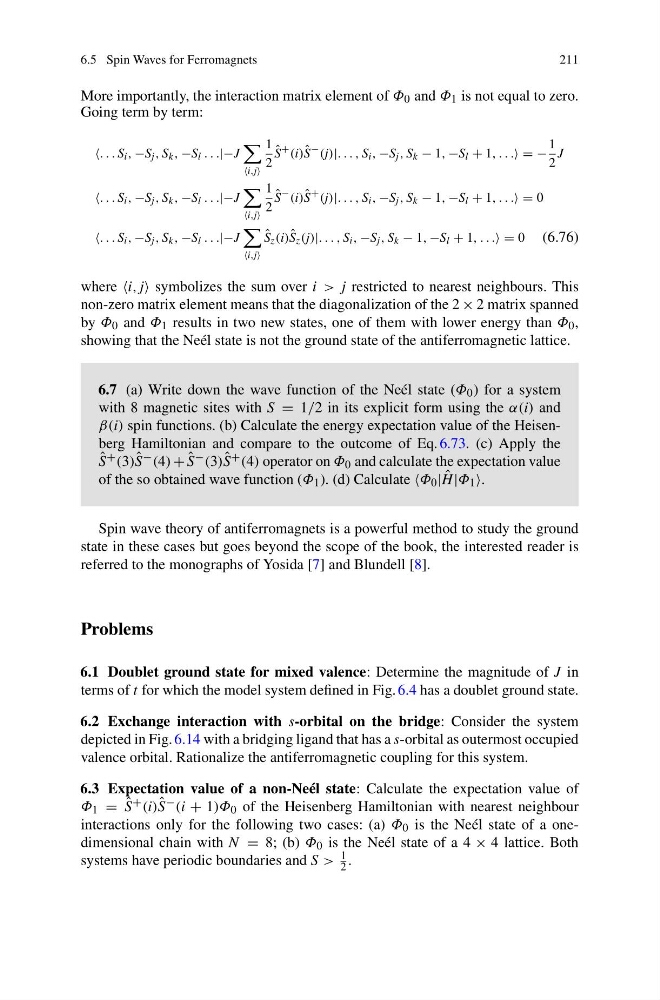
More importantly, the interaction matrix element of Φ 0 and Φ 1 is not equal to zero.
Going term by term:
...S i , −S j , S k , −S l ...|−J
i,j
1
2
ˆ
S
+ (i) ˆ
S
− (j)|...,S i , −S j , S k − 1, −S l + 1,...=−
1
2
J
...S i , −S j , S k , −S l ...|−J
i,j
1
2
ˆ
S
− (i) ˆ
S
+ (j)|...,S i , −S j , S k − 1, −S l + 1,...=0
...S i , −S j , S k , −S l ...|−J
i,j
ˆ
S z (i) ˆ
S z (j)|...,S i , −S j , S k − 1, −S l + 1,...=0 (6.76)
where i, j symbolizes the sum over i > j restricted to nearest neighbours. This
non-zero matrix element means that the diagonalization of the 2 × 2 matrix spanned
by Φ 0 and Φ 1 results in two new states, one of them with lower energy than Φ 0 ,
showing that the Neél state is not the ground state of the antiferromagnetic lattice.
6.7 (a) Write down the wave function of the Neél state (Φ 0 ) for a system
with 8 magnetic sites with S = 1/2 in its explicit form using the α(i) and
β(i) spin functions. (b) Calculate the energy expectation value of the Heisenberg Hamiltonian and compare to the outcome of Eq. 6.73. (c) Apply the
ˆ
S + (3) ˆ
S − (4) + ˆ
S − (3) ˆ
S + (4) operator on Φ 0 and calculate the expectation value
of the so obtained wave function (Φ 1 ). (d) Calculate Φ 0 | ˆ
H|Φ 1 .
Spin wave theory of antiferromagnets is a powerful method to study the ground
state in these cases but goes beyond the scope of the book, the interested reader is
referred to the monographs of Yosida [7] and Blundell [8].
Problems
6.1 Doublet ground state for mixed valence: Determine the magnitude of J in
terms of t for which the model system defined in Fig. 6.4 has a doublet ground state.
6.2 Exchange interaction with s-orbital on the bridge: Consider the system
depicted in Fig. 6.14 with a bridging ligand that has a s-orbital as outermost occupied
valence orbital. Rationalize the antiferromagnetic coupling for this system.
6.3 Expectation value of a non-Neél state: Calculate the expectation value of
Φ 1 = ˆ
S + (i) ˆ
S − (i + 1)Φ 0 of the Heisenberg Hamiltonian with nearest neighbour
interactions only for the following two cases: (a) Φ 0 is the Neél state of a onedimensional chain with N = 8; (b) Φ 0 is the Neél state of a 4 × 4 lattice. Both
systems have periodic boundaries and S >
1
2 .
211
More importantly, the interaction matrix element of Φ 0 and Φ 1 is not equal to zero.
Going term by term:
...S i , −S j , S k , −S l ...|−J
i,j
1
2
ˆ
S
+ (i) ˆ
S
− (j)|...,S i , −S j , S k − 1, −S l + 1,...=−
1
2
J
...S i , −S j , S k , −S l ...|−J
i,j
1
2
ˆ
S
− (i) ˆ
S
+ (j)|...,S i , −S j , S k − 1, −S l + 1,...=0
...S i , −S j , S k , −S l ...|−J
i,j
ˆ
S z (i) ˆ
S z (j)|...,S i , −S j , S k − 1, −S l + 1,...=0 (6.76)
where i, j symbolizes the sum over i > j restricted to nearest neighbours. This
non-zero matrix element means that the diagonalization of the 2 × 2 matrix spanned
by Φ 0 and Φ 1 results in two new states, one of them with lower energy than Φ 0 ,
showing that the Neél state is not the ground state of the antiferromagnetic lattice.
6.7 (a) Write down the wave function of the Neél state (Φ 0 ) for a system
with 8 magnetic sites with S = 1/2 in its explicit form using the α(i) and
β(i) spin functions. (b) Calculate the energy expectation value of the Heisenberg Hamiltonian and compare to the outcome of Eq. 6.73. (c) Apply the
ˆ
S + (3) ˆ
S − (4) + ˆ
S − (3) ˆ
S + (4) operator on Φ 0 and calculate the expectation value
of the so obtained wave function (Φ 1 ). (d) Calculate Φ 0 | ˆ
H|Φ 1 .
Spin wave theory of antiferromagnets is a powerful method to study the ground
state in these cases but goes beyond the scope of the book, the interested reader is
referred to the monographs of Yosida [7] and Blundell [8].
Problems
6.1 Doublet ground state for mixed valence: Determine the magnitude of J in
terms of t for which the model system defined in Fig. 6.4 has a doublet ground state.
6.2 Exchange interaction with s-orbital on the bridge: Consider the system
depicted in Fig. 6.14 with a bridging ligand that has a s-orbital as outermost occupied
valence orbital. Rationalize the antiferromagnetic coupling for this system.
6.3 Expectation value of a non-Neél state: Calculate the expectation value of
Φ 1 = ˆ
S + (i) ˆ
S − (i + 1)Φ 0 of the Heisenberg Hamiltonian with nearest neighbour
interactions only for the following two cases: (a) Φ 0 is the Neél state of a onedimensional chain with N = 8; (b) Φ 0 is the Neél state of a 4 × 4 lattice. Both
systems have periodic boundaries and S >
1
2 .