

1.2 Generation of Many Electron Spin Functions
7
1.4 (a) Demonstrate that the normalization factor is one for the application
of ˆ
s + to β and zero for α. (b) Derive the expression of the total spin operator
ˆ
s 2 in terms of ˆ
s + , ˆ
s − and ˆ
s z . Remember that [ˆ s + , ˆ
s − ]=2ˆ s z . (c) Calculate the
expectation value of ˆ
s 2 of α and β using Eq. 1.19.
In the case of N -electron systems, the spin operators have to be applied on Slater
determinants or linear combinations of these. The action of the N -electron operator
ˆ
S 2 is most conveniently evaluated in the N -electron version of Eq. 1.19 with ˆ
S z , ˆ
S +
and ˆ
S − defined as the sum of the corresponding one-electron operators.
ˆ
S
2 = ˆ
S
+ ˆ
S
− − ˆ
S z + ˆ
S
2
z
(1.21)
with
ˆ
S z =
N
i=1
ˆ
s z (i)
ˆ
S
+ =
N
i=1
ˆ
s
+ (i)
ˆ
S
− =
N
i=1
ˆ
s
− (i)
(1.22)
The multi-electron version of Eq. 1.17 is
ˆ
S
+ |S, M S =
S(S + 1) − M S (M S + 1)|S, M S + 1
ˆ
S
− |S, M S =
S(S + 1) − M S (M S − 1)|S, M S − 1
(1.23)
whereas many-electron functions consisting of one Slater determinant are always
eigenfunctions of ˆ
S z with an eigenvalue given by the difference of the number of
α and β electrons multiplied by one half, this is in general not the case for ˆ
S 2 .T o
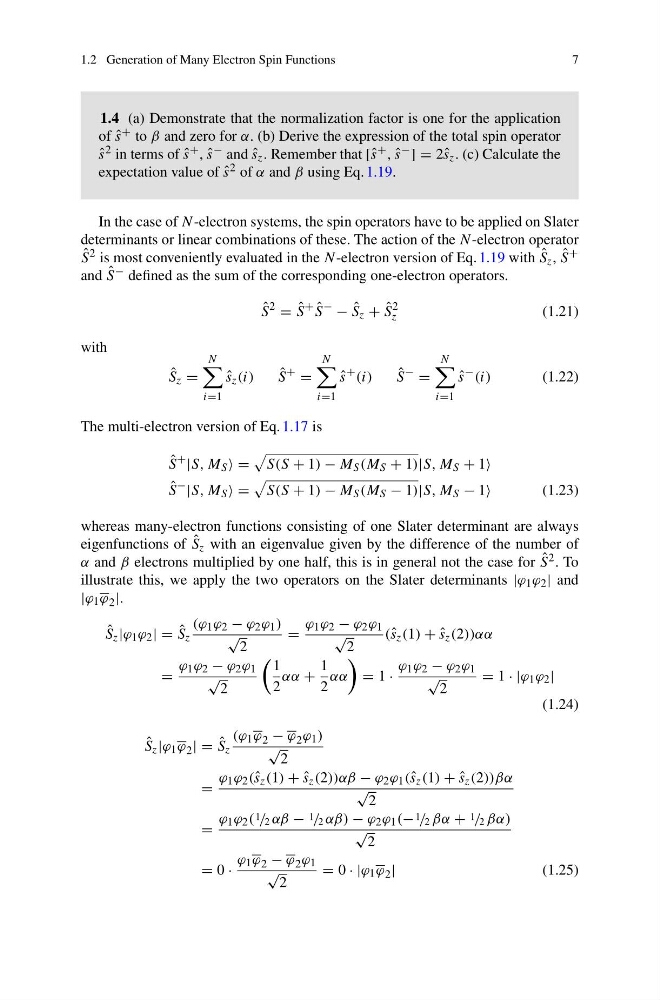
illustrate this, we apply the two operators on the Slater determinants |ϕ 1 ϕ 2 | and
|ϕ 1 ϕ 2 |.
ˆ
S z |ϕ 1 ϕ 2 |= ˆ
S z
(ϕ 1 ϕ 2 − ϕ 2 ϕ 1 )
√
2
=
ϕ 1 ϕ 2 − ϕ 2 ϕ 1
√
2
(ˆ s z (1) +ˆ s z (2))αα
=
ϕ 1 ϕ 2 − ϕ 2 ϕ 1
√
2
1
2
αα +
1
2
αα
= 1 ·
ϕ 1 ϕ 2 − ϕ 2 ϕ 1
√
2
= 1 ·|ϕ 1 ϕ 2 |
(1.24)
ˆ
S z |ϕ 1 ϕ 2 |= ˆ
S z
(ϕ 1 ϕ 2 − ϕ 2 ϕ 1 )
√
2
=
ϕ 1 ϕ 2 (ˆ s z (1) +ˆ s z (2))αβ − ϕ 2 ϕ 1 (ˆ s z (1) +ˆ s z (2))βα
√
2
=
ϕ 1 ϕ 2 ( 1 / 2 αβ − 1 / 2 αβ) − ϕ 2 ϕ 1 (− 1 / 2 βα + 1 / 2 βα)
√
2
= 0 ·
ϕ 1 ϕ 2 − ϕ 2 ϕ 1
√
2
= 0 ·|ϕ 1 ϕ 2 |
(1.25)
7
1.4 (a) Demonstrate that the normalization factor is one for the application
of ˆ
s + to β and zero for α. (b) Derive the expression of the total spin operator
ˆ
s 2 in terms of ˆ
s + , ˆ
s − and ˆ
s z . Remember that [ˆ s + , ˆ
s − ]=2ˆ s z . (c) Calculate the
expectation value of ˆ
s 2 of α and β using Eq. 1.19.
In the case of N -electron systems, the spin operators have to be applied on Slater
determinants or linear combinations of these. The action of the N -electron operator
ˆ
S 2 is most conveniently evaluated in the N -electron version of Eq. 1.19 with ˆ
S z , ˆ
S +
and ˆ
S − defined as the sum of the corresponding one-electron operators.
ˆ
S
2 = ˆ
S
+ ˆ
S
− − ˆ
S z + ˆ
S
2
z
(1.21)
with
ˆ
S z =
N
i=1
ˆ
s z (i)
ˆ
S
+ =
N
i=1
ˆ
s
+ (i)
ˆ
S
− =
N
i=1
ˆ
s
− (i)
(1.22)
The multi-electron version of Eq. 1.17 is
ˆ
S
+ |S, M S =
S(S + 1) − M S (M S + 1)|S, M S + 1
ˆ
S
− |S, M S =
S(S + 1) − M S (M S − 1)|S, M S − 1
(1.23)
whereas many-electron functions consisting of one Slater determinant are always
eigenfunctions of ˆ
S z with an eigenvalue given by the difference of the number of
α and β electrons multiplied by one half, this is in general not the case for ˆ
S 2 .T o
illustrate this, we apply the two operators on the Slater determinants |ϕ 1 ϕ 2 | and
|ϕ 1 ϕ 2 |.
ˆ
S z |ϕ 1 ϕ 2 |= ˆ
S z
(ϕ 1 ϕ 2 − ϕ 2 ϕ 1 )
√
2
=
ϕ 1 ϕ 2 − ϕ 2 ϕ 1
√
2
(ˆ s z (1) +ˆ s z (2))αα
=
ϕ 1 ϕ 2 − ϕ 2 ϕ 1
√
2
1
2
αα +
1
2
αα
= 1 ·
ϕ 1 ϕ 2 − ϕ 2 ϕ 1
√
2
= 1 ·|ϕ 1 ϕ 2 |
(1.24)
ˆ
S z |ϕ 1 ϕ 2 |= ˆ
S z
(ϕ 1 ϕ 2 − ϕ 2 ϕ 1 )
√
2
=
ϕ 1 ϕ 2 (ˆ s z (1) +ˆ s z (2))αβ − ϕ 2 ϕ 1 (ˆ s z (1) +ˆ s z (2))βα
√
2
=
ϕ 1 ϕ 2 ( 1 / 2 αβ − 1 / 2 αβ) − ϕ 2 ϕ 1 (− 1 / 2 βα + 1 / 2 βα)
√
2
= 0 ·
ϕ 1 ϕ 2 − ϕ 2 ϕ 1
√
2
= 0 ·|ϕ 1 ϕ 2 |
(1.25)