

192
6 Magnetism and Conduction
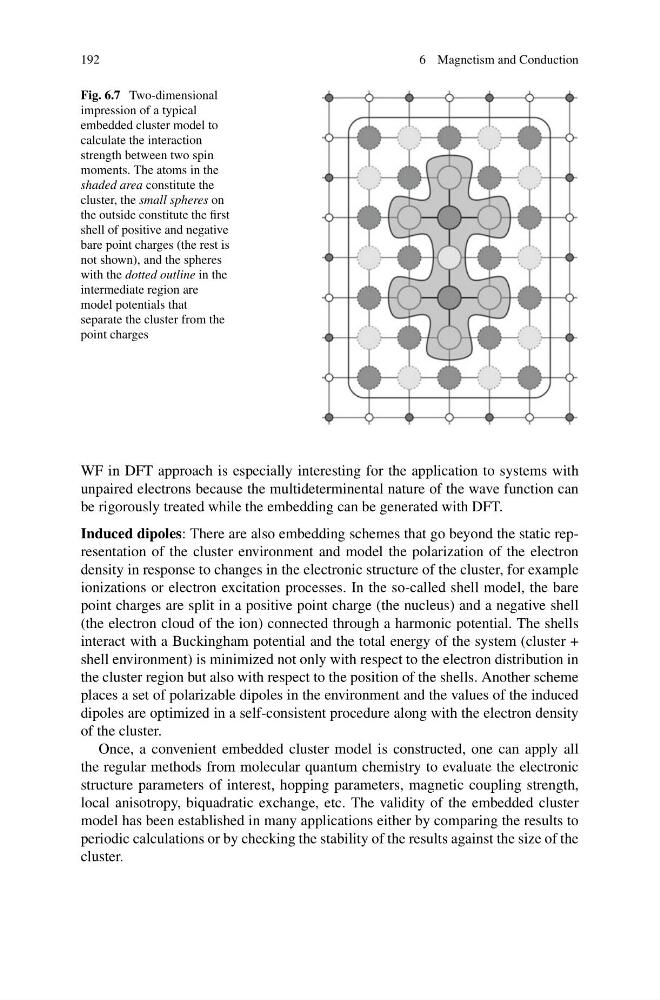
Fig. 6.7 Two-dimensional
impression of a typical
embedded cluster model to
calculate the interaction
strength between two spin
moments. The atoms in the
shaded area constitute the
cluster, the small spheres on
the outside constitute the first
shell of positive and negative
bare point charges (the rest is
not shown), and the spheres
with the dotted outline in the
intermediate region are
model potentials that
separate the cluster from the
point charges
WF in DFT approach is especially interesting for the application to systems with
unpaired electrons because the multideterminental nature of the wave function can
be rigorously treated while the embedding can be generated with DFT.
Induced dipoles: There are also embedding schemes that go beyond the static representation of the cluster environment and model the polarization of the electron
density in response to changes in the electronic structure of the cluster, for example
ionizations or electron excitation processes. In the so-called shell model, the bare
point charges are split in a positive point charge (the nucleus) and a negative shell
(the electron cloud of the ion) connected through a harmonic potential. The shells
interact with a Buckingham potential and the total energy of the system (cluster +
shell environment) is minimized not only with respect to the electron distribution in
the cluster region but also with respect to the position of the shells. Another scheme
places a set of polarizable dipoles in the environment and the values of the induced
dipoles are optimized in a self-consistent procedure along with the electron density
of the cluster.
Once, a convenient embedded cluster model is constructed, one can apply all
the regular methods from molecular quantum chemistry to evaluate the electronic
structure parameters of interest, hopping parameters, magnetic coupling strength,
local anisotropy, biquadratic exchange, etc. The validity of the embedded cluster
model has been established in many applications either by comparing the results to
periodic calculations or by checking the stability of the results against the size of the
cluster.
6 Magnetism and Conduction
Fig. 6.7 Two-dimensional
impression of a typical
embedded cluster model to
calculate the interaction
strength between two spin
moments. The atoms in the
shaded area constitute the
cluster, the small spheres on
the outside constitute the first
shell of positive and negative
bare point charges (the rest is
not shown), and the spheres
with the dotted outline in the
intermediate region are
model potentials that
separate the cluster from the
point charges
WF in DFT approach is especially interesting for the application to systems with
unpaired electrons because the multideterminental nature of the wave function can
be rigorously treated while the embedding can be generated with DFT.
Induced dipoles: There are also embedding schemes that go beyond the static representation of the cluster environment and model the polarization of the electron
density in response to changes in the electronic structure of the cluster, for example
ionizations or electron excitation processes. In the so-called shell model, the bare
point charges are split in a positive point charge (the nucleus) and a negative shell
(the electron cloud of the ion) connected through a harmonic potential. The shells
interact with a Buckingham potential and the total energy of the system (cluster +
shell environment) is minimized not only with respect to the electron distribution in
the cluster region but also with respect to the position of the shells. Another scheme
places a set of polarizable dipoles in the environment and the values of the induced
dipoles are optimized in a self-consistent procedure along with the electron density
of the cluster.
Once, a convenient embedded cluster model is constructed, one can apply all
the regular methods from molecular quantum chemistry to evaluate the electronic
structure parameters of interest, hopping parameters, magnetic coupling strength,
local anisotropy, biquadratic exchange, etc. The validity of the embedded cluster
model has been established in many applications either by comparing the results to
periodic calculations or by checking the stability of the results against the size of the
cluster.