

174
5 Towards a Quantitative Understanding
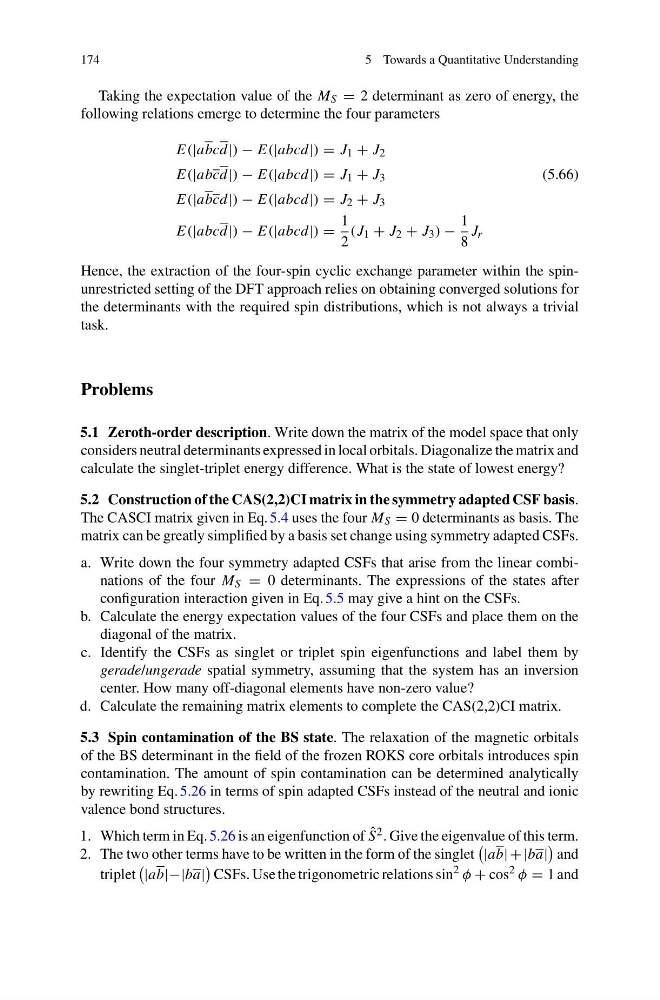
Taking the expectation value of the M S = 2 determinant as zero of energy, the
following relations emerge to determine the four parameters
E(|abcd|) − E(|abcd|) = J 1 + J 2
E(|abcd|) − E(|abcd|) = J 1 + J 3
(5.66)
E(|abcd|) − E(|abcd|) = J 2 + J 3
E(|abcd|) − E(|abcd|) =
1
2
(J 1 + J 2 + J 3 ) −
1
8
J r
Hence, the extraction of the four-spin cyclic exchange parameter within the spinunrestricted setting of the DFT approach relies on obtaining converged solutions for
the determinants with the required spin distributions, which is not always a trivial
task.
Problems
5.1 Zeroth-order description. Write down the matrix of the model space that only
considers neutral determinants expressed in local orbitals. Diagonalize the matrix and
calculate the singlet-triplet energy difference. What is the state of lowest energy?
5.2 Construction of the CAS(2,2)CI matrix in the symmetry adapted CSF basis.
The CASCI matrix given in Eq. 5.4 uses the four M S = 0 determinants as basis. The
matrix can be greatly simplified by a basis set change using symmetry adapted CSFs.
a. Write down the four symmetry adapted CSFs that arise from the linear combinations of the four M S = 0 determinants. The expressions of the states after
configuration interaction given in Eq. 5.5 maygiveahintontheCSFs.
b. Calculate the energy expectation values of the four CSFs and place them on the
diagonal of the matrix.
c. Identify the CSFs as singlet or triplet spin eigenfunctions and label them by
gerade/ungerade spatial symmetry, assuming that the system has an inversion
center. How many off-diagonal elements have non-zero value?
d. Calculate the remaining matrix elements to complete the CAS(2,2)CI matrix.
5.3 Spin contamination of the BS state. The relaxation of the magnetic orbitals
of the BS determinant in the field of the frozen ROKS core orbitals introduces spin
contamination. The amount of spin contamination can be determined analytically
by rewriting Eq. 5.26 in terms of spin adapted CSFs instead of the neutral and ionic
valence bond structures.
1. Which term in Eq. 5.26 is an eigenfunction of ˆ
S 2 . Give the eigenvalue of this term.
2. The two other terms have to be written in the form of the singlet
|ab|+|ba|
and
triplet
|ab|−|ba|
CSFs. Use the trigonometric relations sin 2 φ + cos 2 φ = 1 and
5 Towards a Quantitative Understanding
Taking the expectation value of the M S = 2 determinant as zero of energy, the
following relations emerge to determine the four parameters
E(|abcd|) − E(|abcd|) = J 1 + J 2
E(|abcd|) − E(|abcd|) = J 1 + J 3
(5.66)
E(|abcd|) − E(|abcd|) = J 2 + J 3
E(|abcd|) − E(|abcd|) =
1
2
(J 1 + J 2 + J 3 ) −
1
8
J r
Hence, the extraction of the four-spin cyclic exchange parameter within the spinunrestricted setting of the DFT approach relies on obtaining converged solutions for
the determinants with the required spin distributions, which is not always a trivial
task.
Problems
5.1 Zeroth-order description. Write down the matrix of the model space that only
considers neutral determinants expressed in local orbitals. Diagonalize the matrix and
calculate the singlet-triplet energy difference. What is the state of lowest energy?
5.2 Construction of the CAS(2,2)CI matrix in the symmetry adapted CSF basis.
The CASCI matrix given in Eq. 5.4 uses the four M S = 0 determinants as basis. The
matrix can be greatly simplified by a basis set change using symmetry adapted CSFs.
a. Write down the four symmetry adapted CSFs that arise from the linear combinations of the four M S = 0 determinants. The expressions of the states after
configuration interaction given in Eq. 5.5 maygiveahintontheCSFs.
b. Calculate the energy expectation values of the four CSFs and place them on the
diagonal of the matrix.
c. Identify the CSFs as singlet or triplet spin eigenfunctions and label them by
gerade/ungerade spatial symmetry, assuming that the system has an inversion
center. How many off-diagonal elements have non-zero value?
d. Calculate the remaining matrix elements to complete the CAS(2,2)CI matrix.
5.3 Spin contamination of the BS state. The relaxation of the magnetic orbitals
of the BS determinant in the field of the frozen ROKS core orbitals introduces spin
contamination. The amount of spin contamination can be determined analytically
by rewriting Eq. 5.26 in terms of spin adapted CSFs instead of the neutral and ionic
valence bond structures.
1. Which term in Eq. 5.26 is an eigenfunction of ˆ
S 2 . Give the eigenvalue of this term.
2. The two other terms have to be written in the form of the singlet
|ab|+|ba|
and
triplet
|ab|−|ba|
CSFs. Use the trigonometric relations sin 2 φ + cos 2 φ = 1 and