

158
5 Towards a Quantitative Understanding
J DE =
2
E(BS-ROKS) − E(HS-ROKS)
ˆ
S 2 HS-ROKS −− ˆ
S 2 BS-ROKS
=
2K ab
2 − 1
= 2K ab
(5.23)
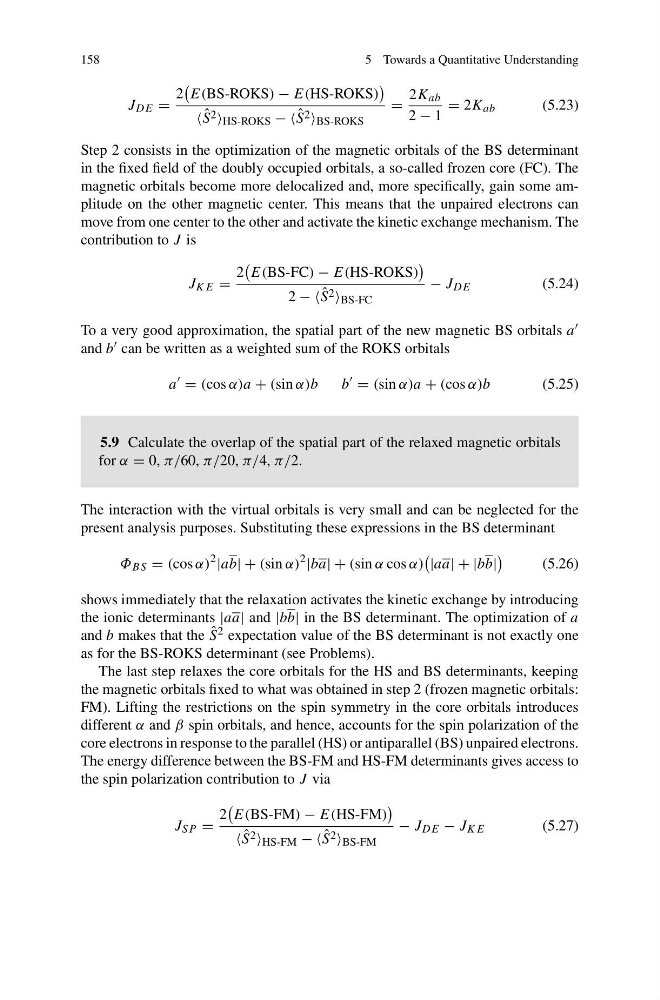
Step 2 consists in the optimization of the magnetic orbitals of the BS determinant
in the fixed field of the doubly occupied orbitals, a so-called frozen core (FC). The
magnetic orbitals become more delocalized and, more specifically, gain some amplitude on the other magnetic center. This means that the unpaired electrons can
move from one center to the other and activate the kinetic exchange mechanism. The
contribution to J is
J KE =
2
E(BS-FC) − E(HS-ROKS)
2 −− ˆ
S 2 BS-FC
− J DE
(5.24)
To a very good approximation, the spatial part of the new magnetic BS orbitals a ′
and b ′ can be written as a weighted sum of the ROKS orbitals
a
′ = (cos α)a + (sin α)bb
′ = (sin α)a + (cos α)b
(5.25)
5.9 Calculate the overlap of the spatial part of the relaxed magnetic orbitals
for α = 0, π/60, π/20, π/4, π/2.
The interaction with the virtual orbitals is very small and can be neglected for the
present analysis purposes. Substituting these expressions in the BS determinant
Φ BS = (cos α)
2 |ab|+(sin α)
2 |ba|+(sin α cos α)
|aa|+|bb|
(5.26)
shows immediately that the relaxation activates the kinetic exchange by introducing
the ionic determinants |aa| and |bb| in the BS determinant. The optimization of a
and b makes that the ˆ
S 2 expectation value of the BS determinant is not exactly one
as for the BS-ROKS determinant (see Problems).
The last step relaxes the core orbitals for the HS and BS determinants, keeping
the magnetic orbitals fixed to what was obtained in step 2 (frozen magnetic orbitals:
FM). Lifting the restrictions on the spin symmetry in the core orbitals introduces
different α and β spin orbitals, and hence, accounts for the spin polarization of the
core electrons in response to the parallel (HS) or antiparallel (BS) unpaired electrons.
The energy difference between the BS-FM and HS-FM determinants gives access to
the spin polarization contribution to J via
J SP =
2
E(BS-FM) − E(HS-FM)
ˆ
S 2 HS-FM −− ˆ
S 2 BS-FM
− J DE − J KE
(5.27)
5 Towards a Quantitative Understanding
J DE =
2
E(BS-ROKS) − E(HS-ROKS)
ˆ
S 2 HS-ROKS −− ˆ
S 2 BS-ROKS
=
2K ab
2 − 1
= 2K ab
(5.23)
Step 2 consists in the optimization of the magnetic orbitals of the BS determinant
in the fixed field of the doubly occupied orbitals, a so-called frozen core (FC). The
magnetic orbitals become more delocalized and, more specifically, gain some amplitude on the other magnetic center. This means that the unpaired electrons can
move from one center to the other and activate the kinetic exchange mechanism. The
contribution to J is
J KE =
2
E(BS-FC) − E(HS-ROKS)
2 −− ˆ
S 2 BS-FC
− J DE
(5.24)
To a very good approximation, the spatial part of the new magnetic BS orbitals a ′
and b ′ can be written as a weighted sum of the ROKS orbitals
a
′ = (cos α)a + (sin α)bb
′ = (sin α)a + (cos α)b
(5.25)
5.9 Calculate the overlap of the spatial part of the relaxed magnetic orbitals
for α = 0, π/60, π/20, π/4, π/2.
The interaction with the virtual orbitals is very small and can be neglected for the
present analysis purposes. Substituting these expressions in the BS determinant
Φ BS = (cos α)
2 |ab|+(sin α)
2 |ba|+(sin α cos α)
|aa|+|bb|
(5.26)
shows immediately that the relaxation activates the kinetic exchange by introducing
the ionic determinants |aa| and |bb| in the BS determinant. The optimization of a
and b makes that the ˆ
S 2 expectation value of the BS determinant is not exactly one
as for the BS-ROKS determinant (see Problems).
The last step relaxes the core orbitals for the HS and BS determinants, keeping
the magnetic orbitals fixed to what was obtained in step 2 (frozen magnetic orbitals:
FM). Lifting the restrictions on the spin symmetry in the core orbitals introduces
different α and β spin orbitals, and hence, accounts for the spin polarization of the
core electrons in response to the parallel (HS) or antiparallel (BS) unpaired electrons.
The energy difference between the BS-FM and HS-FM determinants gives access to
the spin polarization contribution to J via
J SP =
2
E(BS-FM) − E(HS-FM)
ˆ
S 2 HS-FM −− ˆ
S 2 BS-FM
− J DE − J KE
(5.27)