

3.4 Complex Interactions
91
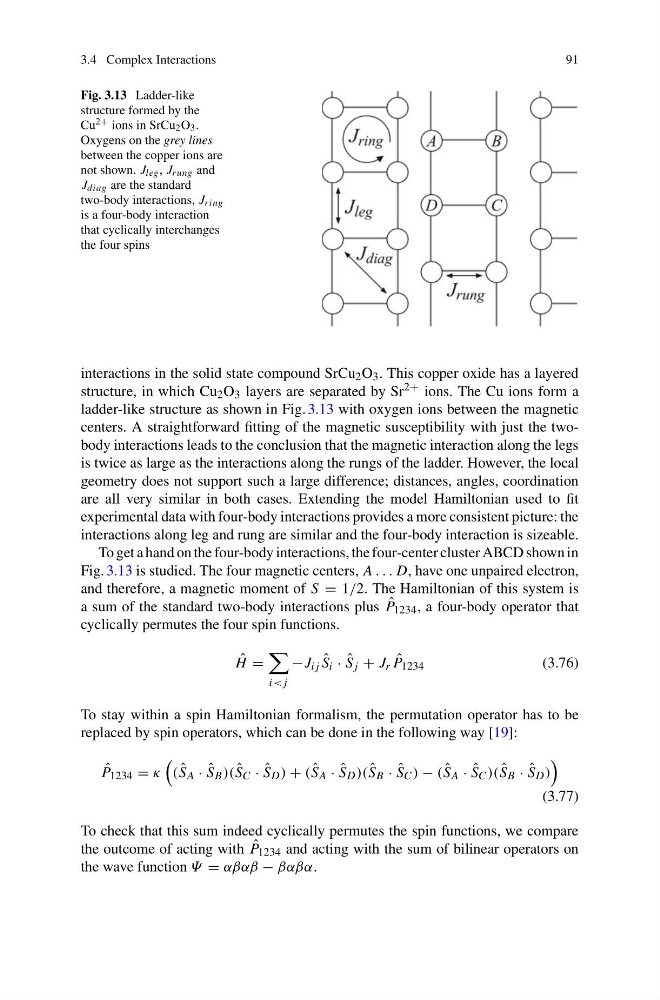
Fig. 3.13 Ladder-like
structure formed by the
Cu 2+ ions in SrCu 2 O 3 .
Oxygens on the grey lines
between the copper ions are
not shown. J leg , J rung and
J diag are the standard
two-body interactions, J ring
is a four-body interaction
that cyclically interchanges
the four spins
interactions in the solid state compound SrCu 2 O 3 . This copper oxide has a layered
structure, in which Cu 2 O 3 layers are separated by Sr 2+ ions. The Cu ions form a
ladder-like structure as shown in Fig. 3.13 with oxygen ions between the magnetic
centers. A straightforward fitting of the magnetic susceptibility with just the twobody interactions leads to the conclusion that the magnetic interaction along the legs
is twice as large as the interactions along the rungs of the ladder. However, the local
geometry does not support such a large difference; distances, angles, coordination
are all very similar in both cases. Extending the model Hamiltonian used to fit
experimental data with four-body interactions provides a more consistent picture: the
interactions along leg and rung are similar and the four-body interaction is sizeable.
To get a hand on the four-body interactions, the four-center cluster ABCD shown in
Fig. 3.13 is studied. The four magnetic centers, A ...D, have one unpaired electron,
and therefore, a magnetic moment of S = 1/2. The Hamiltonian of this system is
a sum of the standard two-body interactions plus ˆ
P 1234 , a four-body operator that
cyclically permutes the four spin functions.
ˆ
H =
i< j
−J ij ˆ
S i · ˆ
S j + J r ˆ
P 1234
(3.76)
To stay within a spin Hamiltonian formalism, the permutation operator has to be
replaced by spin operators, which can be done in the following way [19]:
ˆ
P 1234 = κ
( ˆ
S A · ˆ
S B )( ˆ
S C · ˆ
S D ) + ( ˆ
S A · ˆ
S D )( ˆ
S B · ˆ
S C ) − ( ˆ
S A · ˆ
S C )( ˆ
S B · ˆ
S D )
(3.77)
To check that this sum indeed cyclically permutes the spin functions, we compare
the outcome of acting with ˆ
P 1234 and acting with the sum of bilinear operators on
the wave function Ψ = αβαβ − βαβα.
91
Fig. 3.13 Ladder-like
structure formed by the
Cu 2+ ions in SrCu 2 O 3 .
Oxygens on the grey lines
between the copper ions are
not shown. J leg , J rung and
J diag are the standard
two-body interactions, J ring
is a four-body interaction
that cyclically interchanges
the four spins
interactions in the solid state compound SrCu 2 O 3 . This copper oxide has a layered
structure, in which Cu 2 O 3 layers are separated by Sr 2+ ions. The Cu ions form a
ladder-like structure as shown in Fig. 3.13 with oxygen ions between the magnetic
centers. A straightforward fitting of the magnetic susceptibility with just the twobody interactions leads to the conclusion that the magnetic interaction along the legs
is twice as large as the interactions along the rungs of the ladder. However, the local
geometry does not support such a large difference; distances, angles, coordination
are all very similar in both cases. Extending the model Hamiltonian used to fit
experimental data with four-body interactions provides a more consistent picture: the
interactions along leg and rung are similar and the four-body interaction is sizeable.
To get a hand on the four-body interactions, the four-center cluster ABCD shown in
Fig. 3.13 is studied. The four magnetic centers, A ...D, have one unpaired electron,
and therefore, a magnetic moment of S = 1/2. The Hamiltonian of this system is
a sum of the standard two-body interactions plus ˆ
P 1234 , a four-body operator that
cyclically permutes the four spin functions.
ˆ
H =
i< j
−J ij ˆ
S i · ˆ
S j + J r ˆ
P 1234
(3.76)
To stay within a spin Hamiltonian formalism, the permutation operator has to be
replaced by spin operators, which can be done in the following way [19]:
ˆ
P 1234 = κ
( ˆ
S A · ˆ
S B )( ˆ
S C · ˆ
S D ) + ( ˆ
S A · ˆ
S D )( ˆ
S B · ˆ
S C ) − ( ˆ
S A · ˆ
S C )( ˆ
S B · ˆ
S D )
(3.77)
To check that this sum indeed cyclically permutes the spin functions, we compare
the outcome of acting with ˆ
P 1234 and acting with the sum of bilinear operators on
the wave function Ψ = αβαβ − βαβα.