

applications there are some further specific needs for good processability, like strain
hardening for the film blowing process [54], high melt viscosity at low shear rates
to avoid sagging in pipe extrusion [48], and high melt strength in the blow
molding process of large containers. For pipe extrusion and for blow molding
it is further of interest to influence melt elasticity [49]. Then, the die swell
ratio increases with a favorable influence on surface structure and wall thickness
for blown articles and pipes.
The final product properties mainly depend on average molecular mass and
density. With increasing molecular mass, there is an increase in toughness and all
other properties correlated with toughness [55]. With increasing density, stiffness
increases. However, there are other important properties like stress crack resistance,
rapid crack propagation behavior, and creeping under stress that depend on the
solid state structure [48]. Polyethylene is a semicrystalline material built up by a
crystalline hard phase and an amorphous soft phase. Both phases are interconnected
by tie molecules. These are long polymer chains that bind the crystalline lamellae
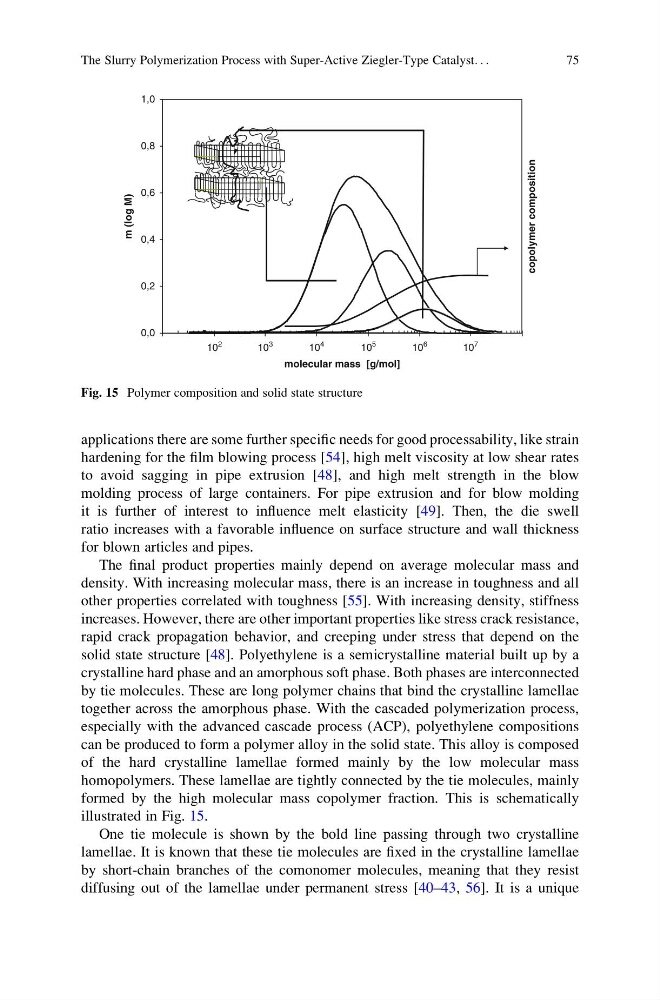
together across the amorphous phase. With the cascaded polymerization process,
especially with the advanced cascade process (ACP), polyethylene compositions
can be produced to form a polymer alloy in the solid state. This alloy is composed
of the hard crystalline lamellae formed mainly by the low molecular mass
homopolymers. These lamellae are tightly connected by the tie molecules, mainly
formed by the high molecular mass copolymer fraction. This is schematically
illustrated in Fig. 15.
One tie molecule is shown by the bold line passing through two crystalline
lamellae. It is known that these tie molecules are fixed in the crystalline lamellae
by short-chain branches of the comonomer molecules, meaning that they resist
diffusing out of the lamellae under permanent stress [40–43, 56]. It is a unique
0,0
0,2
0,4
0,6
0,8
1,0
10
2
10
3
10
4
10
5
10
6
10
7
molecular mass [g/mol]
copolymer composition
m (log M)
Fig. 15 Polymer composition and solid state structure
The Slurry Polymerization Process with Super-Active Ziegler-Type Catalyst. . .
75
hardening for the film blowing process [54], high melt viscosity at low shear rates
to avoid sagging in pipe extrusion [48], and high melt strength in the blow
molding process of large containers. For pipe extrusion and for blow molding
it is further of interest to influence melt elasticity [49]. Then, the die swell
ratio increases with a favorable influence on surface structure and wall thickness
for blown articles and pipes.
The final product properties mainly depend on average molecular mass and
density. With increasing molecular mass, there is an increase in toughness and all
other properties correlated with toughness [55]. With increasing density, stiffness
increases. However, there are other important properties like stress crack resistance,
rapid crack propagation behavior, and creeping under stress that depend on the
solid state structure [48]. Polyethylene is a semicrystalline material built up by a
crystalline hard phase and an amorphous soft phase. Both phases are interconnected
by tie molecules. These are long polymer chains that bind the crystalline lamellae
together across the amorphous phase. With the cascaded polymerization process,
especially with the advanced cascade process (ACP), polyethylene compositions
can be produced to form a polymer alloy in the solid state. This alloy is composed
of the hard crystalline lamellae formed mainly by the low molecular mass
homopolymers. These lamellae are tightly connected by the tie molecules, mainly
formed by the high molecular mass copolymer fraction. This is schematically
illustrated in Fig. 15.
One tie molecule is shown by the bold line passing through two crystalline
lamellae. It is known that these tie molecules are fixed in the crystalline lamellae
by short-chain branches of the comonomer molecules, meaning that they resist
diffusing out of the lamellae under permanent stress [40–43, 56]. It is a unique
0,0
0,2
0,4
0,6
0,8
1,0
10
2
10
3
10
4
10
5
10
6
10
7
molecular mass [g/mol]
copolymer composition
m (log M)
Fig. 15 Polymer composition and solid state structure
The Slurry Polymerization Process with Super-Active Ziegler-Type Catalyst. . .
75