

search in the vicinity, just in case. . . Being a mushroom hunter, I have done that
many times, usually with excellent results. Natta too knew about mushrooms, by
the way.
Trying propene after ethene may seem obvious, but it actually isn’t. The distance
between the two monomers is, in a sense, larger than that between the Earth and the
Moon. If we forget about the possibility of branches and differences in molecular mass,
enchaining ethylene units gives just one chain structure; doing the same with propylene
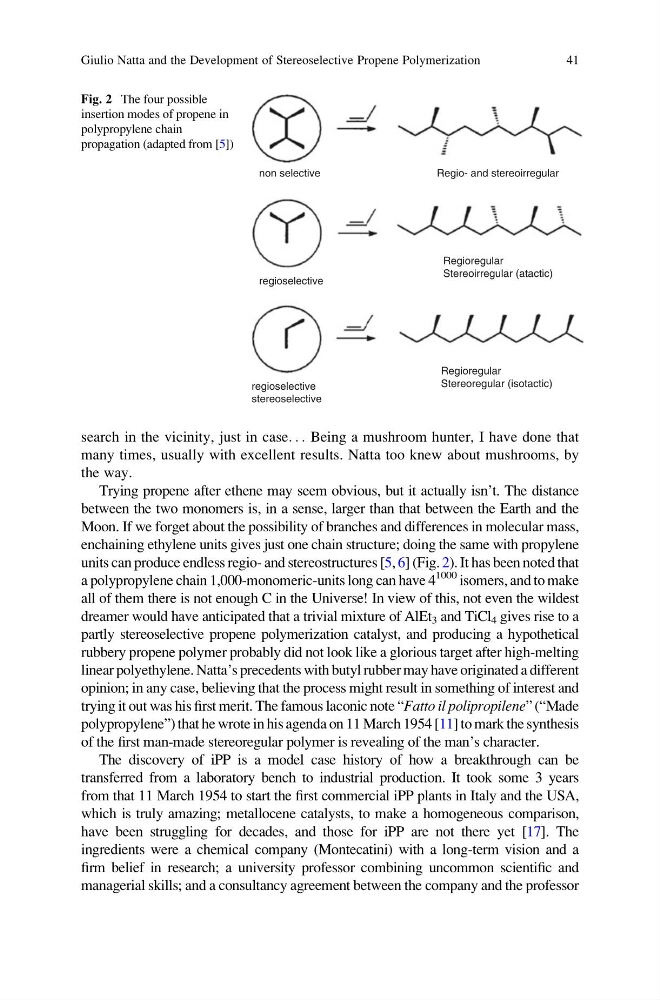
units can produce endless regio- and stereostructures [5, 6] (Fig. 2). It has been noted that
a polypropylene chain 1,000-monomeric-units long can have 4
1000 isomers, and to make
all of them there is not enough C in the Universe! In view of this, not even the wildest
dreamer would have anticipated that a trivial mixture of AlEt 3 and TiCl 4 gives rise to a
partly stereoselective propene polymerization catalyst, and producing a hypothetical
rubbery propene polymer probably did not look like a glorious target after high-melting
linear polyethylene. Natta’s precedents with butyl rubber may have originated a different
opinion; in any case, believing that the process might result in something of interest and
trying it out was his first merit. The famous laconic note “Fatto il polipropilene” (“Made
polypropylene”) that he wrote in his agenda on 11 March 1954 [11] to mark the synthesis
of the first man-made stereoregular polymer is revealing of the man’s character.
The discovery of iPP is a model case history of how a breakthrough can be
transferred from a laboratory bench to industrial production. It took some 3 years
from that 11 March 1954 to start the first commercial iPP plants in Italy and the USA,
which is truly amazing; metallocene catalysts, to make a homogeneous comparison,
have been struggling for decades, and those for iPP are not there yet [17]. The
ingredients were a chemical company (Montecatini) with a long-term vision and a
firm belief in research; a university professor combining uncommon scientific and
managerial skills; and a consultancy agreement between the company and the professor
Regio- and stereoirregular
Regioregular
Stereoirregular (atactic)
Regioregular
Stereoregular (isotactic)
regioselective
stereoselective
regioselective
non selective
Fig. 2 The four possible
insertion modes of propene in
polypropylene chain
propagation (adapted from [5])
Giulio Natta and the Development of Stereoselective Propene Polymerization
41
many times, usually with excellent results. Natta too knew about mushrooms, by
the way.
Trying propene after ethene may seem obvious, but it actually isn’t. The distance
between the two monomers is, in a sense, larger than that between the Earth and the
Moon. If we forget about the possibility of branches and differences in molecular mass,
enchaining ethylene units gives just one chain structure; doing the same with propylene
units can produce endless regio- and stereostructures [5, 6] (Fig. 2). It has been noted that
a polypropylene chain 1,000-monomeric-units long can have 4
1000 isomers, and to make
all of them there is not enough C in the Universe! In view of this, not even the wildest
dreamer would have anticipated that a trivial mixture of AlEt 3 and TiCl 4 gives rise to a
partly stereoselective propene polymerization catalyst, and producing a hypothetical
rubbery propene polymer probably did not look like a glorious target after high-melting
linear polyethylene. Natta’s precedents with butyl rubber may have originated a different
opinion; in any case, believing that the process might result in something of interest and
trying it out was his first merit. The famous laconic note “Fatto il polipropilene” (“Made
polypropylene”) that he wrote in his agenda on 11 March 1954 [11] to mark the synthesis
of the first man-made stereoregular polymer is revealing of the man’s character.
The discovery of iPP is a model case history of how a breakthrough can be
transferred from a laboratory bench to industrial production. It took some 3 years
from that 11 March 1954 to start the first commercial iPP plants in Italy and the USA,
which is truly amazing; metallocene catalysts, to make a homogeneous comparison,
have been struggling for decades, and those for iPP are not there yet [17]. The
ingredients were a chemical company (Montecatini) with a long-term vision and a
firm belief in research; a university professor combining uncommon scientific and
managerial skills; and a consultancy agreement between the company and the professor
Regio- and stereoirregular
Regioregular
Stereoirregular (atactic)
Regioregular
Stereoregular (isotactic)
regioselective
stereoselective
regioselective
non selective
Fig. 2 The four possible
insertion modes of propene in
polypropylene chain
propagation (adapted from [5])
Giulio Natta and the Development of Stereoselective Propene Polymerization
41