

1 Premise
This chapter focuses on the birth and initial developments of Ziegler–Natta (ZN)
catalysts for isotactic polypropylene (iPP). It’s certainly not the first time that this
story has been written (and won’t be the last), but its charm has not faded. The
dramatic sequence of lucky shots triggering Ziegler’s and Natta’s discoveries
contributes some thrill, but the main power of the narration is that it tells about
one of the most outstanding achievements of chemistry and the chemical industry,
in an absolute sense, with an impact on society that can hardly be overestimated.
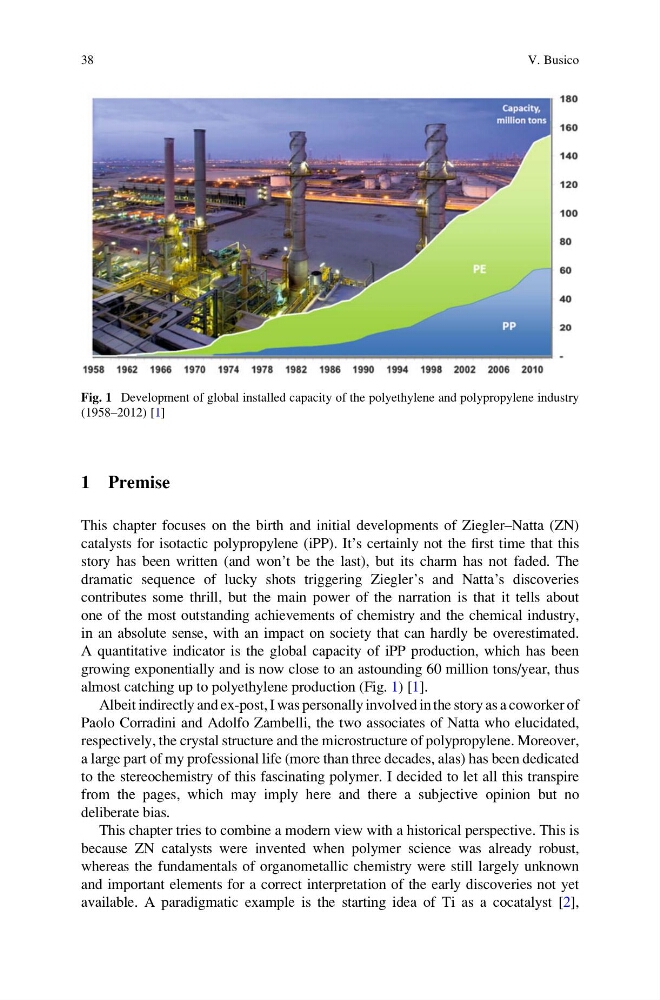
A quantitative indicator is the global capacity of iPP production, which has been
growing exponentially and is now close to an astounding 60 million tons/year, thus
almost catching up to polyethylene production (Fig. 1) [1].
Albeit indirectly and ex-post, I was personally involved in the story as a coworker of
Paolo Corradini and Adolfo Zambelli, the two associates of Natta who elucidated,
respectively, the crystal structure and the microstructure of polypropylene. Moreover,
a large part of my professional life (more than three decades, alas) has been dedicated
to the stereochemistry of this fascinating polymer. I decided to let all this transpire
from the pages, which may imply here and there a subjective opinion but no
deliberate bias.
This chapter tries to combine a modern view with a historical perspective. This is
because ZN catalysts were invented when polymer science was already robust,
whereas the fundamentals of organometallic chemistry were still largely unknown
and important elements for a correct interpretation of the early discoveries not yet
available. A paradigmatic example is the starting idea of Ti as a cocatalyst [2],
Fig. 1 Development of global installed capacity of the polyethylene and polypropylene industry
(1958–2012) [1]
38
V. Busico
This chapter focuses on the birth and initial developments of Ziegler–Natta (ZN)
catalysts for isotactic polypropylene (iPP). It’s certainly not the first time that this
story has been written (and won’t be the last), but its charm has not faded. The
dramatic sequence of lucky shots triggering Ziegler’s and Natta’s discoveries
contributes some thrill, but the main power of the narration is that it tells about
one of the most outstanding achievements of chemistry and the chemical industry,
in an absolute sense, with an impact on society that can hardly be overestimated.
A quantitative indicator is the global capacity of iPP production, which has been
growing exponentially and is now close to an astounding 60 million tons/year, thus
almost catching up to polyethylene production (Fig. 1) [1].
Albeit indirectly and ex-post, I was personally involved in the story as a coworker of
Paolo Corradini and Adolfo Zambelli, the two associates of Natta who elucidated,
respectively, the crystal structure and the microstructure of polypropylene. Moreover,
a large part of my professional life (more than three decades, alas) has been dedicated
to the stereochemistry of this fascinating polymer. I decided to let all this transpire
from the pages, which may imply here and there a subjective opinion but no
deliberate bias.
This chapter tries to combine a modern view with a historical perspective. This is
because ZN catalysts were invented when polymer science was already robust,
whereas the fundamentals of organometallic chemistry were still largely unknown
and important elements for a correct interpretation of the early discoveries not yet
available. A paradigmatic example is the starting idea of Ti as a cocatalyst [2],
Fig. 1 Development of global installed capacity of the polyethylene and polypropylene industry
(1958–2012) [1]
38
V. Busico