

As a further demonstration of the potential of the video microscopy analysis,
Ferrari et al. [63, 64] applied this technique to the gas phase copolymerization.
Figure 30 shows the results of an ethylene/propylene copolymerization with an
industrial MgCl 2 -supported TiCl 4 /AlEt 3 Ziegler-catalyst system.
The particles in Fig. 30 represent an excellent replica of the catalyst particle
distribution through the polymer particle distribution; the spherical form of the
initial particles is retained and the equivalent circle diameters are enlarged from
about 90 μm to about 360 μm after 190 min polymerization time. Their dependence
on time indicates a very active catalyst system with a fast copolymerization rate and
a fast particle expansion caused by the loosely agglomerated MgCl 2 support and the
volume increase of the amorphous copolymer. It seems that this copolymerization
system follows the multigrain model.
0,00
0,10
0,20
0,30
0,40
0,50
0,60
0,70
0
20
40
60
80
100
120
140
160
180
ECD 0
58μm
56μm
45μm
31μm
35μm
33μm
ParticleNr.
21
5
1
3
39
38
Polymerization time [min]
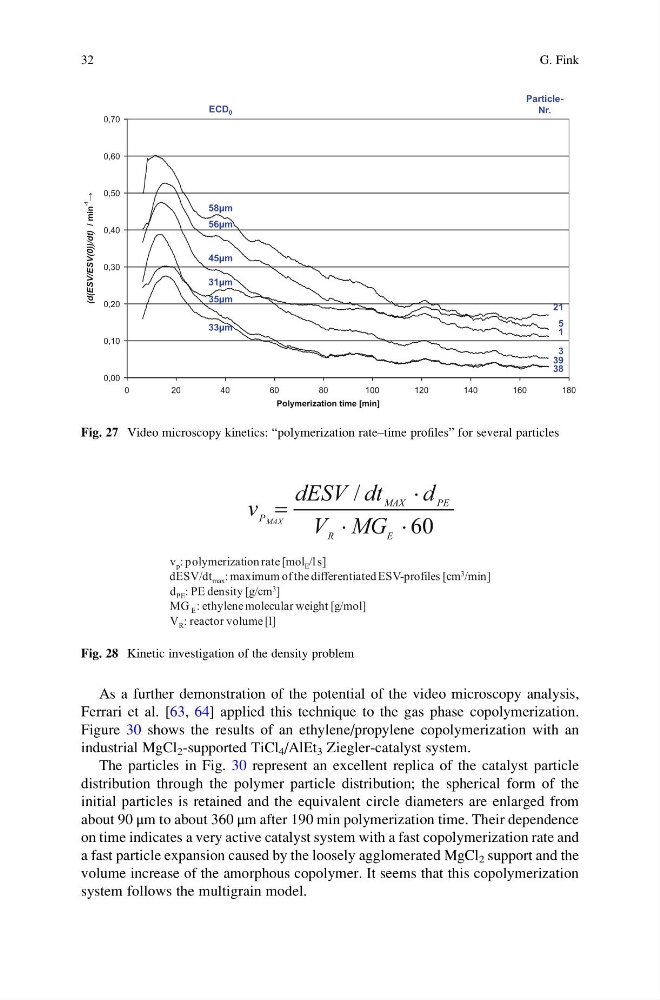
Fig. 27 Video microscopy kinetics: “polymerization rate–time profiles” for several particles
60
/
×
×
×
=
E
R
PE
MAX
P
MG
V
d
dt
dESV
v
v p : polymerization rate [mol E /l s]
dESV/dt max : maximum of the differentiated ESV-profiles [cm 3 /min]
d PE : PE density [g/cm
3 ]
MG E : ethylene molecular weight [g/mol]
V R : reactor volume [l]
MAX
Fig. 28 Kinetic investigation of the density problem
32
G. Fink
Ferrari et al. [63, 64] applied this technique to the gas phase copolymerization.
Figure 30 shows the results of an ethylene/propylene copolymerization with an
industrial MgCl 2 -supported TiCl 4 /AlEt 3 Ziegler-catalyst system.
The particles in Fig. 30 represent an excellent replica of the catalyst particle
distribution through the polymer particle distribution; the spherical form of the
initial particles is retained and the equivalent circle diameters are enlarged from
about 90 μm to about 360 μm after 190 min polymerization time. Their dependence
on time indicates a very active catalyst system with a fast copolymerization rate and
a fast particle expansion caused by the loosely agglomerated MgCl 2 support and the
volume increase of the amorphous copolymer. It seems that this copolymerization
system follows the multigrain model.
0,00
0,10
0,20
0,30
0,40
0,50
0,60
0,70
0
20
40
60
80
100
120
140
160
180
ECD 0
58μm
56μm
45μm
31μm
35μm
33μm
ParticleNr.
21
5
1
3
39
38
Polymerization time [min]
Fig. 27 Video microscopy kinetics: “polymerization rate–time profiles” for several particles
60
/
×
×
×
=
E
R
PE
MAX
P
MG
V
d
dt
dESV
v
v p : polymerization rate [mol E /l s]
dESV/dt max : maximum of the differentiated ESV-profiles [cm 3 /min]
d PE : PE density [g/cm
3 ]
MG E : ethylene molecular weight [g/mol]
V R : reactor volume [l]
MAX
Fig. 28 Kinetic investigation of the density problem
32
G. Fink