

between calculated and experimental pentad distributions. One reason could be the
inversion of the growing chain at the Zr center after an insertion and before
the coordination of the next monomer (“back-skip” of the polymer chain); this
process generates dyad stereo-errors. Other reasons can be the epimerization
reaction of the last inserted monomer [37], transfer reactions, or regio-errors such
as 2,1-insertions of the olefin.
3.2 Stereospecific Propylene Polymerization: The Rotation
Effect, an Insight into Mechanistic Detail
Figure 22 deals with the MAO-activated propylene polymerization of a series of
metallocene catalysts (see Figs. 18 and 19) having a substituent of increasing steric
demand at the cyclopentadienyl ring. To each catalyst is appointed the syndiotactic (rrrr), hemiisotactic, or isotactic (mmmm) NMR pentads (%). These pentad
distributions are measured from samples polymerized at 10
C and 70
C.
The top entry in Fig. 22 shows the catalyst iPr[Cp][Flu]ZrCl 2 with the basic
ligand framework of this series. It has a highly syndiotactic behavior at 10
C with
93.1% rrrr and a statistic atactic behavior at 70
C with 58.6% rrrr. Hence, the
syndiotacticity decreases with increasing temperature because of stereo-errors
through the more distorted ligand framework.
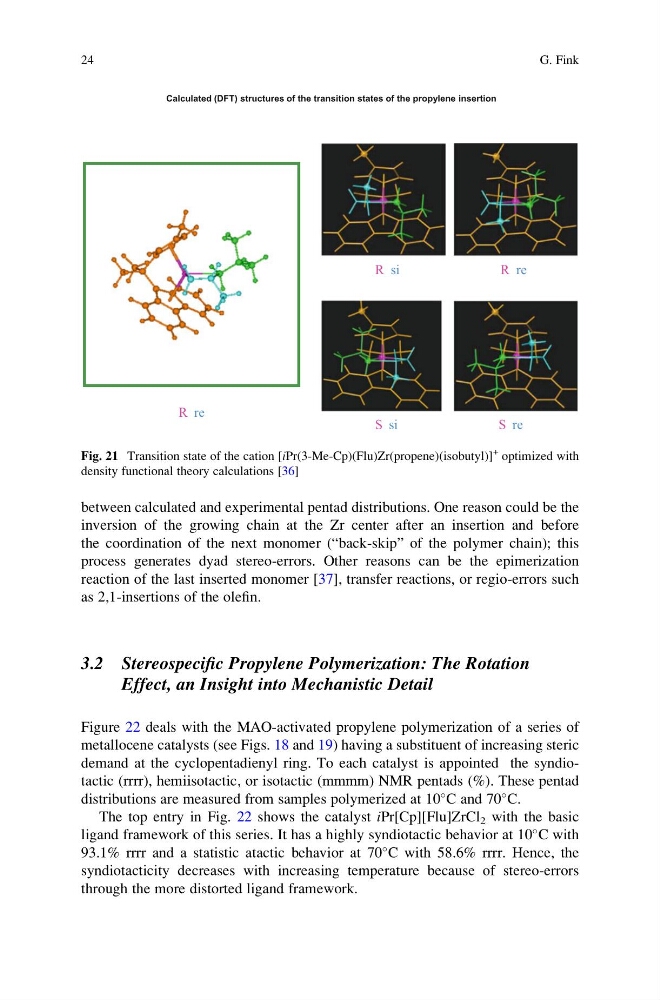
Calculated (DFT) structures of the transition states of the propylene insertion
R re
R si
R re
S si
S re
Fig. 21 Transition state of the cation [iPr(3-Me-Cp)(Flu)Zr(propene)(isobutyl)]
+ optimized with
density functional theory calculations [36]
24
G. Fink
inversion of the growing chain at the Zr center after an insertion and before
the coordination of the next monomer (“back-skip” of the polymer chain); this
process generates dyad stereo-errors. Other reasons can be the epimerization
reaction of the last inserted monomer [37], transfer reactions, or regio-errors such
as 2,1-insertions of the olefin.
3.2 Stereospecific Propylene Polymerization: The Rotation
Effect, an Insight into Mechanistic Detail
Figure 22 deals with the MAO-activated propylene polymerization of a series of
metallocene catalysts (see Figs. 18 and 19) having a substituent of increasing steric
demand at the cyclopentadienyl ring. To each catalyst is appointed the syndiotactic (rrrr), hemiisotactic, or isotactic (mmmm) NMR pentads (%). These pentad
distributions are measured from samples polymerized at 10
C and 70
C.
The top entry in Fig. 22 shows the catalyst iPr[Cp][Flu]ZrCl 2 with the basic
ligand framework of this series. It has a highly syndiotactic behavior at 10
C with
93.1% rrrr and a statistic atactic behavior at 70
C with 58.6% rrrr. Hence, the
syndiotacticity decreases with increasing temperature because of stereo-errors
through the more distorted ligand framework.
Calculated (DFT) structures of the transition states of the propylene insertion
R re
R si
R re
S si
S re
Fig. 21 Transition state of the cation [iPr(3-Me-Cp)(Flu)Zr(propene)(isobutyl)]
+ optimized with
density functional theory calculations [36]
24
G. Fink