

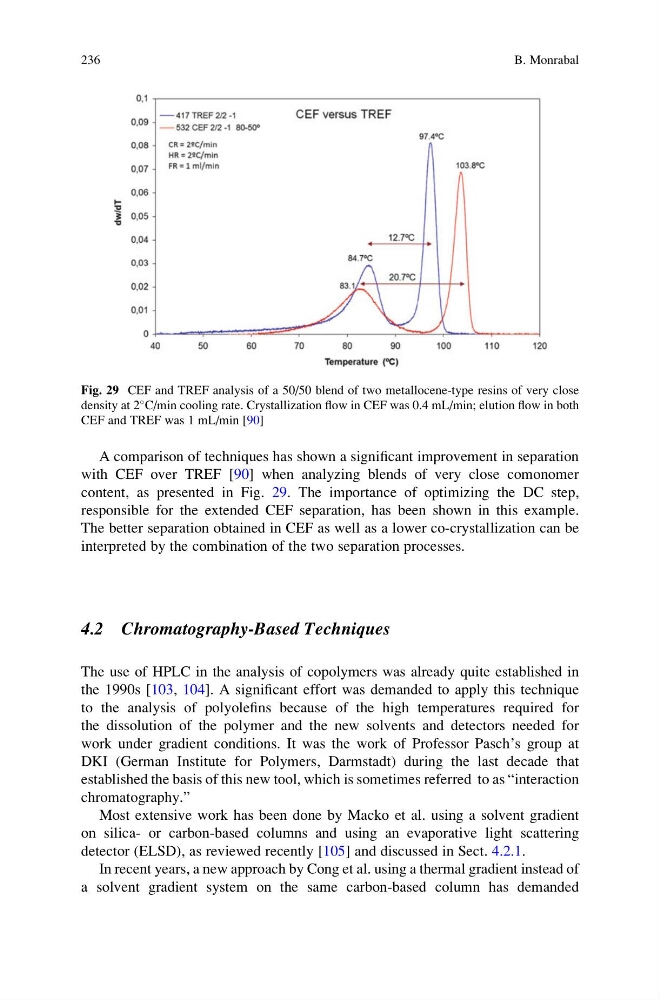
A comparison of techniques has shown a significant improvement in separation
with CEF over TREF [90] when analyzing blends of very close comonomer
content, as presented in Fig. 29. The importance of optimizing the DC step,
responsible for the extended CEF separation, has been shown in this example.
The better separation obtained in CEF as well as a lower co-crystallization can be
interpreted by the combination of the two separation processes.
4.2 Chromatography-Based Techniques
The use of HPLC in the analysis of copolymers was already quite established in
the 1990s [103, 104]. A significant effort was demanded to apply this technique
to the analysis of polyolefins because of the high temperatures required for
the dissolution of the polymer and the new solvents and detectors needed for
work under gradient conditions. It was the work of Professor Pasch’s group at
DKI (German Institute for Polymers, Darmstadt) during the last decade that
established the basis of this new tool, which is sometimes referred to as “interaction
chromatography.”
Most extensive work has been done by Macko et al. using a solvent gradient
on silica- or carbon-based columns and using an evaporative light scattering
detector (ELSD), as reviewed recently [105] and discussed in Sect. 4.2.1.
In recent years, a new approach by Cong et al. using a thermal gradient instead of
a solvent gradient system on the same carbon-based column has demanded
Fig. 29 CEF and TREF analysis of a 50/50 blend of two metallocene-type resins of very close
density at 2
C/min cooling rate. Crystallization flow in CEF was 0.4 mL/min; elution flow in both
CEF and TREF was 1 mL/min [90]
236
B. Monrabal
with CEF over TREF [90] when analyzing blends of very close comonomer
content, as presented in Fig. 29. The importance of optimizing the DC step,
responsible for the extended CEF separation, has been shown in this example.
The better separation obtained in CEF as well as a lower co-crystallization can be
interpreted by the combination of the two separation processes.
4.2 Chromatography-Based Techniques
The use of HPLC in the analysis of copolymers was already quite established in
the 1990s [103, 104]. A significant effort was demanded to apply this technique
to the analysis of polyolefins because of the high temperatures required for
the dissolution of the polymer and the new solvents and detectors needed for
work under gradient conditions. It was the work of Professor Pasch’s group at
DKI (German Institute for Polymers, Darmstadt) during the last decade that
established the basis of this new tool, which is sometimes referred to as “interaction
chromatography.”
Most extensive work has been done by Macko et al. using a solvent gradient
on silica- or carbon-based columns and using an evaporative light scattering
detector (ELSD), as reviewed recently [105] and discussed in Sect. 4.2.1.
In recent years, a new approach by Cong et al. using a thermal gradient instead of
a solvent gradient system on the same carbon-based column has demanded
Fig. 29 CEF and TREF analysis of a 50/50 blend of two metallocene-type resins of very close
density at 2
C/min cooling rate. Crystallization flow in CEF was 0.4 mL/min; elution flow in both
CEF and TREF was 1 mL/min [90]
236
B. Monrabal