

As can be seen from Table 5, the chain transfer rate was enhanced more than the
chain propagation rate after Ti-modification. Consequently, Ti-modification could
result in an increased in the low MW fraction of polyethylene, and thus the MWD
was broadened to the lower MW region.
Copolymerization with α-olefins over a Phillips catalyst is a key method for
controlling the density and microstructures of the polyethylene products in industrial processes. Table 5 also listed the energy barriers for the primary 1,2-insertion
of 1-butene and 1-hexene, and the subsequent chain transfer by β-H elimination for
all the three kinds of Ti-modified models. The calculated energy barriers showed
that Ti-modification could also promote the activity for ethylene copolymerization
with α-olefins. The energy differences between comonomer insertion and chain
transfer can lead to a conclusion on the effect of Ti-modification on the distribution
of the inserted comonomers in polyethylene chains. As listed in Table 5, the
difference between energy barriers for chain propagation and for chain transfer
decreased for model sites 4g, 12g, and 15g. Therefore, it was reasonable to
conclude that Ti-modified catalyst was likely to make low MW polyethylene with
much less comonomer insertion because the inserted comonomer mainly led to a
chain transfer reaction and left the inserted comonomer at the chain end. As a result,
the increased chain termination by comonomer resulted in less SCBs in the low
MW fraction and higher density of the polyethylene product for the Ti-modified
Phillips catalyst.
For traditional heterogeneous olefin polymerization catalysts such as
Ziegler–Natta and Phillips catalysts, the regioselectivity usually prefers
1,2-insertion (primary insertion) of α-olefins compared with 2,1-insertion (secondary insertion) due to obvious steric hindrance in the second insertion mode. The
effect of Ti-modification of the Phillips catalyst on the energy barriers of
1,2-insertion and 2,1-insertion of α-olefins was calculated by a DFT method
based on the three catalyst models. The regiospecific insertion of 1-butene is
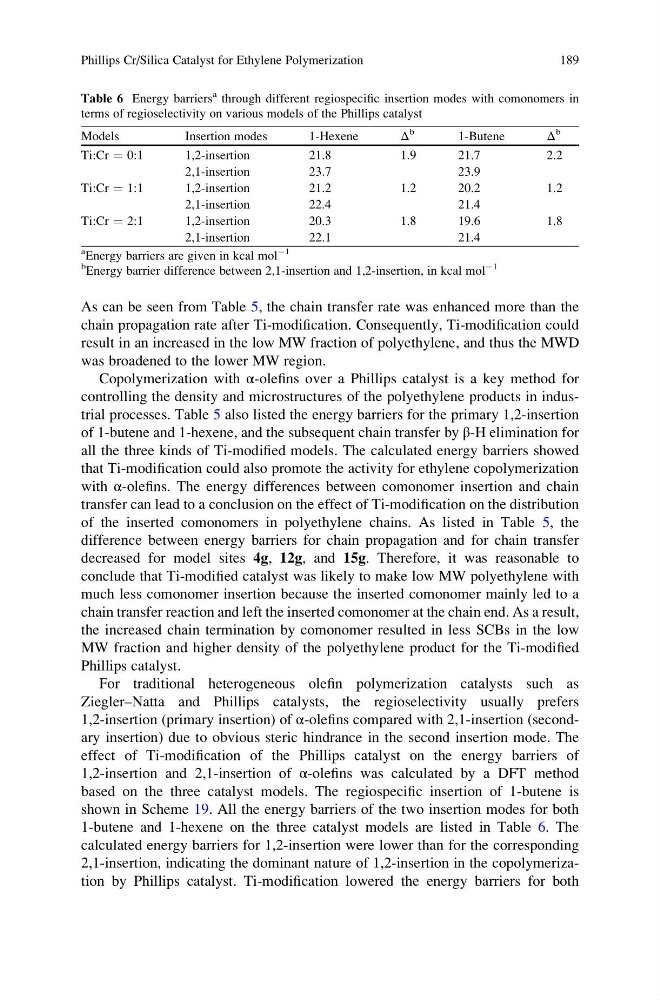
shown in Scheme 19. All the energy barriers of the two insertion modes for both
1-butene and 1-hexene on the three catalyst models are listed in Table 6. The
calculated energy barriers for 1,2-insertion were lower than for the corresponding
2,1-insertion, indicating the dominant nature of 1,2-insertion in the copolymerization by Phillips catalyst. Ti-modification lowered the energy barriers for both
Table 6 Energy barriers
a through different regiospecific insertion modes with comonomers in
terms of regioselectivity on various models of the Phillips catalyst
Models
Insertion modes
1-Hexene
Δ
b
1-Butene
Δ
b
Ti:Cr ¼ 0:1
1,2-insertion
21.8
1.9
21.7
2.2
2,1-insertion
23.7
23.9
Ti:Cr ¼ 1:1
1,2-insertion
21.2
1.2
20.2
1.2
2,1-insertion
22.4
21.4
Ti:Cr ¼ 2:1
1,2-insertion
20.3
1.8
19.6
1.8
2,1-insertion
22.1
21.4
a
Energy barriers are given in kcal mol
À1
b
Energy barrier difference between 2,1-insertion and 1,2-insertion, in kcal mol
À1
Phillips Cr/Silica Catalyst for Ethylene Polymerization
189
chain propagation rate after Ti-modification. Consequently, Ti-modification could
result in an increased in the low MW fraction of polyethylene, and thus the MWD
was broadened to the lower MW region.
Copolymerization with α-olefins over a Phillips catalyst is a key method for
controlling the density and microstructures of the polyethylene products in industrial processes. Table 5 also listed the energy barriers for the primary 1,2-insertion
of 1-butene and 1-hexene, and the subsequent chain transfer by β-H elimination for
all the three kinds of Ti-modified models. The calculated energy barriers showed
that Ti-modification could also promote the activity for ethylene copolymerization
with α-olefins. The energy differences between comonomer insertion and chain
transfer can lead to a conclusion on the effect of Ti-modification on the distribution
of the inserted comonomers in polyethylene chains. As listed in Table 5, the
difference between energy barriers for chain propagation and for chain transfer
decreased for model sites 4g, 12g, and 15g. Therefore, it was reasonable to
conclude that Ti-modified catalyst was likely to make low MW polyethylene with
much less comonomer insertion because the inserted comonomer mainly led to a
chain transfer reaction and left the inserted comonomer at the chain end. As a result,
the increased chain termination by comonomer resulted in less SCBs in the low
MW fraction and higher density of the polyethylene product for the Ti-modified
Phillips catalyst.
For traditional heterogeneous olefin polymerization catalysts such as
Ziegler–Natta and Phillips catalysts, the regioselectivity usually prefers
1,2-insertion (primary insertion) of α-olefins compared with 2,1-insertion (secondary insertion) due to obvious steric hindrance in the second insertion mode. The
effect of Ti-modification of the Phillips catalyst on the energy barriers of
1,2-insertion and 2,1-insertion of α-olefins was calculated by a DFT method
based on the three catalyst models. The regiospecific insertion of 1-butene is
shown in Scheme 19. All the energy barriers of the two insertion modes for both
1-butene and 1-hexene on the three catalyst models are listed in Table 6. The
calculated energy barriers for 1,2-insertion were lower than for the corresponding
2,1-insertion, indicating the dominant nature of 1,2-insertion in the copolymerization by Phillips catalyst. Ti-modification lowered the energy barriers for both
Table 6 Energy barriers
a through different regiospecific insertion modes with comonomers in
terms of regioselectivity on various models of the Phillips catalyst
Models
Insertion modes
1-Hexene
Δ
b
1-Butene
Δ
b
Ti:Cr ¼ 0:1
1,2-insertion
21.8
1.9
21.7
2.2
2,1-insertion
23.7
23.9
Ti:Cr ¼ 1:1
1,2-insertion
21.2
1.2
20.2
1.2
2,1-insertion
22.4
21.4
Ti:Cr ¼ 2:1
1,2-insertion
20.3
1.8
19.6
1.8
2,1-insertion
22.1
21.4
a
Energy barriers are given in kcal mol
À1
b
Energy barrier difference between 2,1-insertion and 1,2-insertion, in kcal mol
À1
Phillips Cr/Silica Catalyst for Ethylene Polymerization
189