

cluster model for modeling the properties of Cr(III) species on the silica surface of
the Phillips catalyst [145].
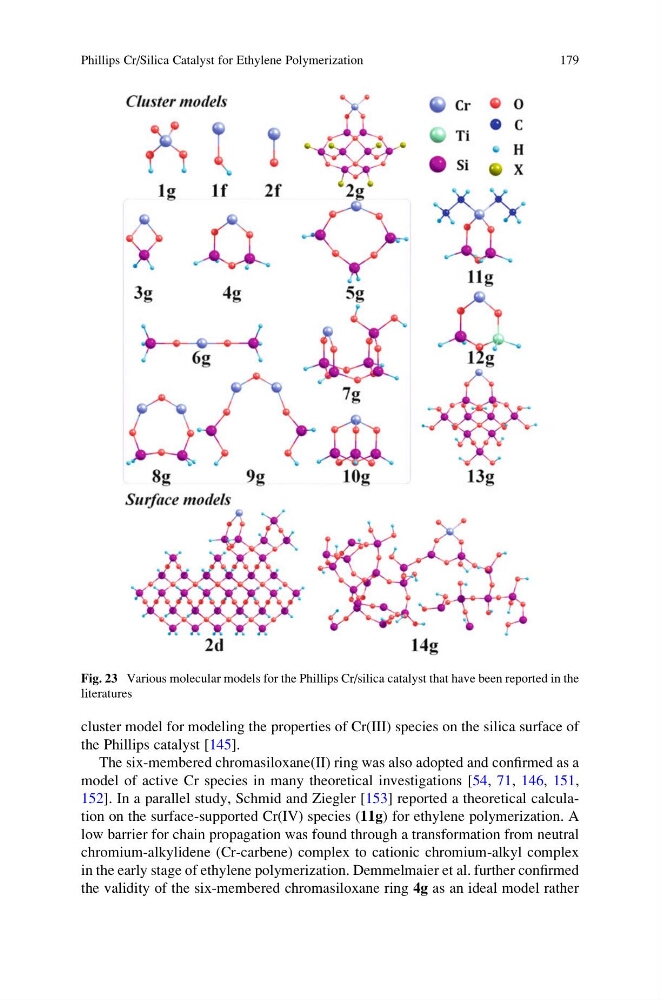
The six-membered chromasiloxane(II) ring was also adopted and confirmed as a
model of active Cr species in many theoretical investigations [54, 71, 146, 151,
152]. In a parallel study, Schmid and Ziegler [153] reported a theoretical calculation on the surface-supported Cr(IV) species (11g) for ethylene polymerization. A
low barrier for chain propagation was found through a transformation from neutral
chromium-alkylidene (Cr-carbene) complex to cationic chromium-alkyl complex
in the early stage of ethylene polymerization. Demmelmaier et al. further confirmed
the validity of the six-membered chromasiloxane ring 4g as an ideal model rather
Fig. 23 Various molecular models for the Phillips Cr/silica catalyst that have been reported in the
literatures
Phillips Cr/Silica Catalyst for Ethylene Polymerization
179
the Phillips catalyst [145].
The six-membered chromasiloxane(II) ring was also adopted and confirmed as a
model of active Cr species in many theoretical investigations [54, 71, 146, 151,
152]. In a parallel study, Schmid and Ziegler [153] reported a theoretical calculation on the surface-supported Cr(IV) species (11g) for ethylene polymerization. A
low barrier for chain propagation was found through a transformation from neutral
chromium-alkylidene (Cr-carbene) complex to cationic chromium-alkyl complex
in the early stage of ethylene polymerization. Demmelmaier et al. further confirmed
the validity of the six-membered chromasiloxane ring 4g as an ideal model rather
Fig. 23 Various molecular models for the Phillips Cr/silica catalyst that have been reported in the
literatures
Phillips Cr/Silica Catalyst for Ethylene Polymerization
179