

Because the Phillips catalyst is unique for its metal-alkyl-free feature in both the
catalyst preparation and subsequent polymerization processes, ethylene monomer
could play a key role in the activation through reduction of the hexavalent chromate
species into surface-stabilized Cr(II) species [Cr(II)O x,surf ] as the final active
precursor, followed by initiation of ethylene polymerization through alkylation of
the Cr(II) center during the initial stage, in which an induction period is usually
observed after the introduction of ethylene monomer at usual operating
temperatures (lower than 150
C) [2, 6, 10]. The initiation mechanism in terms of
an alkylation of the Cr(II) center by ethylene monomer, followed by the propagation of the first polyethylene chain is the most interesting and important academic
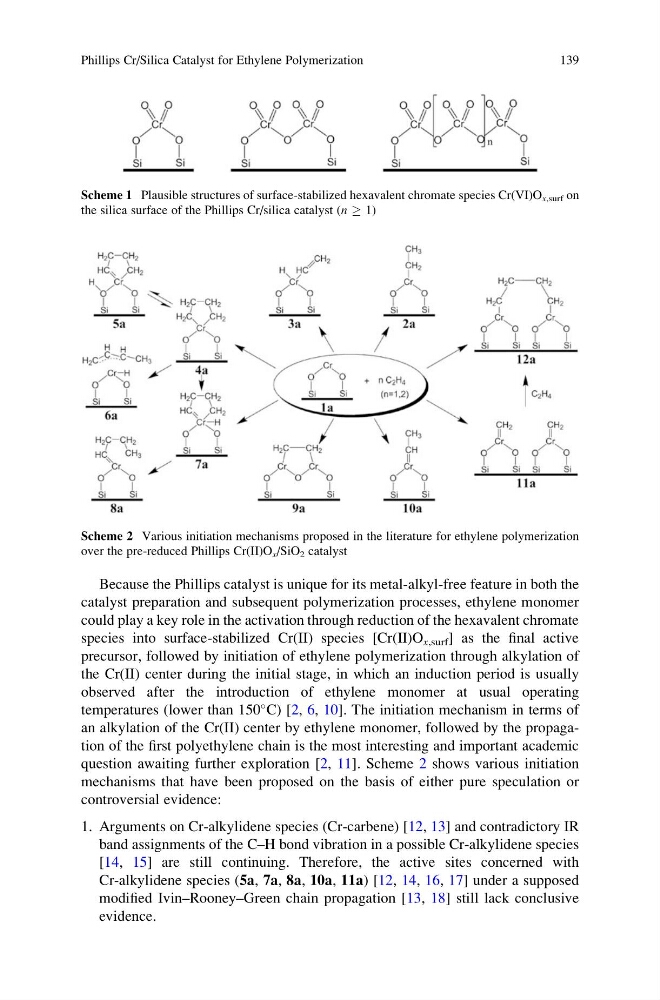
question awaiting further exploration [2, 11]. Scheme 2 shows various initiation
mechanisms that have been proposed on the basis of either pure speculation or
controversial evidence:
1. Arguments on Cr-alkylidene species (Cr-carbene) [12, 13] and contradictory IR
band assignments of the C–H bond vibration in a possible Cr-alkylidene species
[14, 15] are still continuing. Therefore, the active sites concerned with
Cr-alkylidene species (5a, 7a, 8a, 10a, 11a) [12, 14, 16, 17] under a supposed
modified Ivin–Rooney–Green chain propagation [13, 18] still lack conclusive
evidence.
Scheme 1 Plausible structures of surface-stabilized hexavalent chromate species Cr(VI)O x,surf on
the silica surface of the Phillips Cr/silica catalyst (n ! 1)
Scheme 2 Various initiation mechanisms proposed in the literature for ethylene polymerization
over the pre-reduced Phillips Cr(II)O x /SiO 2 catalyst
Phillips Cr/Silica Catalyst for Ethylene Polymerization
139
catalyst preparation and subsequent polymerization processes, ethylene monomer
could play a key role in the activation through reduction of the hexavalent chromate
species into surface-stabilized Cr(II) species [Cr(II)O x,surf ] as the final active
precursor, followed by initiation of ethylene polymerization through alkylation of
the Cr(II) center during the initial stage, in which an induction period is usually
observed after the introduction of ethylene monomer at usual operating
temperatures (lower than 150
C) [2, 6, 10]. The initiation mechanism in terms of
an alkylation of the Cr(II) center by ethylene monomer, followed by the propagation of the first polyethylene chain is the most interesting and important academic
question awaiting further exploration [2, 11]. Scheme 2 shows various initiation
mechanisms that have been proposed on the basis of either pure speculation or
controversial evidence:
1. Arguments on Cr-alkylidene species (Cr-carbene) [12, 13] and contradictory IR
band assignments of the C–H bond vibration in a possible Cr-alkylidene species
[14, 15] are still continuing. Therefore, the active sites concerned with
Cr-alkylidene species (5a, 7a, 8a, 10a, 11a) [12, 14, 16, 17] under a supposed
modified Ivin–Rooney–Green chain propagation [13, 18] still lack conclusive
evidence.
Scheme 1 Plausible structures of surface-stabilized hexavalent chromate species Cr(VI)O x,surf on
the silica surface of the Phillips Cr/silica catalyst (n ! 1)
Scheme 2 Various initiation mechanisms proposed in the literature for ethylene polymerization
over the pre-reduced Phillips Cr(II)O x /SiO 2 catalyst
Phillips Cr/Silica Catalyst for Ethylene Polymerization
139