

1.1 Biographical Data
26.11.1898
Karl Ziegler is born in Helsa near Kassel as the second son of the pastor Carl
August Ziegler and his wife Luise, nee ´ Rall. He spent his early years in
Helsa and, after 1910, in Marburg
Summer 1915
Abitur from the Realgymnasium of Marburg
1916–1920
Chemistry student at the University of Marburg
03.08.1920
Doctoral degree from the University of Marburg with a thesis entitled
Untersuchungen u ¨ber Semibenzole und verwandte Verbindungen
(Investigations on semibenzenes and related compounds). Supervisor:
Karl von Auwers
11.03.1922
Marriage to Maria Kurtz from Marburg. The couple were to have two children –
Marianne and Erhard
1923
Habilitation at the University of Marburg with a thesis entitled Zur Kenntnis
des dreiwertigen Kohlenstoffs: €
Uber Tetra-Aryl-Allyl-Radikale und ihre
Derivate (Three valent carbon: tetra-aryl-allyl-radicals and their derivatives)
1925/1926
Temporary lectureship with Julius von Braun at the University of Frankfurt am
Main
1926
Privatdozent (lecturer) with Karl Freudenberg at the University of Heidelberg
18.01.1928
Promotion to außerordentlicher (associate) Professor at the University of
Heidelberg
(continued)
.
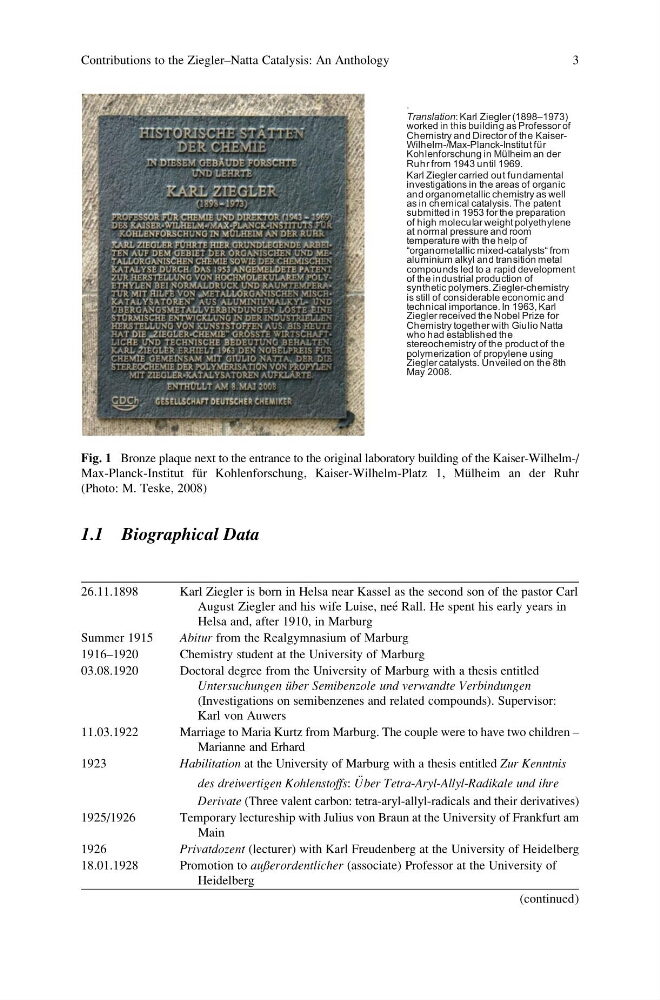
Translation: Karl Ziegler (1898–1973)
worked in this building as Professor of
Chemistry and Director of the KaiserWilhelm-/Max-Planck-Institut für
Kohlenforschung in Mülheim an der
Ruhr from 1943 until 1969.
Karl Ziegler carried out fundamental
investigations in the areas of organic
and organometallic chemistry as well
as in chemical catalysis. The patent
submitted in 1953 for the preparation
of high molecular weight polyethylene
at normal pressure and room
temperature with the help of
“organometallic mixed-catalysts“ from
aluminium alkyl and transition metal
compounds led to a rapid development
of the industrial production of
synthetic polymers. Ziegler-chemistry
is still of considerable economic and
technical importance. In 1963, Karl
Ziegler received the Nobel Prize for
Chemistry together with Giulio Natta
who had established the
stereochemistry of the product of the
polymerization of propylene using
Ziegler catalysts. Unveiled on the 8th
May 2008.
Fig. 1 Bronze plaque next to the entrance to the original laboratory building of the Kaiser-Wilhelm-/
Max-Planck-Institut fu ¨r Kohlenforschung, Kaiser-Wilhelm-Platz 1, Mu ¨lheim an der Ruhr
(Photo: M. Teske, 2008)
Contributions to the Ziegler–Natta Catalysis: An Anthology
3
26.11.1898
Karl Ziegler is born in Helsa near Kassel as the second son of the pastor Carl
August Ziegler and his wife Luise, nee ´ Rall. He spent his early years in
Helsa and, after 1910, in Marburg
Summer 1915
Abitur from the Realgymnasium of Marburg
1916–1920
Chemistry student at the University of Marburg
03.08.1920
Doctoral degree from the University of Marburg with a thesis entitled
Untersuchungen u ¨ber Semibenzole und verwandte Verbindungen
(Investigations on semibenzenes and related compounds). Supervisor:
Karl von Auwers
11.03.1922
Marriage to Maria Kurtz from Marburg. The couple were to have two children –
Marianne and Erhard
1923
Habilitation at the University of Marburg with a thesis entitled Zur Kenntnis
des dreiwertigen Kohlenstoffs: €
Uber Tetra-Aryl-Allyl-Radikale und ihre
Derivate (Three valent carbon: tetra-aryl-allyl-radicals and their derivatives)
1925/1926
Temporary lectureship with Julius von Braun at the University of Frankfurt am
Main
1926
Privatdozent (lecturer) with Karl Freudenberg at the University of Heidelberg
18.01.1928
Promotion to außerordentlicher (associate) Professor at the University of
Heidelberg
(continued)
.
Translation: Karl Ziegler (1898–1973)
worked in this building as Professor of
Chemistry and Director of the KaiserWilhelm-/Max-Planck-Institut für
Kohlenforschung in Mülheim an der
Ruhr from 1943 until 1969.
Karl Ziegler carried out fundamental
investigations in the areas of organic
and organometallic chemistry as well
as in chemical catalysis. The patent
submitted in 1953 for the preparation
of high molecular weight polyethylene
at normal pressure and room
temperature with the help of
“organometallic mixed-catalysts“ from
aluminium alkyl and transition metal
compounds led to a rapid development
of the industrial production of
synthetic polymers. Ziegler-chemistry
is still of considerable economic and
technical importance. In 1963, Karl
Ziegler received the Nobel Prize for
Chemistry together with Giulio Natta
who had established the
stereochemistry of the product of the
polymerization of propylene using
Ziegler catalysts. Unveiled on the 8th
May 2008.
Fig. 1 Bronze plaque next to the entrance to the original laboratory building of the Kaiser-Wilhelm-/
Max-Planck-Institut fu ¨r Kohlenforschung, Kaiser-Wilhelm-Platz 1, Mu ¨lheim an der Ruhr
(Photo: M. Teske, 2008)
Contributions to the Ziegler–Natta Catalysis: An Anthology
3