

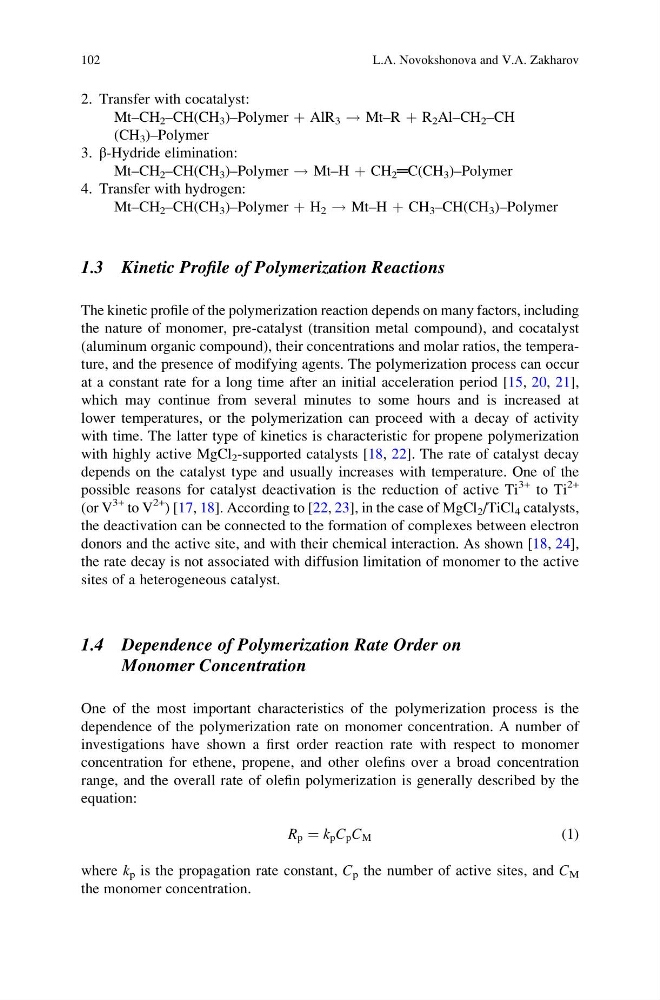
2. Transfer with cocatalyst:
Mt–CH 2 –CH(CH 3 )–Polymer þ AlR 3 ! Mt–R þ R 2 Al–CH 2 –CH
(CH 3 )–Polymer
3. β-Hydride elimination:
Mt–CH 2 –CH(CH 3 )–Polymer ! Mt–H þ CH 2 ═C(CH 3 )–Polymer
4. Transfer with hydrogen:
Mt–CH 2 –CH(CH 3 )–Polymer þ H 2 ! Mt–H þ CH 3 –CH(CH 3 )–Polymer
1.3 Kinetic Profile of Polymerization Reactions
The kinetic profile of the polymerization reaction depends on many factors, including
the nature of monomer, pre-catalyst (transition metal compound), and cocatalyst
(aluminum organic compound), their concentrations and molar ratios, the temperature, and the presence of modifying agents. The polymerization process can occur
at a constant rate for a long time after an initial acceleration period [15, 20, 21],
which may continue from several minutes to some hours and is increased at
lower temperatures, or the polymerization can proceed with a decay of activity
with time. The latter type of kinetics is characteristic for propene polymerization
with highly active MgCl 2 -supported catalysts [18, 22]. The rate of catalyst decay
depends on the catalyst type and usually increases with temperature. One of the
possible reasons for catalyst deactivation is the reduction of active Ti
3+ to Ti
2+
(or V
3+ to V
2+ ) [17, 18]. According to [22, 23], in the case of MgCl 2 /TiCl 4 catalysts,
the deactivation can be connected to the formation of complexes between electron
donors and the active site, and with their chemical interaction. As shown [18, 24],
the rate decay is not associated with diffusion limitation of monomer to the active
sites of a heterogeneous catalyst.
1.4 Dependence of Polymerization Rate Order on
Monomer Concentration
One of the most important characteristics of the polymerization process is the
dependence of the polymerization rate on monomer concentration. A number of
investigations have shown a first order reaction rate with respect to monomer
concentration for ethene, propene, and other olefins over a broad concentration
range, and the overall rate of olefin polymerization is generally described by the
equation:
R p ¼ k p C p C M
(1)
where k p is the propagation rate constant, C p the number of active sites, and C M
the monomer concentration.
102
L.A. Novokshonova and V.A. Zakharov
Mt–CH 2 –CH(CH 3 )–Polymer þ AlR 3 ! Mt–R þ R 2 Al–CH 2 –CH
(CH 3 )–Polymer
3. β-Hydride elimination:
Mt–CH 2 –CH(CH 3 )–Polymer ! Mt–H þ CH 2 ═C(CH 3 )–Polymer
4. Transfer with hydrogen:
Mt–CH 2 –CH(CH 3 )–Polymer þ H 2 ! Mt–H þ CH 3 –CH(CH 3 )–Polymer
1.3 Kinetic Profile of Polymerization Reactions
The kinetic profile of the polymerization reaction depends on many factors, including
the nature of monomer, pre-catalyst (transition metal compound), and cocatalyst
(aluminum organic compound), their concentrations and molar ratios, the temperature, and the presence of modifying agents. The polymerization process can occur
at a constant rate for a long time after an initial acceleration period [15, 20, 21],
which may continue from several minutes to some hours and is increased at
lower temperatures, or the polymerization can proceed with a decay of activity
with time. The latter type of kinetics is characteristic for propene polymerization
with highly active MgCl 2 -supported catalysts [18, 22]. The rate of catalyst decay
depends on the catalyst type and usually increases with temperature. One of the
possible reasons for catalyst deactivation is the reduction of active Ti
3+ to Ti
2+
(or V
3+ to V
2+ ) [17, 18]. According to [22, 23], in the case of MgCl 2 /TiCl 4 catalysts,
the deactivation can be connected to the formation of complexes between electron
donors and the active site, and with their chemical interaction. As shown [18, 24],
the rate decay is not associated with diffusion limitation of monomer to the active
sites of a heterogeneous catalyst.
1.4 Dependence of Polymerization Rate Order on
Monomer Concentration
One of the most important characteristics of the polymerization process is the
dependence of the polymerization rate on monomer concentration. A number of
investigations have shown a first order reaction rate with respect to monomer
concentration for ethene, propene, and other olefins over a broad concentration
range, and the overall rate of olefin polymerization is generally described by the
equation:
R p ¼ k p C p C M
(1)
where k p is the propagation rate constant, C p the number of active sites, and C M
the monomer concentration.
102
L.A. Novokshonova and V.A. Zakharov