

52
Z. Amini et al.
ˆ
D, ˆ
α i j , ˆ
X
arg min ˆ
D,α i j ,X λX − Y
2
2 + i j μ i j
α i j
0
+ i j
Dα i j − R i j X
2
2
(3.8)
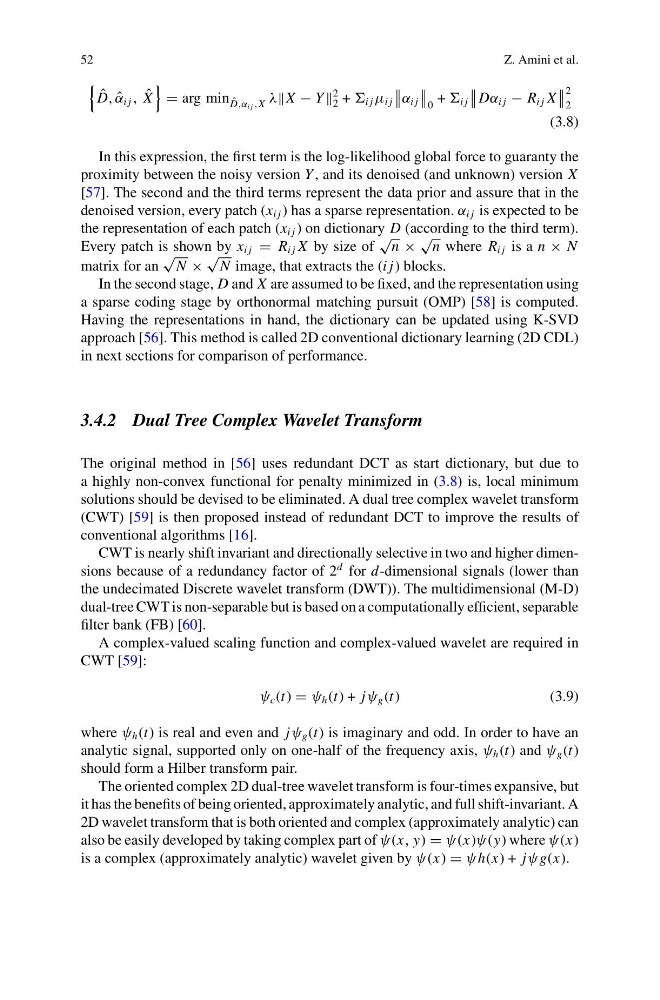
In this expression, the first term is the log-likelihood global force to guaranty the
proximity between the noisy version Y , and its denoised (and unknown) version X
[57]. The second and the third terms represent the data prior and assure that in the
denoised version, every patch (x i j ) has a sparse representation. α i j is expected to be
the representation of each patch (x i j ) on dictionary D (according to the third term).
Every patch is shown by x i j R i j X by size of
√
n ×
√
n where R i j is a n × N
matrix for an
√
N ×
√
N image, that extracts the (i j) blocks.
In the second stage, D and X are assumed to be fixed, and the representation using
a sparse coding stage by orthonormal matching pursuit (OMP) [58] is computed.
Having the representations in hand, the dictionary can be updated using K-SVD
approach [56]. This method is called 2D conventional dictionary learning (2D CDL)
in next sections for comparison of performance.
3.4.2 Dual Tree Complex Wavelet Transform
The original method in [56] uses redundant DCT as start dictionary, but due to
a highly non-convex functional for penalty minimized in (3.8) is, local minimum
solutions should be devised to be eliminated. A dual tree complex wavelet transform
(CWT) [59] is then proposed instead of redundant DCT to improve the results of
conventional algorithms [16].
CWT is nearly shift invariant and directionally selective in two and higher dimensions because of a redundancy factor of 2
d for d-dimensional signals (lower than
the undecimated Discrete wavelet transform (DWT)). The multidimensional (M-D)
dual-tree CWT is non-separable but is based on a computationally efficient, separable
filter bank (FB) [60].
A complex-valued scaling function and complex-valued wavelet are required in
CWT [59]:
ψ c (t) ψ h (t) + jψ g (t)
(3.9)
where ψ h (t) is real and even and jψ g (t) is imaginary and odd. In order to have an
analytic signal, supported only on one-half of the frequency axis, ψ h (t) and ψ g (t)
should form a Hilber transform pair.
The oriented complex 2D dual-tree wavelet transform is four-times expansive, but
it has the benefits of being oriented, approximately analytic, and full shift-invariant. A
2D wavelet transform that is both oriented and complex (approximately analytic) can
also be easily developed by taking complex part of ψ(x, y) ψ(x)ψ(y) where ψ(x)
is a complex (approximately analytic) wavelet given by ψ(x) ψh(x) + jψg(x).
Z. Amini et al.
ˆ
D, ˆ
α i j , ˆ
X
arg min ˆ
D,α i j ,X λX − Y
2
2 + i j μ i j
α i j
0
+ i j
Dα i j − R i j X
2
2
(3.8)
In this expression, the first term is the log-likelihood global force to guaranty the
proximity between the noisy version Y , and its denoised (and unknown) version X
[57]. The second and the third terms represent the data prior and assure that in the
denoised version, every patch (x i j ) has a sparse representation. α i j is expected to be
the representation of each patch (x i j ) on dictionary D (according to the third term).
Every patch is shown by x i j R i j X by size of
√
n ×
√
n where R i j is a n × N
matrix for an
√
N ×
√
N image, that extracts the (i j) blocks.
In the second stage, D and X are assumed to be fixed, and the representation using
a sparse coding stage by orthonormal matching pursuit (OMP) [58] is computed.
Having the representations in hand, the dictionary can be updated using K-SVD
approach [56]. This method is called 2D conventional dictionary learning (2D CDL)
in next sections for comparison of performance.
3.4.2 Dual Tree Complex Wavelet Transform
The original method in [56] uses redundant DCT as start dictionary, but due to
a highly non-convex functional for penalty minimized in (3.8) is, local minimum
solutions should be devised to be eliminated. A dual tree complex wavelet transform
(CWT) [59] is then proposed instead of redundant DCT to improve the results of
conventional algorithms [16].
CWT is nearly shift invariant and directionally selective in two and higher dimensions because of a redundancy factor of 2
d for d-dimensional signals (lower than
the undecimated Discrete wavelet transform (DWT)). The multidimensional (M-D)
dual-tree CWT is non-separable but is based on a computationally efficient, separable
filter bank (FB) [60].
A complex-valued scaling function and complex-valued wavelet are required in
CWT [59]:
ψ c (t) ψ h (t) + jψ g (t)
(3.9)
where ψ h (t) is real and even and jψ g (t) is imaginary and odd. In order to have an
analytic signal, supported only on one-half of the frequency axis, ψ h (t) and ψ g (t)
should form a Hilber transform pair.
The oriented complex 2D dual-tree wavelet transform is four-times expansive, but
it has the benefits of being oriented, approximately analytic, and full shift-invariant. A
2D wavelet transform that is both oriented and complex (approximately analytic) can
also be easily developed by taking complex part of ψ(x, y) ψ(x)ψ(y) where ψ(x)
is a complex (approximately analytic) wavelet given by ψ(x) ψh(x) + jψg(x).