

200
M. Wu et al.
(a)
(b)
(c)
(d)
(e)
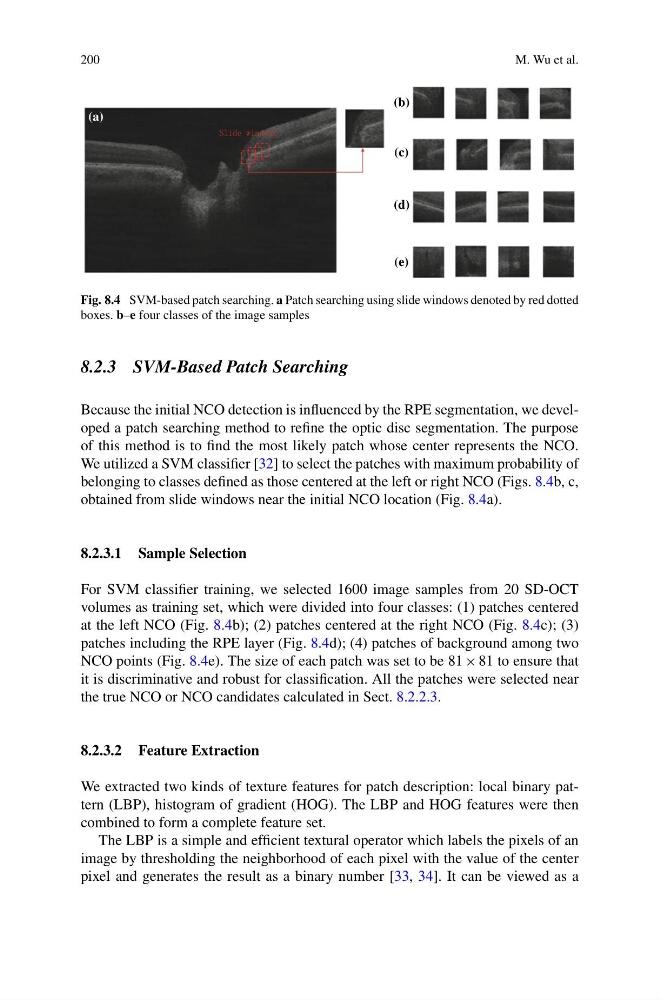
Fig. 8.4 SVM-based patch searching. a Patch searching using slide windows denoted by red dotted
boxes. b–e four classes of the image samples
8.2.3 SVM-Based Patch Searching
Because the initial NCO detection is influenced by the RPE segmentation, we developed a patch searching method to refine the optic disc segmentation. The purpose
of this method is to find the most likely patch whose center represents the NCO.
We utilized a SVM classifier [32] to select the patches with maximum probability of
belonging to classes defined as those centered at the left or right NCO (Figs. 8.4b, c,
obtained from slide windows near the initial NCO location (Fig. 8.4a).
8.2.3.1 Sample Selection
For SVM classifier training, we selected 1600 image samples from 20 SD-OCT
volumes as training set, which were divided into four classes: (1) patches centered
at the left NCO (Fig. 8.4b); (2) patches centered at the right NCO (Fig. 8.4c); (3)
patches including the RPE layer (Fig. 8.4d); (4) patches of background among two
NCO points (Fig. 8.4e). The size of each patch was set to be 81 × 81 to ensure that
it is discriminative and robust for classification. All the patches were selected near
the true NCO or NCO candidates calculated in Sect. 8.2.2.3.
8.2.3.2 Feature Extraction
We extracted two kinds of texture features for patch description: local binary pattern (LBP), histogram of gradient (HOG). The LBP and HOG features were then
combined to form a complete feature set.
The LBP is a simple and efficient textural operator which labels the pixels of an
image by thresholding the neighborhood of each pixel with the value of the center
pixel and generates the result as a binary number [33, 34]. It can be viewed as a
M. Wu et al.
(a)
(b)
(c)
(d)
(e)
Fig. 8.4 SVM-based patch searching. a Patch searching using slide windows denoted by red dotted
boxes. b–e four classes of the image samples
8.2.3 SVM-Based Patch Searching
Because the initial NCO detection is influenced by the RPE segmentation, we developed a patch searching method to refine the optic disc segmentation. The purpose
of this method is to find the most likely patch whose center represents the NCO.
We utilized a SVM classifier [32] to select the patches with maximum probability of
belonging to classes defined as those centered at the left or right NCO (Figs. 8.4b, c,
obtained from slide windows near the initial NCO location (Fig. 8.4a).
8.2.3.1 Sample Selection
For SVM classifier training, we selected 1600 image samples from 20 SD-OCT
volumes as training set, which were divided into four classes: (1) patches centered
at the left NCO (Fig. 8.4b); (2) patches centered at the right NCO (Fig. 8.4c); (3)
patches including the RPE layer (Fig. 8.4d); (4) patches of background among two
NCO points (Fig. 8.4e). The size of each patch was set to be 81 × 81 to ensure that
it is discriminative and robust for classification. All the patches were selected near
the true NCO or NCO candidates calculated in Sect. 8.2.2.3.
8.2.3.2 Feature Extraction
We extracted two kinds of texture features for patch description: local binary pattern (LBP), histogram of gradient (HOG). The LBP and HOG features were then
combined to form a complete feature set.
The LBP is a simple and efficient textural operator which labels the pixels of an
image by thresholding the neighborhood of each pixel with the value of the center
pixel and generates the result as a binary number [33, 34]. It can be viewed as a