

154
D. Cabrera DeBuc et al.
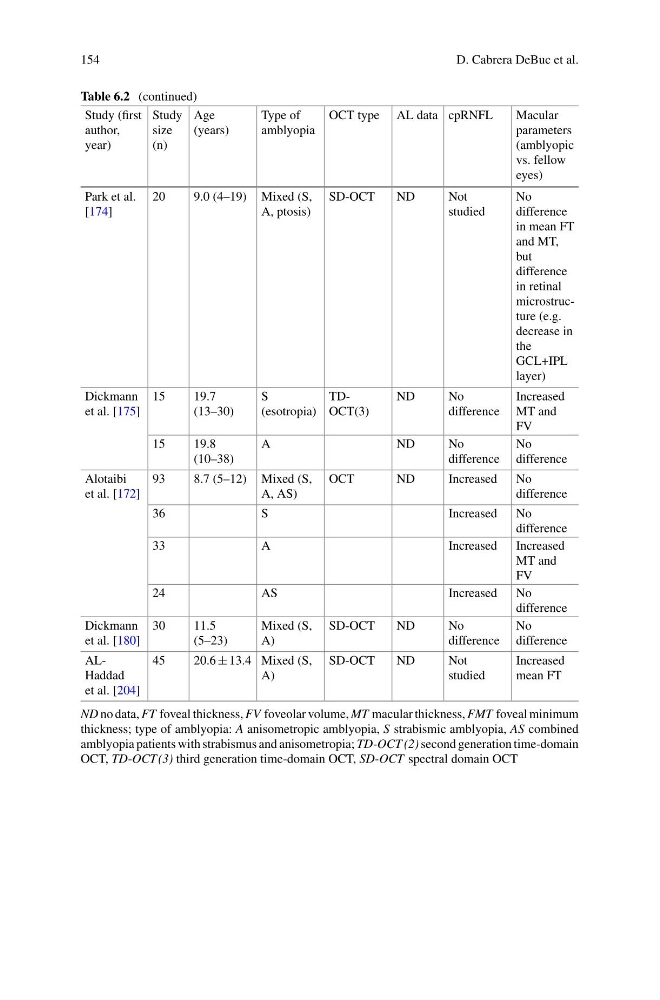
Table 6.2 (continued)
Study (first
author,
year)
Study
size
(n)
Age
(years)
Type of
amblyopia
OCT type AL data cpRNFL
Macular
parameters
(amblyopic
vs. fellow
eyes)
Park et al.
[174]
20
9.0 (4–19) Mixed (S,
A, ptosis)
SD-OCT
ND
Not
studied
No
difference
in mean FT
and MT,
but
difference
in retinal
microstructure (e.g.
decrease in
the
GCL+IPL
layer)
Dickmann
et al. [175]
15
19.7
(13–30)
S
(esotropia)
TDOCT(3)
ND
No
difference
Increased
MT and
FV
15
19.8
(10–38)
A
ND
No
difference
No
difference
Alotaibi
et al. [172]
93
8.7 (5–12) Mixed (S,
A, AS)
OCT
ND
Increased No
difference
36
S
Increased No
difference
33
A
Increased Increased
MT and
FV
24
AS
Increased No
difference
Dickmann
et al. [180]
30
11.5
(5–23)
Mixed (S,
A)
SD-OCT
ND
No
difference
No
difference
ALHaddad
et al. [204]
45
20.6 ± 13.4 Mixed (S,
A)
SD-OCT
ND
Not
studied
Increased
mean FT
ND no data, FT foveal thickness, FV foveolar volume, MT macular thickness, FMT foveal minimum
thickness; type of amblyopia: A anisometropic amblyopia, S strabismic amblyopia, AS combined
amblyopia patients with strabismus and anisometropia; TD-OCT (2) second generation time-domain
OCT, TD-OCT (3) third generation time-domain OCT, SD-OCT spectral domain OCT
D. Cabrera DeBuc et al.
Table 6.2 (continued)
Study (first
author,
year)
Study
size
(n)
Age
(years)
Type of
amblyopia
OCT type AL data cpRNFL
Macular
parameters
(amblyopic
vs. fellow
eyes)
Park et al.
[174]
20
9.0 (4–19) Mixed (S,
A, ptosis)
SD-OCT
ND
Not
studied
No
difference
in mean FT
and MT,
but
difference
in retinal
microstructure (e.g.
decrease in
the
GCL+IPL
layer)
Dickmann
et al. [175]
15
19.7
(13–30)
S
(esotropia)
TDOCT(3)
ND
No
difference
Increased
MT and
FV
15
19.8
(10–38)
A
ND
No
difference
No
difference
Alotaibi
et al. [172]
93
8.7 (5–12) Mixed (S,
A, AS)
OCT
ND
Increased No
difference
36
S
Increased No
difference
33
A
Increased Increased
MT and
FV
24
AS
Increased No
difference
Dickmann
et al. [180]
30
11.5
(5–23)
Mixed (S,
A)
SD-OCT
ND
No
difference
No
difference
ALHaddad
et al. [204]
45
20.6 ± 13.4 Mixed (S,
A)
SD-OCT
ND
Not
studied
Increased
mean FT
ND no data, FT foveal thickness, FV foveolar volume, MT macular thickness, FMT foveal minimum
thickness; type of amblyopia: A anisometropic amblyopia, S strabismic amblyopia, AS combined
amblyopia patients with strabismus and anisometropia; TD-OCT (2) second generation time-domain
OCT, TD-OCT (3) third generation time-domain OCT, SD-OCT spectral domain OCT