

92
L. Fang and S. Li
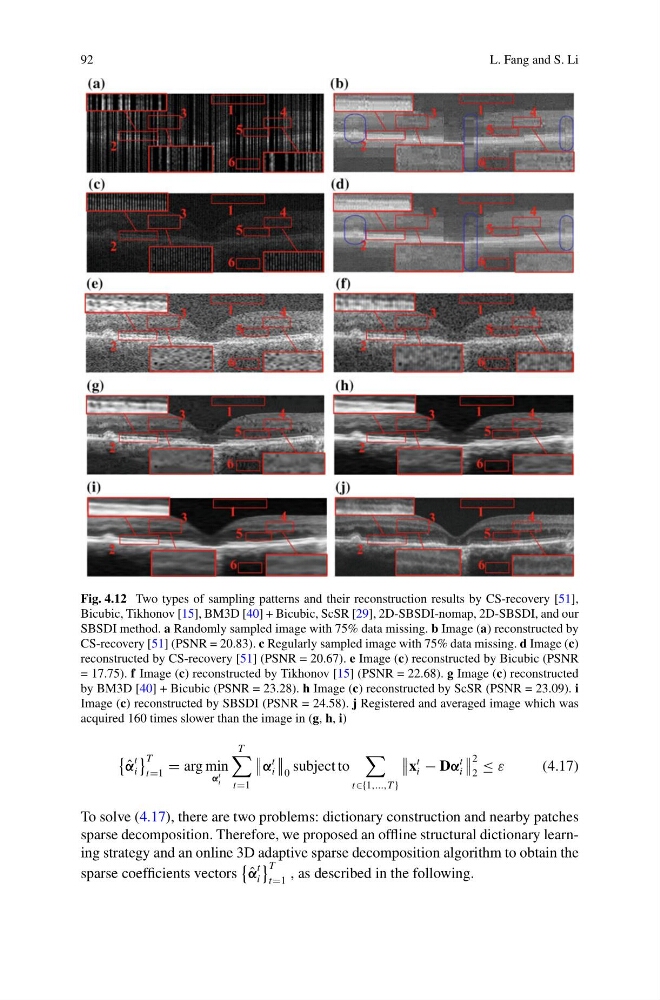
Fig. 4.12 Two types of sampling patterns and their reconstruction results by CS-recovery [51],
Bicubic, Tikhonov [15], BM3D [40] + Bicubic, ScSR [29], 2D-SBSDI-nomap, 2D-SBSDI, and our
SBSDI method. a Randomly sampled image with 75% data missing. b Image (a) reconstructed by
CS-recovery [51] (PSNR = 20.83). c Regularly sampled image with 75% data missing. d Image (c)
reconstructed by CS-recovery [51] (PSNR = 20.67). e Image (c) reconstructed by Bicubic (PSNR
= 17.75). f Image (c) reconstructed by Tikhonov [15] (PSNR = 22.68). g Image (c) reconstructed
by BM3D [40] + Bicubic (PSNR = 23.28). h Image (c) reconstructed by ScSR (PSNR = 23.09). i
Image (c) reconstructed by SBSDI (PSNR = 24.58). j Registered and averaged image which was
acquired 160 times slower than the image in (g, h, i)
ˆ
α
t
i
T
t1
arg min
α
t
i
T
t1
α
t
i
0
subject to
t∈{1,...,T }
x
t
i − Dα
t
i
2
2
≤ ε
(4.17)
To solve (4.17), there are two problems: dictionary construction and nearby patches
sparse decomposition. Therefore, we proposed an offline structural dictionary learning strategy and an online 3D adaptive sparse decomposition algorithm to obtain the
sparse coefficients vectors
ˆ
α
t
i
T
t1
, as described in the following.
L. Fang and S. Li
Fig. 4.12 Two types of sampling patterns and their reconstruction results by CS-recovery [51],
Bicubic, Tikhonov [15], BM3D [40] + Bicubic, ScSR [29], 2D-SBSDI-nomap, 2D-SBSDI, and our
SBSDI method. a Randomly sampled image with 75% data missing. b Image (a) reconstructed by
CS-recovery [51] (PSNR = 20.83). c Regularly sampled image with 75% data missing. d Image (c)
reconstructed by CS-recovery [51] (PSNR = 20.67). e Image (c) reconstructed by Bicubic (PSNR
= 17.75). f Image (c) reconstructed by Tikhonov [15] (PSNR = 22.68). g Image (c) reconstructed
by BM3D [40] + Bicubic (PSNR = 23.28). h Image (c) reconstructed by ScSR (PSNR = 23.09). i
Image (c) reconstructed by SBSDI (PSNR = 24.58). j Registered and averaged image which was
acquired 160 times slower than the image in (g, h, i)
ˆ
α
t
i
T
t1
arg min
α
t
i
T
t1
α
t
i
0
subject to
t∈{1,...,T }
x
t
i − Dα
t
i
2
2
≤ ε
(4.17)
To solve (4.17), there are two problems: dictionary construction and nearby patches
sparse decomposition. Therefore, we proposed an offline structural dictionary learning strategy and an online 3D adaptive sparse decomposition algorithm to obtain the
sparse coefficients vectors
ˆ
α
t
i
T
t1
, as described in the following.