

6.5.3
in the diffusion process. Currents resulting from diffusion are proportional to the gradient
in particle concentration. For electrons and holes, they are given by
Combining Eqs. (6.26a) and (6.26b) leads to the total diffusion current,
The proportionality constants, D n and D p are called the electron and hole diffusion
coefficients, respectively. The diffusion coefficients of electrons and holes are linked with
the mobilities of the corresponding charge carriers by the Einstein relationship that is
given by
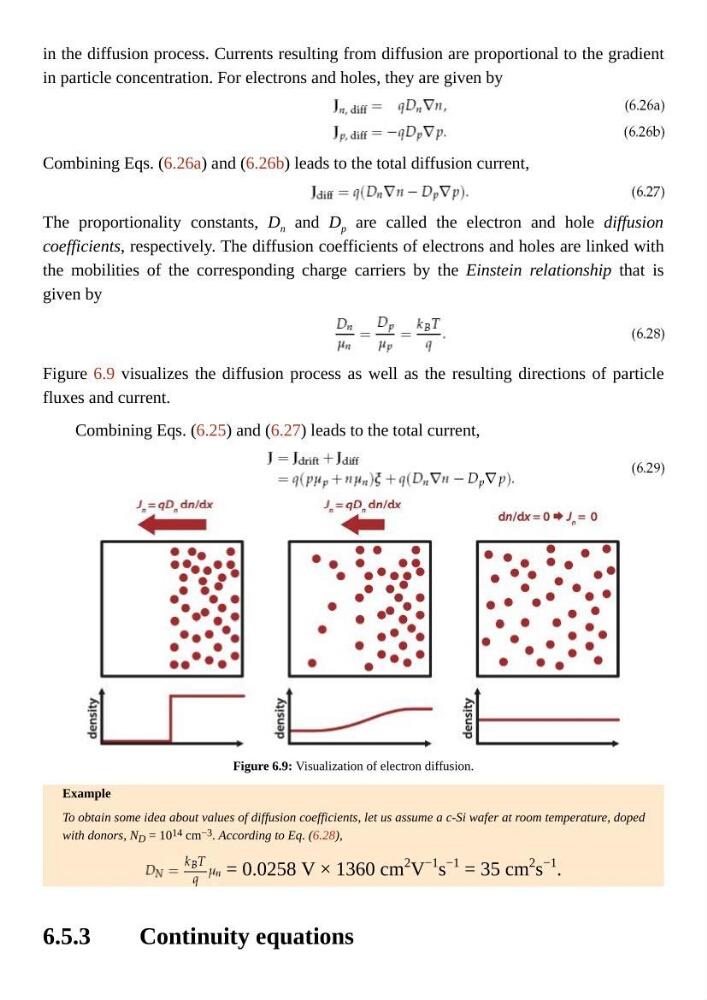
Figure 6.9 visualizes the diffusion process as well as the resulting directions of particle
fluxes and current.
Combining Eqs. (6.25) and (6.27) leads to the total current,
Figure 6.9: Visualization of electron diffusion.
Example
To obtain some idea about values of diffusion coefficients, let us assume a c-Si wafer at room temperature, doped
with donors, N D = 10 14 cm −3 . According to Eq. (6.28),
= 0.0258 V × 1360 cm
2
V
−1
s
−1
= 35 cm
2 s
−1
.
Continuity equations
in the diffusion process. Currents resulting from diffusion are proportional to the gradient
in particle concentration. For electrons and holes, they are given by
Combining Eqs. (6.26a) and (6.26b) leads to the total diffusion current,
The proportionality constants, D n and D p are called the electron and hole diffusion
coefficients, respectively. The diffusion coefficients of electrons and holes are linked with
the mobilities of the corresponding charge carriers by the Einstein relationship that is
given by
Figure 6.9 visualizes the diffusion process as well as the resulting directions of particle
fluxes and current.
Combining Eqs. (6.25) and (6.27) leads to the total current,
Figure 6.9: Visualization of electron diffusion.
Example
To obtain some idea about values of diffusion coefficients, let us assume a c-Si wafer at room temperature, doped
with donors, N D = 10 14 cm −3 . According to Eq. (6.28),
= 0.0258 V × 1360 cm
2
V
−1
s
−1
= 35 cm
2 s
−1
.
Continuity equations