

6.2 Atomic structure
The atomic number of silicon is 14, which means that 14 electrons are orbiting the
nucleus. In ground state configuration, two electrons are in the first shell, both in the 1s
orbital. Further, eight electrons are in the second shell, two in the 2s and six in the 2p
orbitals. Hence, four electrons are in the third shell, which is the outermost shell for a Si
atom. Only these four electrons interact with other atoms, for example via forming
chemical bonds. They are called the valence electrons.
Two Si atoms are bonded together when they share each other’s valence electron.
This is the so-called covalent bond that is formed by two electrons. Since Si atoms have
four valence electrons, they can be covalently bonded to four other Si atoms. In the
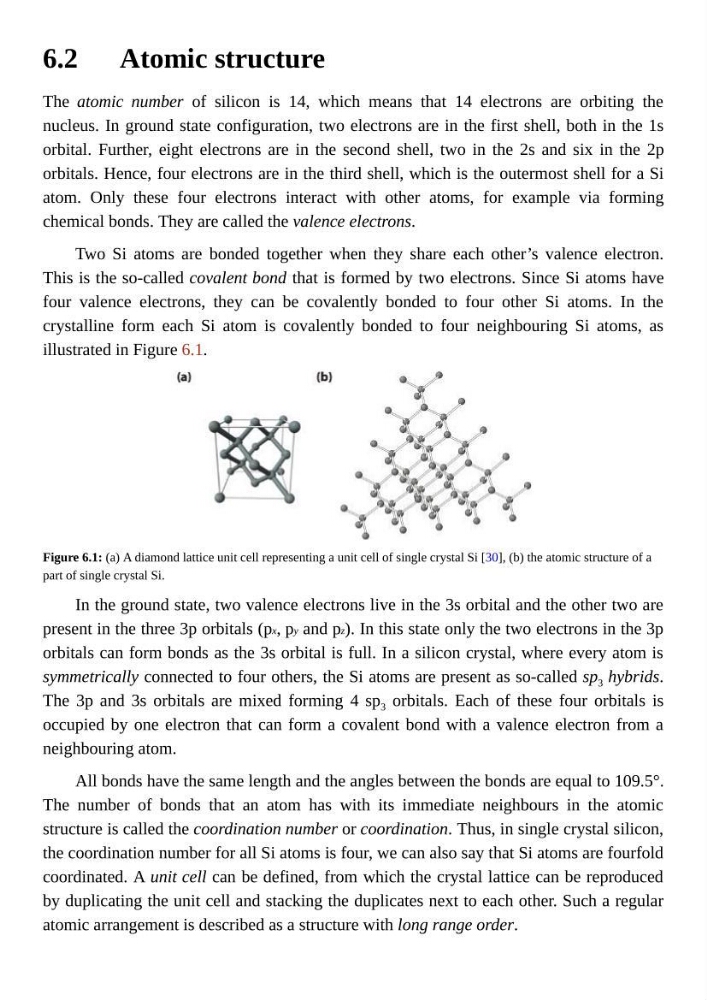
crystalline form each Si atom is covalently bonded to four neighbouring Si atoms, as
illustrated in Figure 6.1.
Figure 6.1: (a) A diamond lattice unit cell representing a unit cell of single crystal Si [30], (b) the atomic structure of a
part of single crystal Si.
In the ground state, two valence electrons live in the 3s orbital and the other two are
present in the three 3p orbitals (px, py and pz). In this state only the two electrons in the 3p
orbitals can form bonds as the 3s orbital is full. In a silicon crystal, where every atom is
symmetrically connected to four others, the Si atoms are present as so-called sp 3 hybrids.
The 3p and 3s orbitals are mixed forming 4 sp 3 orbitals. Each of these four orbitals is
occupied by one electron that can form a covalent bond with a valence electron from a
neighbouring atom.
All bonds have the same length and the angles between the bonds are equal to 109.5°.
The number of bonds that an atom has with its immediate neighbours in the atomic
structure is called the coordination number or coordination. Thus, in single crystal silicon,
the coordination number for all Si atoms is four, we can also say that Si atoms are fourfold
coordinated. A unit cell can be defined, from which the crystal lattice can be reproduced
by duplicating the unit cell and stacking the duplicates next to each other. Such a regular
atomic arrangement is described as a structure with long range order.
The atomic number of silicon is 14, which means that 14 electrons are orbiting the
nucleus. In ground state configuration, two electrons are in the first shell, both in the 1s
orbital. Further, eight electrons are in the second shell, two in the 2s and six in the 2p
orbitals. Hence, four electrons are in the third shell, which is the outermost shell for a Si
atom. Only these four electrons interact with other atoms, for example via forming
chemical bonds. They are called the valence electrons.
Two Si atoms are bonded together when they share each other’s valence electron.
This is the so-called covalent bond that is formed by two electrons. Since Si atoms have
four valence electrons, they can be covalently bonded to four other Si atoms. In the
crystalline form each Si atom is covalently bonded to four neighbouring Si atoms, as
illustrated in Figure 6.1.
Figure 6.1: (a) A diamond lattice unit cell representing a unit cell of single crystal Si [30], (b) the atomic structure of a
part of single crystal Si.
In the ground state, two valence electrons live in the 3s orbital and the other two are
present in the three 3p orbitals (px, py and pz). In this state only the two electrons in the 3p
orbitals can form bonds as the 3s orbital is full. In a silicon crystal, where every atom is
symmetrically connected to four others, the Si atoms are present as so-called sp 3 hybrids.
The 3p and 3s orbitals are mixed forming 4 sp 3 orbitals. Each of these four orbitals is
occupied by one electron that can form a covalent bond with a valence electron from a
neighbouring atom.
All bonds have the same length and the angles between the bonds are equal to 109.5°.
The number of bonds that an atom has with its immediate neighbours in the atomic
structure is called the coordination number or coordination. Thus, in single crystal silicon,
the coordination number for all Si atoms is four, we can also say that Si atoms are fourfold
coordinated. A unit cell can be defined, from which the crystal lattice can be reproduced
by duplicating the unit cell and stacking the duplicates next to each other. Such a regular
atomic arrangement is described as a structure with long range order.