

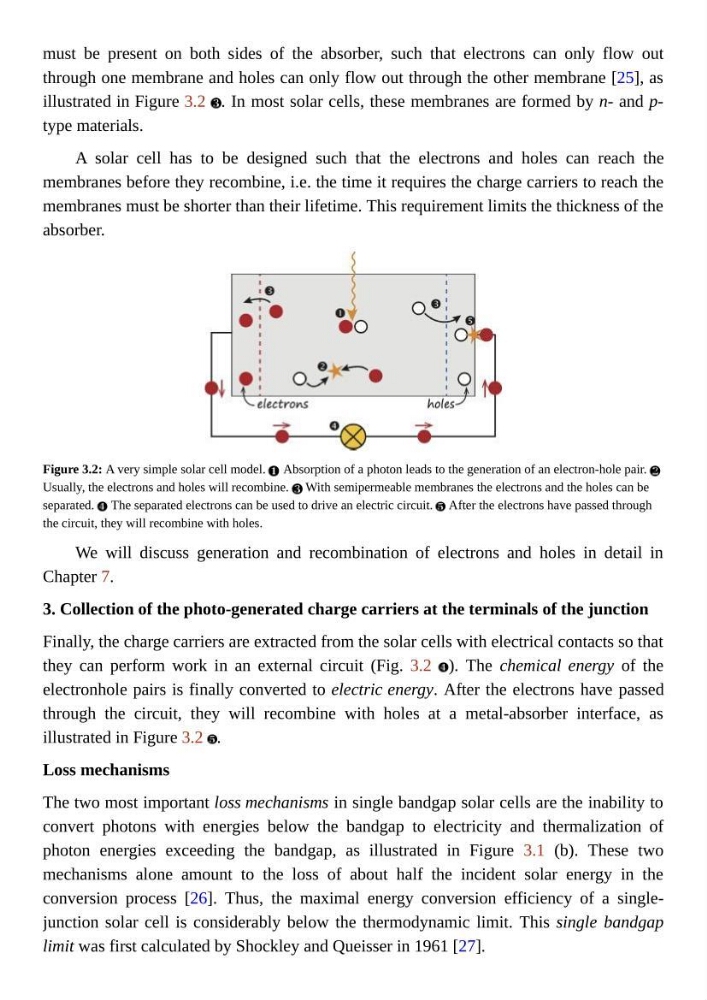
must be present on both sides of the absorber, such that electrons can only flow out
through one membrane and holes can only flow out through the other membrane [25], as
illustrated in Figure 3.2 . In most solar cells, these membranes are formed by n- and ptype materials.
A solar cell has to be designed such that the electrons and holes can reach the
membranes before they recombine, i.e. the time it requires the charge carriers to reach the
membranes must be shorter than their lifetime. This requirement limits the thickness of the
absorber.
Figure 3.2: A very simple solar cell model. Absorption of a photon leads to the generation of an electron-hole pair.
Usually, the electrons and holes will recombine. With semipermeable membranes the electrons and the holes can be
separated. The separated electrons can be used to drive an electric circuit. After the electrons have passed through
the circuit, they will recombine with holes.
We will discuss generation and recombination of electrons and holes in detail in
Chapter 7.
3. Collection of the photo-generated charge carriers at the terminals of the junction
Finally, the charge carriers are extracted from the solar cells with electrical contacts so that
they can perform work in an external circuit (Fig. 3.2 ). The chemical energy of the
electronhole pairs is finally converted to electric energy. After the electrons have passed
through the circuit, they will recombine with holes at a metal-absorber interface, as
illustrated in Figure 3.2 .
Loss mechanisms
The two most important loss mechanisms in single bandgap solar cells are the inability to
convert photons with energies below the bandgap to electricity and thermalization of
photon energies exceeding the bandgap, as illustrated in Figure 3.1 (b). These two
mechanisms alone amount to the loss of about half the incident solar energy in the
conversion process [26]. Thus, the maximal energy conversion efficiency of a singlejunction solar cell is considerably below the thermodynamic limit. This single bandgap
limit was first calculated by Shockley and Queisser in 1961 [27].
through one membrane and holes can only flow out through the other membrane [25], as
illustrated in Figure 3.2 . In most solar cells, these membranes are formed by n- and ptype materials.
A solar cell has to be designed such that the electrons and holes can reach the
membranes before they recombine, i.e. the time it requires the charge carriers to reach the
membranes must be shorter than their lifetime. This requirement limits the thickness of the
absorber.
Figure 3.2: A very simple solar cell model. Absorption of a photon leads to the generation of an electron-hole pair.
Usually, the electrons and holes will recombine. With semipermeable membranes the electrons and the holes can be
separated. The separated electrons can be used to drive an electric circuit. After the electrons have passed through
the circuit, they will recombine with holes.
We will discuss generation and recombination of electrons and holes in detail in
Chapter 7.
3. Collection of the photo-generated charge carriers at the terminals of the junction
Finally, the charge carriers are extracted from the solar cells with electrical contacts so that
they can perform work in an external circuit (Fig. 3.2 ). The chemical energy of the
electronhole pairs is finally converted to electric energy. After the electrons have passed
through the circuit, they will recombine with holes at a metal-absorber interface, as
illustrated in Figure 3.2 .
Loss mechanisms
The two most important loss mechanisms in single bandgap solar cells are the inability to
convert photons with energies below the bandgap to electricity and thermalization of
photon energies exceeding the bandgap, as illustrated in Figure 3.1 (b). These two
mechanisms alone amount to the loss of about half the incident solar energy in the
conversion process [26]. Thus, the maximal energy conversion efficiency of a singlejunction solar cell is considerably below the thermodynamic limit. This single bandgap
limit was first calculated by Shockley and Queisser in 1961 [27].