

is
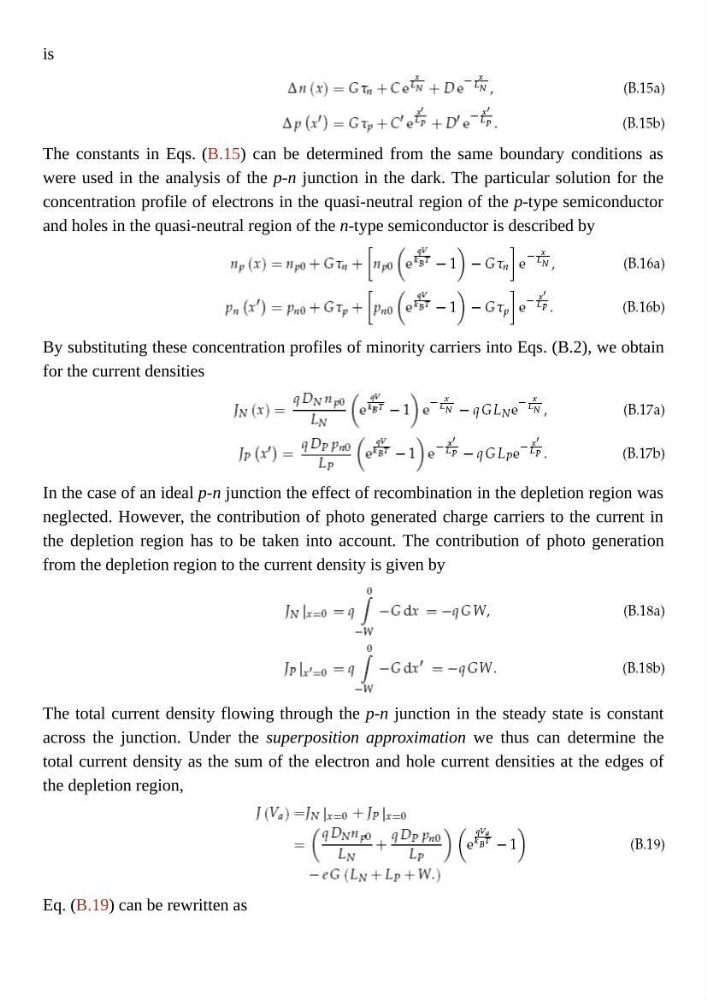
The constants in Eqs. (B.15) can be determined from the same boundary conditions as
were used in the analysis of the p-n junction in the dark. The particular solution for the
concentration profile of electrons in the quasi-neutral region of the p-type semiconductor
and holes in the quasi-neutral region of the n-type semiconductor is described by
By substituting these concentration profiles of minority carriers into Eqs. (B.2), we obtain
for the current densities
In the case of an ideal p-n junction the effect of recombination in the depletion region was
neglected. However, the contribution of photo generated charge carriers to the current in
the depletion region has to be taken into account. The contribution of photo generation
from the depletion region to the current density is given by
The total current density flowing through the p-n junction in the steady state is constant
across the junction. Under the superposition approximation we thus can determine the
total current density as the sum of the electron and hole current densities at the edges of
the depletion region,
Eq. (B.19) can be rewritten as
The constants in Eqs. (B.15) can be determined from the same boundary conditions as
were used in the analysis of the p-n junction in the dark. The particular solution for the
concentration profile of electrons in the quasi-neutral region of the p-type semiconductor
and holes in the quasi-neutral region of the n-type semiconductor is described by
By substituting these concentration profiles of minority carriers into Eqs. (B.2), we obtain
for the current densities
In the case of an ideal p-n junction the effect of recombination in the depletion region was
neglected. However, the contribution of photo generated charge carriers to the current in
the depletion region has to be taken into account. The contribution of photo generation
from the depletion region to the current density is given by
The total current density flowing through the p-n junction in the steady state is constant
across the junction. Under the superposition approximation we thus can determine the
total current density as the sum of the electron and hole current densities at the edges of
the depletion region,
Eq. (B.19) can be rewritten as