

A.3
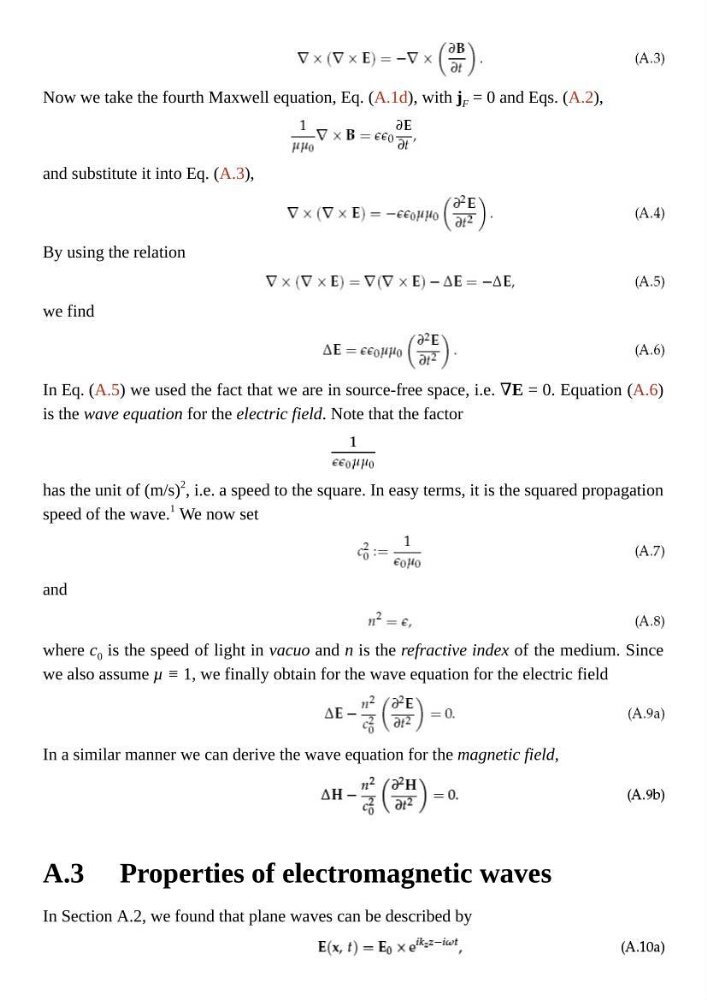
Now we take the fourth Maxwell equation, Eq. (A.1d), with j F = 0 and Eqs. (A.2),
and substitute it into Eq. (A.3),
By using the relation
we find
In Eq. (A.5) we used the fact that we are in source-free space, i.e. ∇E = 0. Equation (A.6)
is the wave equation for the electric field. Note that the factor
has the unit of (m/s)
2
, i.e. a speed to the square. In easy terms, it is the squared propagation
speed of the wave.
1 We now set
and
where c 0 is the speed of light in vacuo and n is the refractive index of the medium. Since
we also assume µ ≡ 1, we finally obtain for the wave equation for the electric field
In a similar manner we can derive the wave equation for the magnetic field,
Properties of electromagnetic waves
In Section A.2, we found that plane waves can be described by
Now we take the fourth Maxwell equation, Eq. (A.1d), with j F = 0 and Eqs. (A.2),
and substitute it into Eq. (A.3),
By using the relation
we find
In Eq. (A.5) we used the fact that we are in source-free space, i.e. ∇E = 0. Equation (A.6)
is the wave equation for the electric field. Note that the factor
has the unit of (m/s)
2
, i.e. a speed to the square. In easy terms, it is the squared propagation
speed of the wave.
1 We now set
and
where c 0 is the speed of light in vacuo and n is the refractive index of the medium. Since
we also assume µ ≡ 1, we finally obtain for the wave equation for the electric field
In a similar manner we can derive the wave equation for the magnetic field,
Properties of electromagnetic waves
In Section A.2, we found that plane waves can be described by