

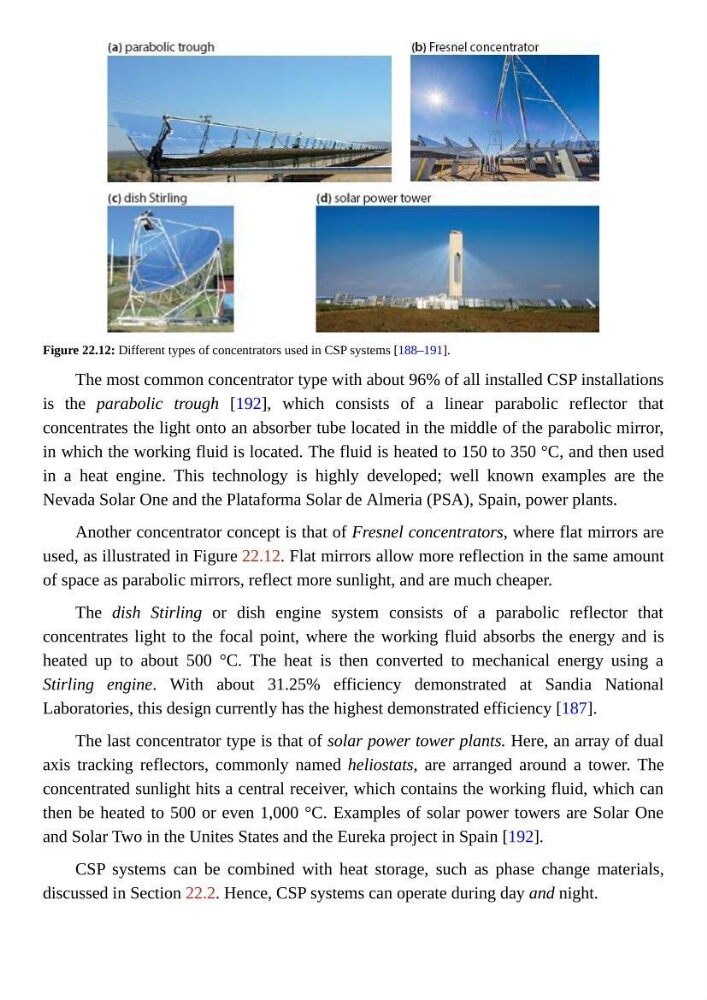
Figure 22.12: Different types of concentrators used in CSP systems [188–191].
The most common concentrator type with about 96% of all installed CSP installations
is the parabolic trough [192], which consists of a linear parabolic reflector that
concentrates the light onto an absorber tube located in the middle of the parabolic mirror,
in which the working fluid is located. The fluid is heated to 150 to 350 °C, and then used
in a heat engine. This technology is highly developed; well known examples are the
Nevada Solar One and the Plataforma Solar de Almeria (PSA), Spain, power plants.
Another concentrator concept is that of Fresnel concentrators, where flat mirrors are
used, as illustrated in Figure 22.12. Flat mirrors allow more reflection in the same amount
of space as parabolic mirrors, reflect more sunlight, and are much cheaper.
The dish Stirling or dish engine system consists of a parabolic reflector that
concentrates light to the focal point, where the working fluid absorbs the energy and is
heated up to about 500 °C. The heat is then converted to mechanical energy using a
Stirling engine. With about 31.25% efficiency demonstrated at Sandia National
Laboratories, this design currently has the highest demonstrated efficiency [187].
The last concentrator type is that of solar power tower plants. Here, an array of dual
axis tracking reflectors, commonly named heliostats, are arranged around a tower. The
concentrated sunlight hits a central receiver, which contains the working fluid, which can
then be heated to 500 or even 1,000 °C. Examples of solar power towers are Solar One
and Solar Two in the Unites States and the Eureka project in Spain [192].
CSP systems can be combined with heat storage, such as phase change materials,
discussed in Section 22.2. Hence, CSP systems can operate during day and night.
The most common concentrator type with about 96% of all installed CSP installations
is the parabolic trough [192], which consists of a linear parabolic reflector that
concentrates the light onto an absorber tube located in the middle of the parabolic mirror,
in which the working fluid is located. The fluid is heated to 150 to 350 °C, and then used
in a heat engine. This technology is highly developed; well known examples are the
Nevada Solar One and the Plataforma Solar de Almeria (PSA), Spain, power plants.
Another concentrator concept is that of Fresnel concentrators, where flat mirrors are
used, as illustrated in Figure 22.12. Flat mirrors allow more reflection in the same amount
of space as parabolic mirrors, reflect more sunlight, and are much cheaper.
The dish Stirling or dish engine system consists of a parabolic reflector that
concentrates light to the focal point, where the working fluid absorbs the energy and is
heated up to about 500 °C. The heat is then converted to mechanical energy using a
Stirling engine. With about 31.25% efficiency demonstrated at Sandia National
Laboratories, this design currently has the highest demonstrated efficiency [187].
The last concentrator type is that of solar power tower plants. Here, an array of dual
axis tracking reflectors, commonly named heliostats, are arranged around a tower. The
concentrated sunlight hits a central receiver, which contains the working fluid, which can
then be heated to 500 or even 1,000 °C. Examples of solar power towers are Solar One
and Solar Two in the Unites States and the Eureka project in Spain [192].
CSP systems can be combined with heat storage, such as phase change materials,
discussed in Section 22.2. Hence, CSP systems can operate during day and night.