

21.1
21.1.1
21
PV system economics and ecology
PV system economics
We conclude our discussions on PV systems by looking at several important topics on the
economics of PV systems. The economics of PV can be discussed at several levels, such
as the consumer level, the manufacturing level, the level of PV installers, and the
technology level where PV is compared to other electricity generation technologies from
an economical point of view.
Payback time
We will start this discussion with the definition of the payback time, which in finance is
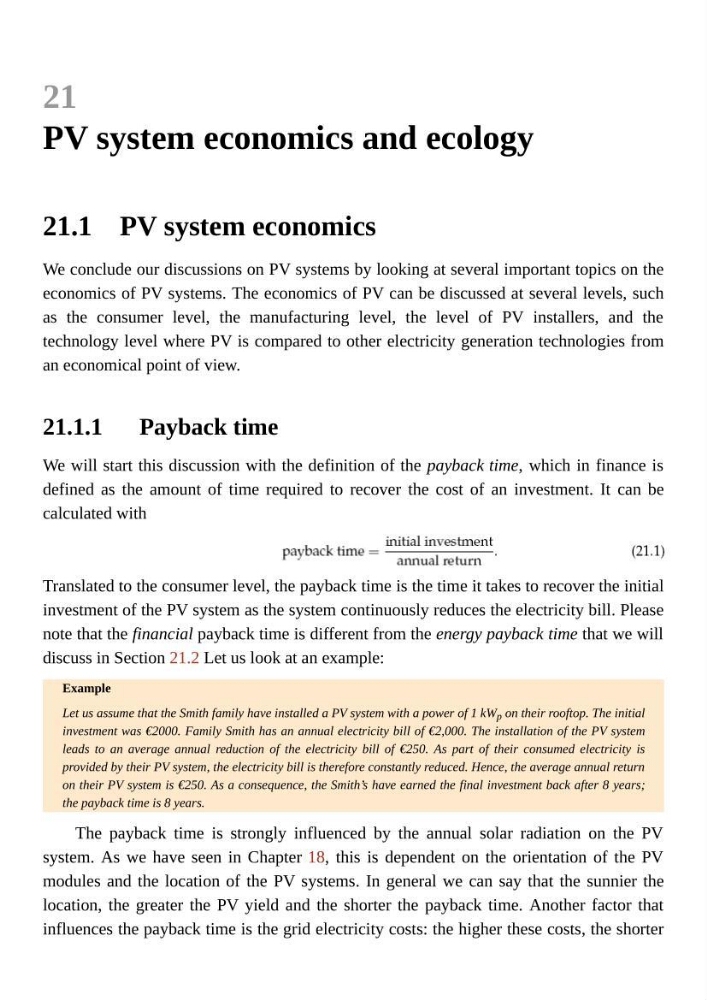
defined as the amount of time required to recover the cost of an investment. It can be
calculated with
Translated to the consumer level, the payback time is the time it takes to recover the initial
investment of the PV system as the system continuously reduces the electricity bill. Please
note that the financial payback time is different from the energy payback time that we will
discuss in Section 21.2 Let us look at an example:
Example
Let us assume that the Smith family have installed a PV system with a power of 1 kW p on their rooftop. The initial
investment was €2000. Family Smith has an annual electricity bill of €2,000. The installation of the PV system
leads to an average annual reduction of the electricity bill of €250. As part of their consumed electricity is
provided by their PV system, the electricity bill is therefore constantly reduced. Hence, the average annual return
on their PV system is €250. As a consequence, the Smith’s have earned the final investment back after 8 years;
the payback time is 8 years.
The payback time is strongly influenced by the annual solar radiation on the PV
system. As we have seen in Chapter 18, this is dependent on the orientation of the PV
modules and the location of the PV systems. In general we can say that the sunnier the
location, the greater the PV yield and the shorter the payback time. Another factor that
influences the payback time is the grid electricity costs: the higher these costs, the shorter
21.1.1
21
PV system economics and ecology
PV system economics
We conclude our discussions on PV systems by looking at several important topics on the
economics of PV systems. The economics of PV can be discussed at several levels, such
as the consumer level, the manufacturing level, the level of PV installers, and the
technology level where PV is compared to other electricity generation technologies from
an economical point of view.
Payback time
We will start this discussion with the definition of the payback time, which in finance is
defined as the amount of time required to recover the cost of an investment. It can be
calculated with
Translated to the consumer level, the payback time is the time it takes to recover the initial
investment of the PV system as the system continuously reduces the electricity bill. Please
note that the financial payback time is different from the energy payback time that we will
discuss in Section 21.2 Let us look at an example:
Example
Let us assume that the Smith family have installed a PV system with a power of 1 kW p on their rooftop. The initial
investment was €2000. Family Smith has an annual electricity bill of €2,000. The installation of the PV system
leads to an average annual reduction of the electricity bill of €250. As part of their consumed electricity is
provided by their PV system, the electricity bill is therefore constantly reduced. Hence, the average annual return
on their PV system is €250. As a consequence, the Smith’s have earned the final investment back after 8 years;
the payback time is 8 years.
The payback time is strongly influenced by the annual solar radiation on the PV
system. As we have seen in Chapter 18, this is dependent on the orientation of the PV
modules and the location of the PV systems. In general we can say that the sunnier the
location, the greater the PV yield and the shorter the payback time. Another factor that
influences the payback time is the grid electricity costs: the higher these costs, the shorter