

1.4
1.1
1.2
1.3
(a)
(b)
(c)
(d)
1.4
(a)
i.
ii.
iii.
(b)
Exercises
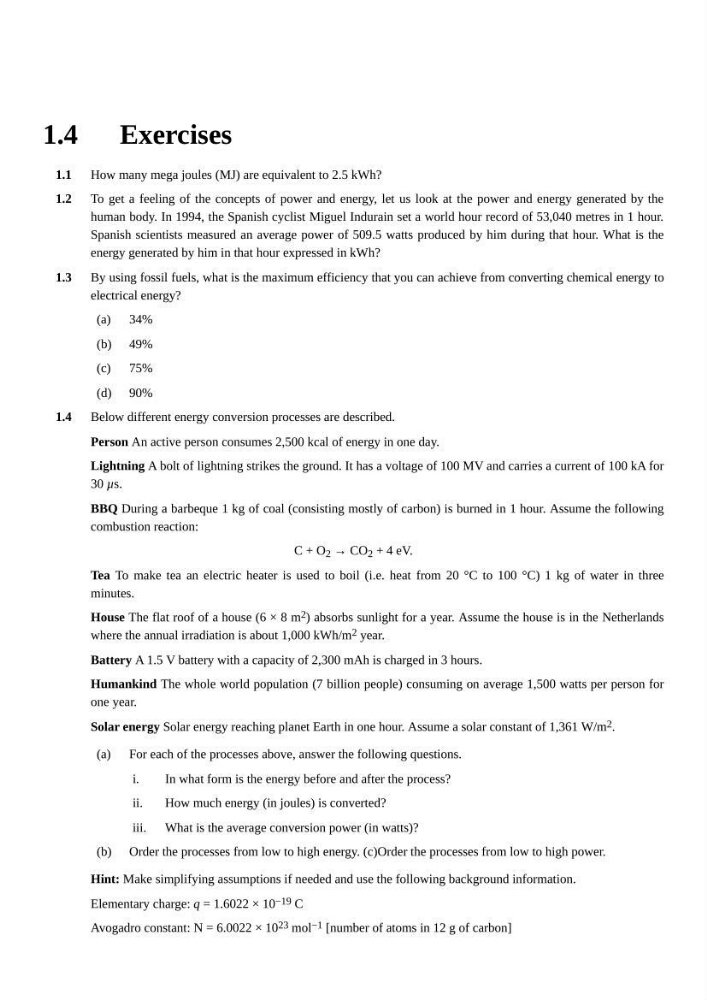
How many mega joules (MJ) are equivalent to 2.5 kWh?
To get a feeling of the concepts of power and energy, let us look at the power and energy generated by the
human body. In 1994, the Spanish cyclist Miguel Indurain set a world hour record of 53,040 metres in 1 hour.
Spanish scientists measured an average power of 509.5 watts produced by him during that hour. What is the
energy generated by him in that hour expressed in kWh?
By using fossil fuels, what is the maximum efficiency that you can achieve from converting chemical energy to
electrical energy?
34%
49%
75%
90%
Below different energy conversion processes are described.
Person An active person consumes 2,500 kcal of energy in one day.
Lightning A bolt of lightning strikes the ground. It has a voltage of 100 MV and carries a current of 100 kA for
30 µs.
BBQ During a barbeque 1 kg of coal (consisting mostly of carbon) is burned in 1 hour. Assume the following
combustion reaction:
C + O 2 → CO 2 + 4 eV.
Tea To make tea an electric heater is used to boil (i.e. heat from 20 °C to 100 °C) 1 kg of water in three
minutes.
House The flat roof of a house (6 × 8 m 2 ) absorbs sunlight for a year. Assume the house is in the Netherlands
where the annual irradiation is about 1,000 kWh/m 2 year.
Battery A 1.5 V battery with a capacity of 2,300 mAh is charged in 3 hours.
Humankind The whole world population (7 billion people) consuming on average 1,500 watts per person for
one year.
Solar energy Solar energy reaching planet Earth in one hour. Assume a solar constant of 1,361 W/m 2 .
For each of the processes above, answer the following questions.
In what form is the energy before and after the process?
How much energy (in joules) is converted?
What is the average conversion power (in watts)?
Order the processes from low to high energy. (c)Order the processes from low to high power.
Hint: Make simplifying assumptions if needed and use the following background information.
Elementary charge: q = 1.6022 × 10 −19 C
Avogadro constant: N = 6.0022 × 10 23 mol −1 [number of atoms in 12 g of carbon]
1.1
1.2
1.3
(a)
(b)
(c)
(d)
1.4
(a)
i.
ii.
iii.
(b)
Exercises
How many mega joules (MJ) are equivalent to 2.5 kWh?
To get a feeling of the concepts of power and energy, let us look at the power and energy generated by the
human body. In 1994, the Spanish cyclist Miguel Indurain set a world hour record of 53,040 metres in 1 hour.
Spanish scientists measured an average power of 509.5 watts produced by him during that hour. What is the
energy generated by him in that hour expressed in kWh?
By using fossil fuels, what is the maximum efficiency that you can achieve from converting chemical energy to
electrical energy?
34%
49%
75%
90%
Below different energy conversion processes are described.
Person An active person consumes 2,500 kcal of energy in one day.
Lightning A bolt of lightning strikes the ground. It has a voltage of 100 MV and carries a current of 100 kA for
30 µs.
BBQ During a barbeque 1 kg of coal (consisting mostly of carbon) is burned in 1 hour. Assume the following
combustion reaction:
C + O 2 → CO 2 + 4 eV.
Tea To make tea an electric heater is used to boil (i.e. heat from 20 °C to 100 °C) 1 kg of water in three
minutes.
House The flat roof of a house (6 × 8 m 2 ) absorbs sunlight for a year. Assume the house is in the Netherlands
where the annual irradiation is about 1,000 kWh/m 2 year.
Battery A 1.5 V battery with a capacity of 2,300 mAh is charged in 3 hours.
Humankind The whole world population (7 billion people) consuming on average 1,500 watts per person for
one year.
Solar energy Solar energy reaching planet Earth in one hour. Assume a solar constant of 1,361 W/m 2 .
For each of the processes above, answer the following questions.
In what form is the energy before and after the process?
How much energy (in joules) is converted?
What is the average conversion power (in watts)?
Order the processes from low to high energy. (c)Order the processes from low to high power.
Hint: Make simplifying assumptions if needed and use the following background information.
Elementary charge: q = 1.6022 × 10 −19 C
Avogadro constant: N = 6.0022 × 10 23 mol −1 [number of atoms in 12 g of carbon]