

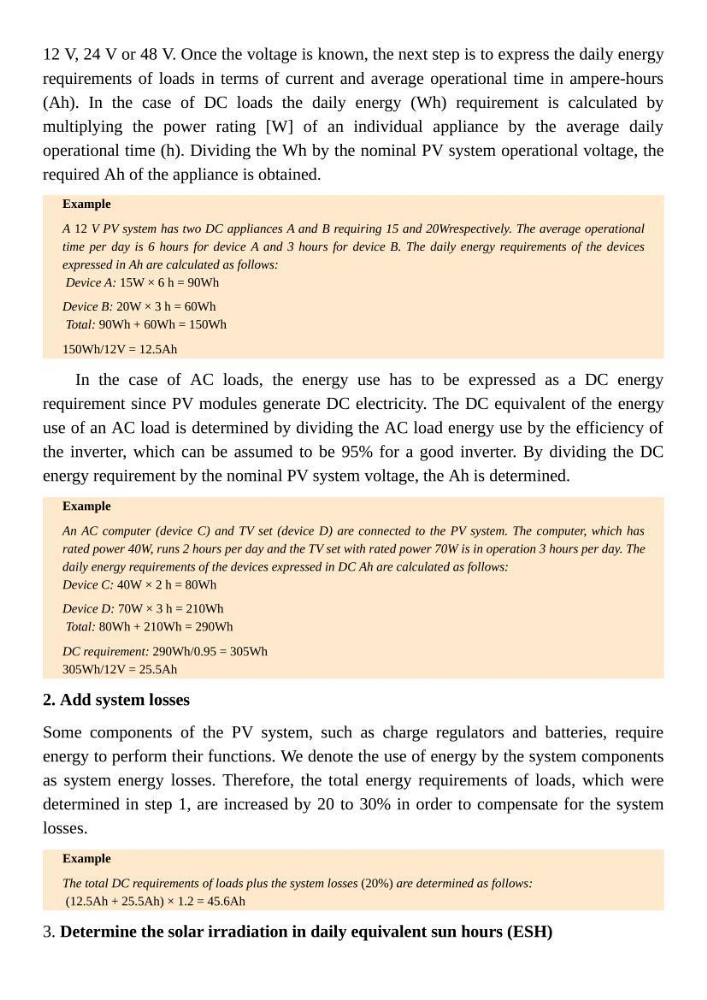
12 V, 24 V or 48 V. Once the voltage is known, the next step is to express the daily energy
requirements of loads in terms of current and average operational time in ampere-hours
(Ah). In the case of DC loads the daily energy (Wh) requirement is calculated by
multiplying the power rating [W] of an individual appliance by the average daily
operational time (h). Dividing the Wh by the nominal PV system operational voltage, the
required Ah of the appliance is obtained.
Example
A 12 V PV system has two DC appliances A and B requiring 15 and 20Wrespectively. The average operational
time per day is 6 hours for device A and 3 hours for device B. The daily energy requirements of the devices
expressed in Ah are calculated as follows:
Device A: 15W × 6 h = 90Wh
Device B: 20W × 3 h = 60Wh
Total: 90Wh + 60Wh = 150Wh
150Wh/12V = 12.5Ah
In the case of AC loads, the energy use has to be expressed as a DC energy
requirement since PV modules generate DC electricity. The DC equivalent of the energy
use of an AC load is determined by dividing the AC load energy use by the efficiency of
the inverter, which can be assumed to be 95% for a good inverter. By dividing the DC
energy requirement by the nominal PV system voltage, the Ah is determined.
Example
An AC computer (device C) and TV set (device D) are connected to the PV system. The computer, which has
rated power 40W, runs 2 hours per day and the TV set with rated power 70W is in operation 3 hours per day. The
daily energy requirements of the devices expressed in DC Ah are calculated as follows:
Device C: 40W × 2 h = 80Wh
Device D: 70W × 3 h = 210Wh
Total: 80Wh + 210Wh = 290Wh
DC requirement: 290Wh/0.95 = 305Wh
305Wh/12V = 25.5Ah
2. Add system losses
Some components of the PV system, such as charge regulators and batteries, require
energy to perform their functions. We denote the use of energy by the system components
as system energy losses. Therefore, the total energy requirements of loads, which were
determined in step 1, are increased by 20 to 30% in order to compensate for the system
losses.
Example
The total DC requirements of loads plus the system losses (20%) are determined as follows:
(12.5Ah + 25.5Ah) × 1.2 = 45.6Ah
3. Determine the solar irradiation in daily equivalent sun hours (ESH)
requirements of loads in terms of current and average operational time in ampere-hours
(Ah). In the case of DC loads the daily energy (Wh) requirement is calculated by
multiplying the power rating [W] of an individual appliance by the average daily
operational time (h). Dividing the Wh by the nominal PV system operational voltage, the
required Ah of the appliance is obtained.
Example
A 12 V PV system has two DC appliances A and B requiring 15 and 20Wrespectively. The average operational
time per day is 6 hours for device A and 3 hours for device B. The daily energy requirements of the devices
expressed in Ah are calculated as follows:
Device A: 15W × 6 h = 90Wh
Device B: 20W × 3 h = 60Wh
Total: 90Wh + 60Wh = 150Wh
150Wh/12V = 12.5Ah
In the case of AC loads, the energy use has to be expressed as a DC energy
requirement since PV modules generate DC electricity. The DC equivalent of the energy
use of an AC load is determined by dividing the AC load energy use by the efficiency of
the inverter, which can be assumed to be 95% for a good inverter. By dividing the DC
energy requirement by the nominal PV system voltage, the Ah is determined.
Example
An AC computer (device C) and TV set (device D) are connected to the PV system. The computer, which has
rated power 40W, runs 2 hours per day and the TV set with rated power 70W is in operation 3 hours per day. The
daily energy requirements of the devices expressed in DC Ah are calculated as follows:
Device C: 40W × 2 h = 80Wh
Device D: 70W × 3 h = 210Wh
Total: 80Wh + 210Wh = 290Wh
DC requirement: 290Wh/0.95 = 305Wh
305Wh/12V = 25.5Ah
2. Add system losses
Some components of the PV system, such as charge regulators and batteries, require
energy to perform their functions. We denote the use of energy by the system components
as system energy losses. Therefore, the total energy requirements of loads, which were
determined in step 1, are increased by 20 to 30% in order to compensate for the system
losses.
Example
The total DC requirements of loads plus the system losses (20%) are determined as follows:
(12.5Ah + 25.5Ah) × 1.2 = 45.6Ah
3. Determine the solar irradiation in daily equivalent sun hours (ESH)