

19.4 Charge controllers
After having discussed different types of batteries and different battery characteristics, it is
now time to discuss charge controllers, which are used in PV systems that use batteries.
As we have seen above, it is very important to charge and discharge batteries at the right
voltage and current levels in order to ensure a long battery lifetime. A battery is an
electrochemical device that requires a small over potential to be charged. However,
batteries have strict voltage limits, which are necessary for their optimal functioning.
Further more, the amount of current sent to the battery by the PV array and the current
flowing through the battery while being discharged have to be within well defined limits
for proper functioning of the battery. We have seen before that lead-acid batteries suffer
from both overcharge and over discharge. On the other hand, the PV array responds
dynamically to ambient conditions like irradiance, temperature and other factors such as
shading. Thus, directly coupling the battery to the PV array and the loads is detrimental to
the battery lifetime.
Therefore a device is needed that controls the currents flowing between the battery,
the PV array and the load that ensures that the electrical parameters present at the battery
are kept within the specifications given by the battery manufacturer. These tasks are done
by a charge controller, which has several different functionalities, depending on the
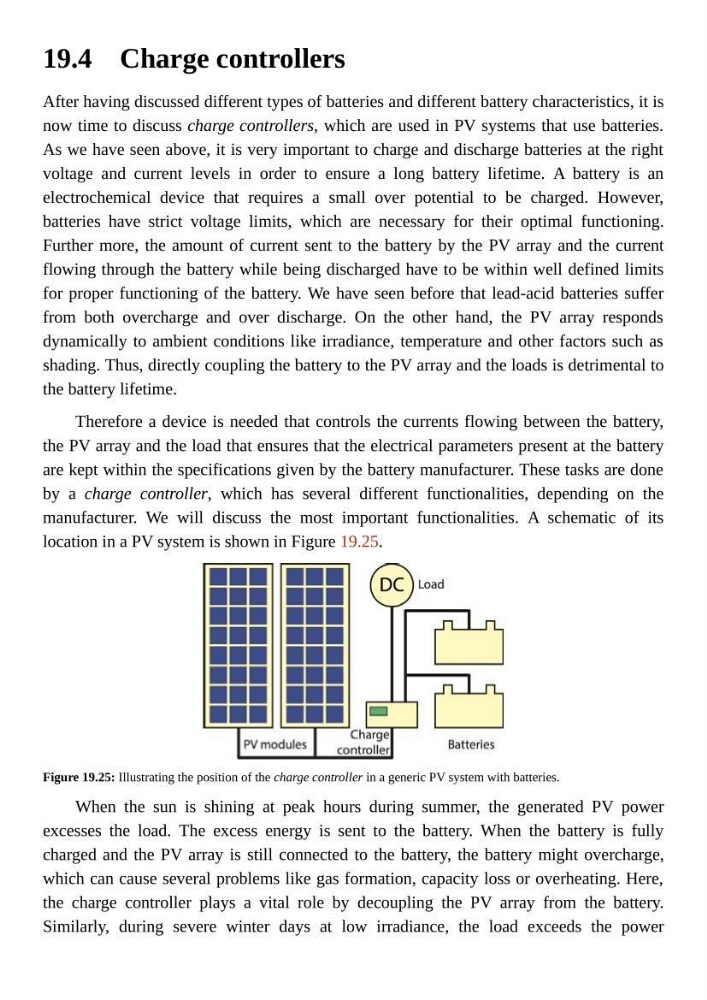
manufacturer. We will discuss the most important functionalities. A schematic of its
location in a PV system is shown in Figure 19.25.
Figure 19.25: Illustrating the position of the charge controller in a generic PV system with batteries.
When the sun is shining at peak hours during summer, the generated PV power
excesses the load. The excess energy is sent to the battery. When the battery is fully
charged and the PV array is still connected to the battery, the battery might overcharge,
which can cause several problems like gas formation, capacity loss or overheating. Here,
the charge controller plays a vital role by decoupling the PV array from the battery.
Similarly, during severe winter days at low irradiance, the load exceeds the power
After having discussed different types of batteries and different battery characteristics, it is
now time to discuss charge controllers, which are used in PV systems that use batteries.
As we have seen above, it is very important to charge and discharge batteries at the right
voltage and current levels in order to ensure a long battery lifetime. A battery is an
electrochemical device that requires a small over potential to be charged. However,
batteries have strict voltage limits, which are necessary for their optimal functioning.
Further more, the amount of current sent to the battery by the PV array and the current
flowing through the battery while being discharged have to be within well defined limits
for proper functioning of the battery. We have seen before that lead-acid batteries suffer
from both overcharge and over discharge. On the other hand, the PV array responds
dynamically to ambient conditions like irradiance, temperature and other factors such as
shading. Thus, directly coupling the battery to the PV array and the loads is detrimental to
the battery lifetime.
Therefore a device is needed that controls the currents flowing between the battery,
the PV array and the load that ensures that the electrical parameters present at the battery
are kept within the specifications given by the battery manufacturer. These tasks are done
by a charge controller, which has several different functionalities, depending on the
manufacturer. We will discuss the most important functionalities. A schematic of its
location in a PV system is shown in Figure 19.25.
Figure 19.25: Illustrating the position of the charge controller in a generic PV system with batteries.
When the sun is shining at peak hours during summer, the generated PV power
excesses the load. The excess energy is sent to the battery. When the battery is fully
charged and the PV array is still connected to the battery, the battery might overcharge,
which can cause several problems like gas formation, capacity loss or overheating. Here,
the charge controller plays a vital role by decoupling the PV array from the battery.
Similarly, during severe winter days at low irradiance, the load exceeds the power