

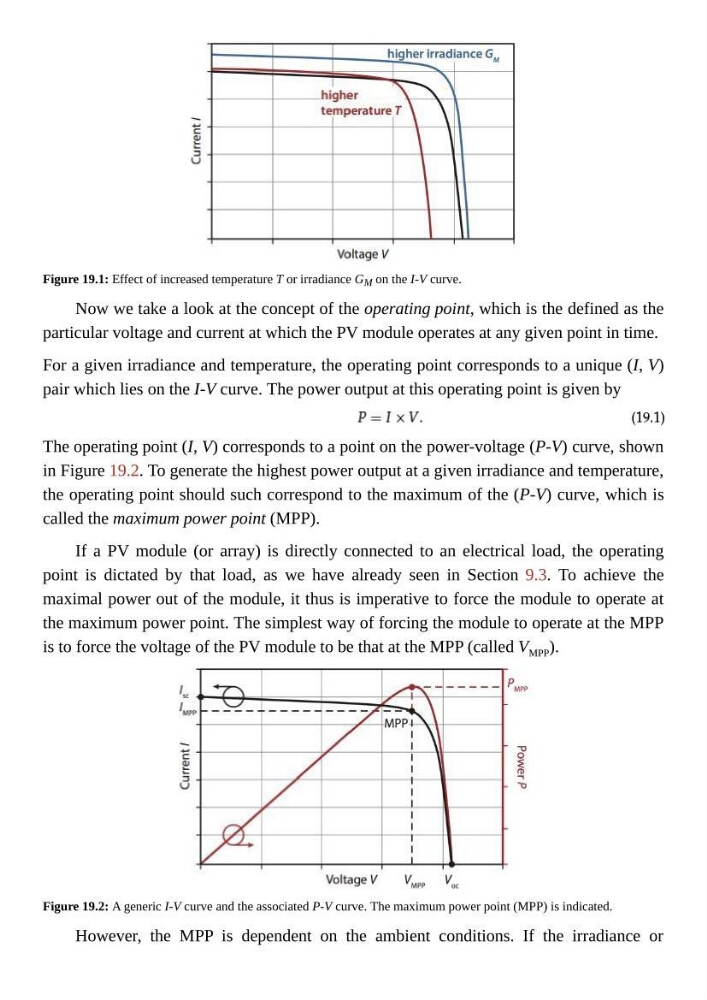
Figure 19.1: Effect of increased temperature T or irradiance G M on the I-V curve.
Now we take a look at the concept of the operating point, which is the defined as the
particular voltage and current at which the PV module operates at any given point in time.
For a given irradiance and temperature, the operating point corresponds to a unique (I, V)
pair which lies on the I-V curve. The power output at this operating point is given by
The operating point (I, V) corresponds to a point on the power-voltage (P-V) curve, shown
in Figure 19.2. To generate the highest power output at a given irradiance and temperature,
the operating point should such correspond to the maximum of the (P-V) curve, which is
called the maximum power point (MPP).
If a PV module (or array) is directly connected to an electrical load, the operating
point is dictated by that load, as we have already seen in Section 9.3. To achieve the
maximal power out of the module, it thus is imperative to force the module to operate at
the maximum power point. The simplest way of forcing the module to operate at the MPP
is to force the voltage of the PV module to be that at the MPP (called V MPP ).
Figure 19.2: A generic I-V curve and the associated P-V curve. The maximum power point (MPP) is indicated.
However, the MPP is dependent on the ambient conditions. If the irradiance or
Now we take a look at the concept of the operating point, which is the defined as the
particular voltage and current at which the PV module operates at any given point in time.
For a given irradiance and temperature, the operating point corresponds to a unique (I, V)
pair which lies on the I-V curve. The power output at this operating point is given by
The operating point (I, V) corresponds to a point on the power-voltage (P-V) curve, shown
in Figure 19.2. To generate the highest power output at a given irradiance and temperature,
the operating point should such correspond to the maximum of the (P-V) curve, which is
called the maximum power point (MPP).
If a PV module (or array) is directly connected to an electrical load, the operating
point is dictated by that load, as we have already seen in Section 9.3. To achieve the
maximal power out of the module, it thus is imperative to force the module to operate at
the maximum power point. The simplest way of forcing the module to operate at the MPP
is to force the voltage of the PV module to be that at the MPP (called V MPP ).
Figure 19.2: A generic I-V curve and the associated P-V curve. The maximum power point (MPP) is indicated.
However, the MPP is dependent on the ambient conditions. If the irradiance or