

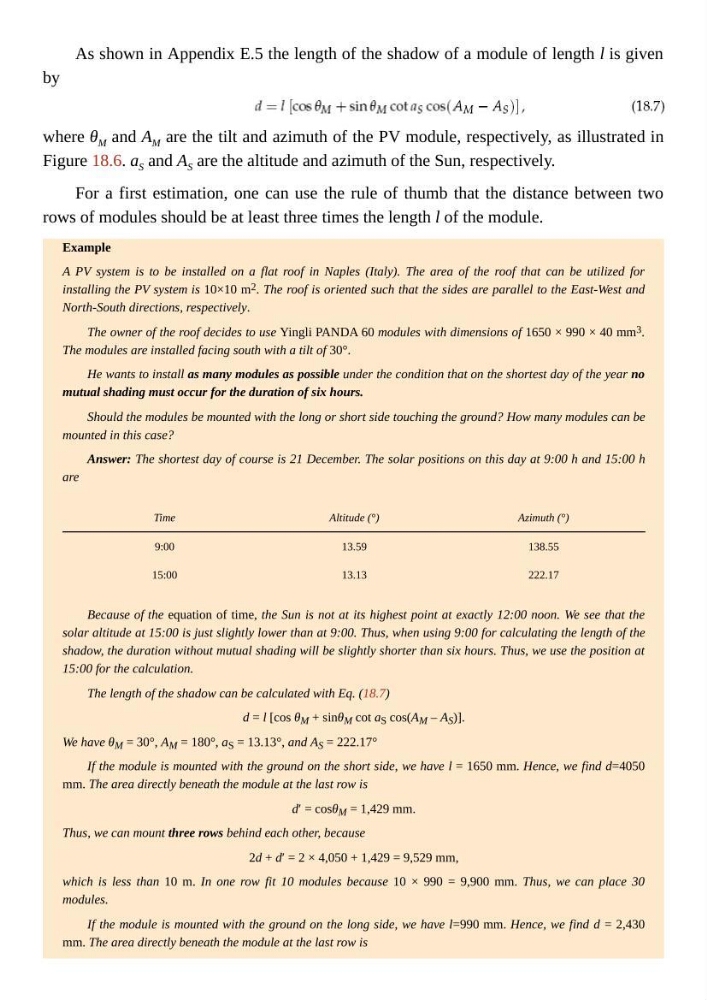
As shown in Appendix E.5 the length of the shadow of a module of length l is given
by
where θ M and A M are the tilt and azimuth of the PV module, respectively, as illustrated in
Figure 18.6. a S and A S are the altitude and azimuth of the Sun, respectively.
For a first estimation, one can use the rule of thumb that the distance between two
rows of modules should be at least three times the length l of the module.
Example
A PV system is to be installed on a flat roof in Naples (Italy). The area of the roof that can be utilized for
installing the PV system is 10×10 m 2 . The roof is oriented such that the sides are parallel to the East-West and
North-South directions, respectively.
The owner of the roof decides to use Yingli PANDA 60 modules with dimensions of 1650 × 990 × 40 mm 3 .
The modules are installed facing south with a tilt of 30°.
He wants to install as many modules as possible under the condition that on the shortest day of the year no
mutual shading must occur for the duration of six hours.
Should the modules be mounted with the long or short side touching the ground? How many modules can be
mounted in this case?
Answer: The shortest day of course is 21 December. The solar positions on this day at 9:00 h and 15:00 h
are
Time
Altitude (°)
Azimuth (°)
9:00
13.59
138.55
15:00
13.13
222.17
Because of the equation of time, the Sun is not at its highest point at exactly 12:00 noon. We see that the
solar altitude at 15:00 is just slightly lower than at 9:00. Thus, when using 9:00 for calculating the length of the
shadow, the duration without mutual shading will be slightly shorter than six hours. Thus, we use the position at
15:00 for the calculation.
The length of the shadow can be calculated with Eq. (18.7)
d = l [cos θ M + sinθ M cot a S cos(A M – A S )].
We have θ M = 30°, A M = 180°, a S = 13.13°, and A S = 222.17°
If the module is mounted with the ground on the short side, we have l = 1650 mm. Hence, we find d=4050
mm. The area directly beneath the module at the last row is
d′ = cosθ M = 1,429 mm.
Thus, we can mount three rows behind each other, because
2d + d′ = 2 × 4,050 + 1,429 = 9,529 mm,
which is less than 10 m. In one row fit 10 modules because 10 × 990 = 9,900 mm. Thus, we can place 30
modules.
If the module is mounted with the ground on the long side, we have l=990 mm. Hence, we find d = 2,430
mm. The area directly beneath the module at the last row is
by
where θ M and A M are the tilt and azimuth of the PV module, respectively, as illustrated in
Figure 18.6. a S and A S are the altitude and azimuth of the Sun, respectively.
For a first estimation, one can use the rule of thumb that the distance between two
rows of modules should be at least three times the length l of the module.
Example
A PV system is to be installed on a flat roof in Naples (Italy). The area of the roof that can be utilized for
installing the PV system is 10×10 m 2 . The roof is oriented such that the sides are parallel to the East-West and
North-South directions, respectively.
The owner of the roof decides to use Yingli PANDA 60 modules with dimensions of 1650 × 990 × 40 mm 3 .
The modules are installed facing south with a tilt of 30°.
He wants to install as many modules as possible under the condition that on the shortest day of the year no
mutual shading must occur for the duration of six hours.
Should the modules be mounted with the long or short side touching the ground? How many modules can be
mounted in this case?
Answer: The shortest day of course is 21 December. The solar positions on this day at 9:00 h and 15:00 h
are
Time
Altitude (°)
Azimuth (°)
9:00
13.59
138.55
15:00
13.13
222.17
Because of the equation of time, the Sun is not at its highest point at exactly 12:00 noon. We see that the
solar altitude at 15:00 is just slightly lower than at 9:00. Thus, when using 9:00 for calculating the length of the
shadow, the duration without mutual shading will be slightly shorter than six hours. Thus, we use the position at
15:00 for the calculation.
The length of the shadow can be calculated with Eq. (18.7)
d = l [cos θ M + sinθ M cot a S cos(A M – A S )].
We have θ M = 30°, A M = 180°, a S = 13.13°, and A S = 222.17°
If the module is mounted with the ground on the short side, we have l = 1650 mm. Hence, we find d=4050
mm. The area directly beneath the module at the last row is
d′ = cosθ M = 1,429 mm.
Thus, we can mount three rows behind each other, because
2d + d′ = 2 × 4,050 + 1,429 = 9,529 mm,
which is less than 10 m. In one row fit 10 modules because 10 × 990 = 9,900 mm. Thus, we can place 30
modules.
If the module is mounted with the ground on the long side, we have l=990 mm. Hence, we find d = 2,430
mm. The area directly beneath the module at the last row is