

18.2
18.2.1
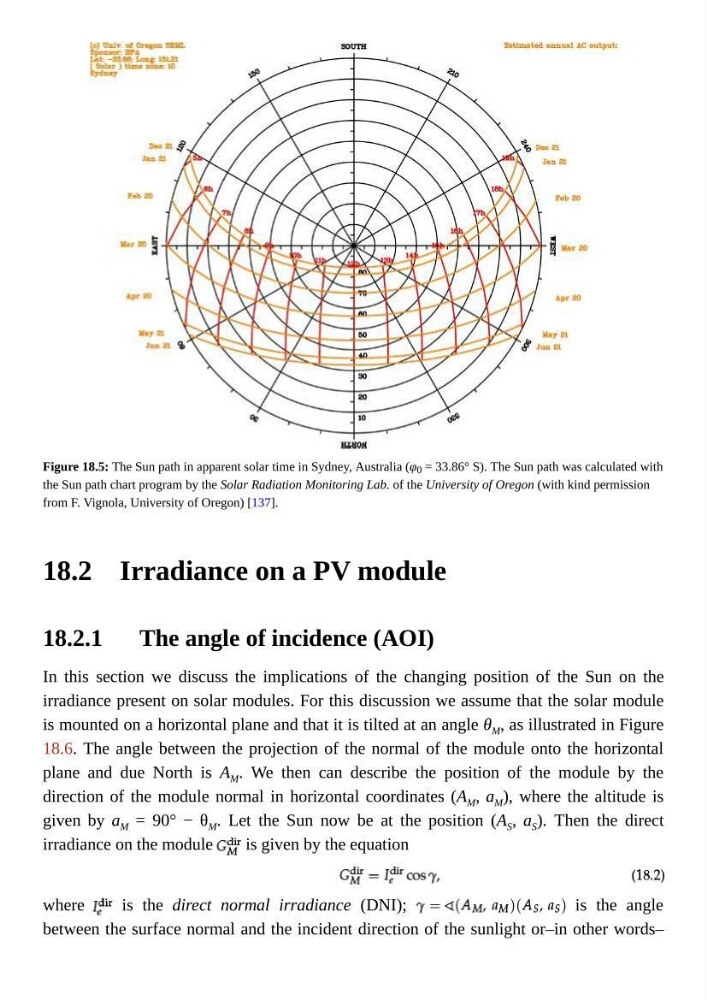
Figure 18.5: The Sun path in apparent solar time in Sydney, Australia (φ 0 = 33.86° S). The Sun path was calculated with
the Sun path chart program by the Solar Radiation Monitoring Lab. of the University of Oregon (with kind permission
from F. Vignola, University of Oregon) [137].
Irradiance on a PV module
The angle of incidence (AOI)
In this section we discuss the implications of the changing position of the Sun on the
irradiance present on solar modules. For this discussion we assume that the solar module
is mounted on a horizontal plane and that it is tilted at an angle θ M , as illustrated in Figure
18.6. The angle between the projection of the normal of the module onto the horizontal
plane and due North is A M . We then can describe the position of the module by the
direction of the module normal in horizontal coordinates (A M , a M ), where the altitude is
given by a M = 90° − θ M . Let the Sun now be at the position (A S , a S ). Then the direct
irradiance on the module is given by the equation
where is the direct normal irradiance (DNI);
is the angle
between the surface normal and the incident direction of the sunlight or–in other words–
18.2.1
Figure 18.5: The Sun path in apparent solar time in Sydney, Australia (φ 0 = 33.86° S). The Sun path was calculated with
the Sun path chart program by the Solar Radiation Monitoring Lab. of the University of Oregon (with kind permission
from F. Vignola, University of Oregon) [137].
Irradiance on a PV module
The angle of incidence (AOI)
In this section we discuss the implications of the changing position of the Sun on the
irradiance present on solar modules. For this discussion we assume that the solar module
is mounted on a horizontal plane and that it is tilted at an angle θ M , as illustrated in Figure
18.6. The angle between the projection of the normal of the module onto the horizontal
plane and due North is A M . We then can describe the position of the module by the
direction of the module normal in horizontal coordinates (A M , a M ), where the altitude is
given by a M = 90° − θ M . Let the Sun now be at the position (A S , a S ). Then the direct
irradiance on the module is given by the equation
where is the direct normal irradiance (DNI);
is the angle
between the surface normal and the incident direction of the sunlight or–in other words–