

16.5
as for example summarized in [132]. In such solar cells, a layer with the intermediate
states is placed in-between p and n layers. For example quantum dots can be used to
realize the intermediate states. Further, various bulk materials have been studied for
realizing the intermediate states. One major problem of experimental IB cells is that the
voltages are lower than those of reference cells without IB structures.
Figure 16.7: Band diagram with (a) the intermediate band depicted; and (b) the quasi-Fermi levels exceeding the energy
of the low energy photons.
Hot carrier solar cells
The idea of hot carrier solar cells is to reduce the energy losses due to relaxation and
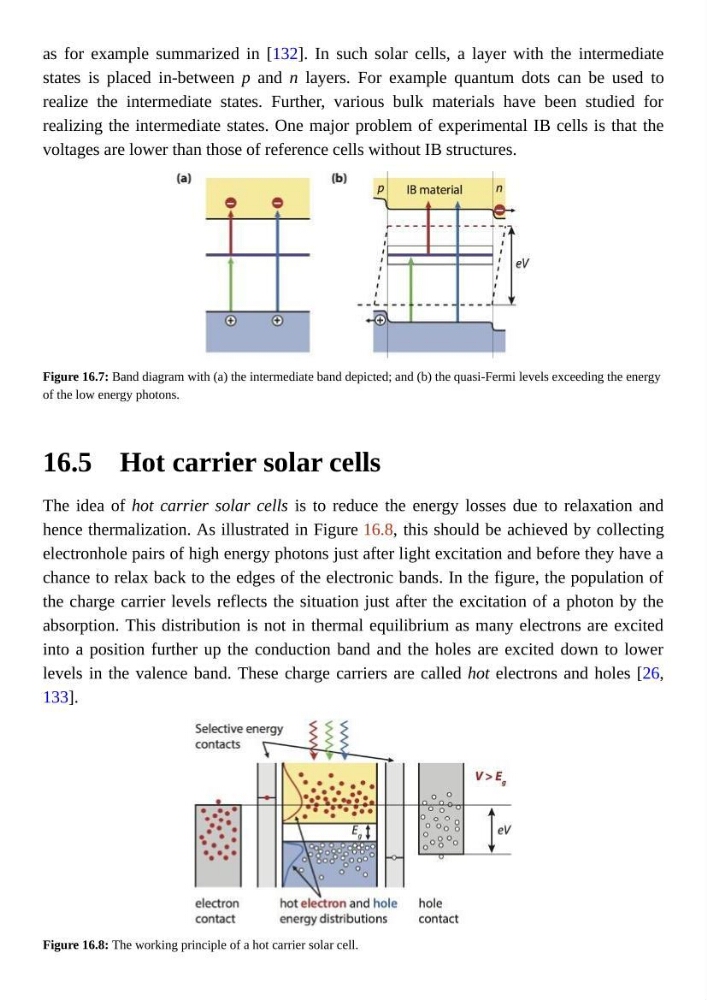
hence thermalization. As illustrated in Figure 16.8, this should be achieved by collecting
electronhole pairs of high energy photons just after light excitation and before they have a
chance to relax back to the edges of the electronic bands. In the figure, the population of
the charge carrier levels reflects the situation just after the excitation of a photon by the
absorption. This distribution is not in thermal equilibrium as many electrons are excited
into a position further up the conduction band and the holes are excited down to lower
levels in the valence band. These charge carriers are called hot electrons and holes [26,
133].
Figure 16.8: The working principle of a hot carrier solar cell.
as for example summarized in [132]. In such solar cells, a layer with the intermediate
states is placed in-between p and n layers. For example quantum dots can be used to
realize the intermediate states. Further, various bulk materials have been studied for
realizing the intermediate states. One major problem of experimental IB cells is that the
voltages are lower than those of reference cells without IB structures.
Figure 16.7: Band diagram with (a) the intermediate band depicted; and (b) the quasi-Fermi levels exceeding the energy
of the low energy photons.
Hot carrier solar cells
The idea of hot carrier solar cells is to reduce the energy losses due to relaxation and
hence thermalization. As illustrated in Figure 16.8, this should be achieved by collecting
electronhole pairs of high energy photons just after light excitation and before they have a
chance to relax back to the edges of the electronic bands. In the figure, the population of
the charge carrier levels reflects the situation just after the excitation of a photon by the
absorption. This distribution is not in thermal equilibrium as many electrons are excited
into a position further up the conduction band and the holes are excited down to lower
levels in the valence band. These charge carriers are called hot electrons and holes [26,
133].
Figure 16.8: The working principle of a hot carrier solar cell.