

Further, the human brain consumes a lot of energy. All of this energy has to be supplied to
the body from the outside in the form of food. An average body of a human adult male
requires about 10,000 kJ every day.
2
We can easily show that this consumption
corresponds to an average power of the human body of 115.7W. We will come back to this
value later.
In modern society, humans not only require energy to keep their body running but in
fact consume energy for many different purposes. We use energy for heating the water in
our houses and for heating our houses. If water is heated, its thermal energy increases, and
this energy must be supplied from the outside. Further, we use a lot of energy for
transportation of people and products, by cars, trains, trucks and planes. We use energy to
produce our goods and also to produce food. At the moment, you are consuming energy
when you are reading this book on a computer or tablet. But also if you are reading it in a
printed version, you implicitly consume the energy that was required to print it and to
transport it to your place.
As mentioned above, energy is never produced but always converted from one form
to another. The form of energy may change in time, but the total amount does not change.
If we want to utilize energy to work for us, we usually convert it from one form to another
more useable form. An example is the electric motor, in which we convert electrical
energy to mechanical energy.
To measure the amount of energy humankind consumes, we refer to two concepts:
first, primary energy, which ‘is the energy embodied in natural resources prior to
undergoing any human-made conversions or transformations. Examples of primary energy
resources include coal, crude oil, sunlight, wind, running rivers, vegetation
3
, and uranium
[2]. Humans do not directly use carriers of primary energy, but converted forms of energy,
which are called secondary energy or final energy. Examples of secondary energy carriers
are electricity, refined fuels such as gasoline or diesel, and heat which is transported to
consumers via district heating.
Modern society is very much based on the capability of humankind to convert energy
from one form to another. The most prosperous and technologically developed nations are
also the ones which have access to and are consuming the most energy per inhabitant.
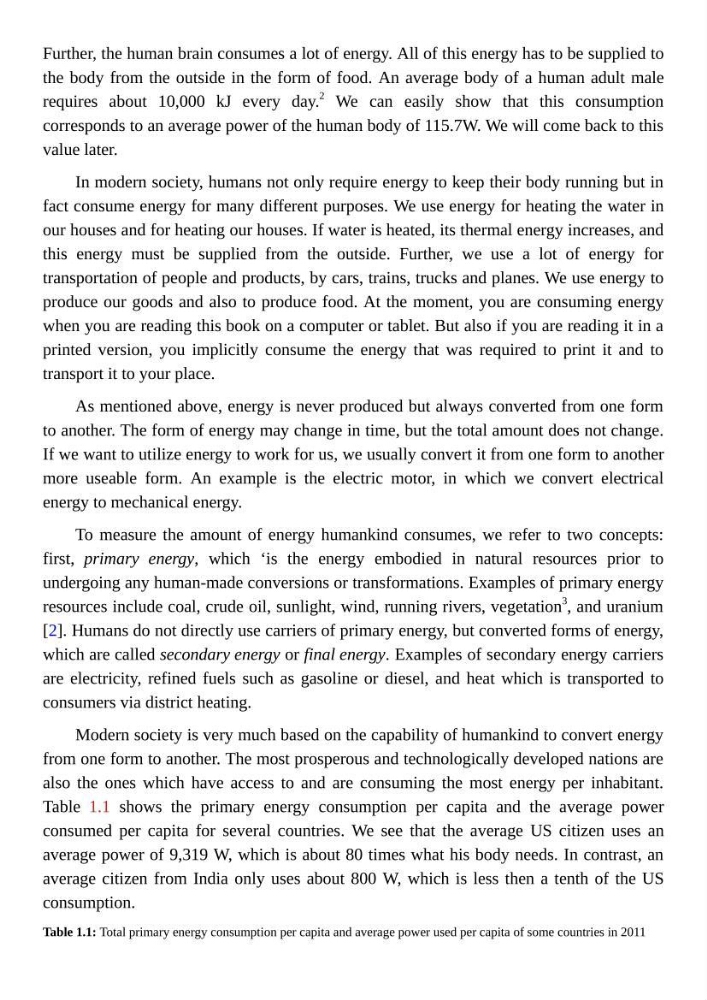
Table 1.1 shows the primary energy consumption per capita and the average power
consumed per capita for several countries. We see that the average US citizen uses an
average power of 9,319 W, which is about 80 times what his body needs. In contrast, an
average citizen from India only uses about 800 W, which is less then a tenth of the US
consumption.
Table 1.1: Total primary energy consumption per capita and average power used per capita of some countries in 2011
the body from the outside in the form of food. An average body of a human adult male
requires about 10,000 kJ every day.
2
We can easily show that this consumption
corresponds to an average power of the human body of 115.7W. We will come back to this
value later.
In modern society, humans not only require energy to keep their body running but in
fact consume energy for many different purposes. We use energy for heating the water in
our houses and for heating our houses. If water is heated, its thermal energy increases, and
this energy must be supplied from the outside. Further, we use a lot of energy for
transportation of people and products, by cars, trains, trucks and planes. We use energy to
produce our goods and also to produce food. At the moment, you are consuming energy
when you are reading this book on a computer or tablet. But also if you are reading it in a
printed version, you implicitly consume the energy that was required to print it and to
transport it to your place.
As mentioned above, energy is never produced but always converted from one form
to another. The form of energy may change in time, but the total amount does not change.
If we want to utilize energy to work for us, we usually convert it from one form to another
more useable form. An example is the electric motor, in which we convert electrical
energy to mechanical energy.
To measure the amount of energy humankind consumes, we refer to two concepts:
first, primary energy, which ‘is the energy embodied in natural resources prior to
undergoing any human-made conversions or transformations. Examples of primary energy
resources include coal, crude oil, sunlight, wind, running rivers, vegetation
3
, and uranium
[2]. Humans do not directly use carriers of primary energy, but converted forms of energy,
which are called secondary energy or final energy. Examples of secondary energy carriers
are electricity, refined fuels such as gasoline or diesel, and heat which is transported to
consumers via district heating.
Modern society is very much based on the capability of humankind to convert energy
from one form to another. The most prosperous and technologically developed nations are
also the ones which have access to and are consuming the most energy per inhabitant.
Table 1.1 shows the primary energy consumption per capita and the average power
consumed per capita for several countries. We see that the average US citizen uses an
average power of 9,319 W, which is about 80 times what his body needs. In contrast, an
average citizen from India only uses about 800 W, which is less then a tenth of the US
consumption.
Table 1.1: Total primary energy consumption per capita and average power used per capita of some countries in 2011