

15.9
15.1
(a)
(b)
(c)
15.2
(a)
(b)
(c)
(d)
15.3
(a)
(b)
(c)
15.4
(a)
Exercises
We have identical crystalline silicon solar cells available, with a short circuit current of 4 A and an open circuit
voltage of 0.6 V at STC. These cells are used to make a PV module with 54 cells connected in series.
What is the open circuit voltage of the module at STC? Assume that the interconnection losses are
negligible.
What is the short circuit current of the module at STC?
Assume that the module does not have any bypass diodes. If the module is partially shaded and one of
the cells is only able to produce 2 A, what will be the new short circuit current under these conditions?
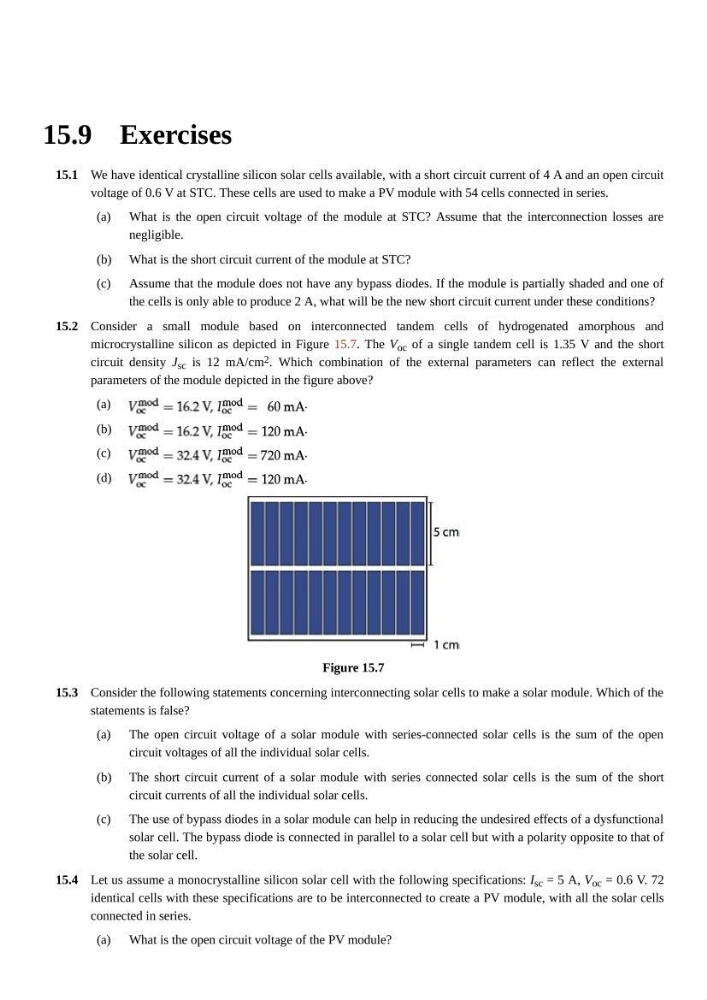
Consider a small module based on interconnected tandem cells of hydrogenated amorphous and
microcrystalline silicon as depicted in Figure 15.7. The V oc of a single tandem cell is 1.35 V and the short
circuit density J sc is 12 mA/cm 2 . Which combination of the external parameters can reflect the external
parameters of the module depicted in the figure above?
.
.
.
.
Figure 15.7
Consider the following statements concerning interconnecting solar cells to make a solar module. Which of the
statements is false?
The open circuit voltage of a solar module with series-connected solar cells is the sum of the open
circuit voltages of all the individual solar cells.
The short circuit current of a solar module with series connected solar cells is the sum of the short
circuit currents of all the individual solar cells.
The use of bypass diodes in a solar module can help in reducing the undesired effects of a dysfunctional
solar cell. The bypass diode is connected in parallel to a solar cell but with a polarity opposite to that of
the solar cell.
Let us assume a monocrystalline silicon solar cell with the following specifications: I sc = 5 A, V oc = 0.6 V. 72
identical cells with these specifications are to be interconnected to create a PV module, with all the solar cells
connected in series.
What is the open circuit voltage of the PV module?
15.1
(a)
(b)
(c)
15.2
(a)
(b)
(c)
(d)
15.3
(a)
(b)
(c)
15.4
(a)
Exercises
We have identical crystalline silicon solar cells available, with a short circuit current of 4 A and an open circuit
voltage of 0.6 V at STC. These cells are used to make a PV module with 54 cells connected in series.
What is the open circuit voltage of the module at STC? Assume that the interconnection losses are
negligible.
What is the short circuit current of the module at STC?
Assume that the module does not have any bypass diodes. If the module is partially shaded and one of
the cells is only able to produce 2 A, what will be the new short circuit current under these conditions?
Consider a small module based on interconnected tandem cells of hydrogenated amorphous and
microcrystalline silicon as depicted in Figure 15.7. The V oc of a single tandem cell is 1.35 V and the short
circuit density J sc is 12 mA/cm 2 . Which combination of the external parameters can reflect the external
parameters of the module depicted in the figure above?
.
.
.
.
Figure 15.7
Consider the following statements concerning interconnecting solar cells to make a solar module. Which of the
statements is false?
The open circuit voltage of a solar module with series-connected solar cells is the sum of the open
circuit voltages of all the individual solar cells.
The short circuit current of a solar module with series connected solar cells is the sum of the short
circuit currents of all the individual solar cells.
The use of bypass diodes in a solar module can help in reducing the undesired effects of a dysfunctional
solar cell. The bypass diode is connected in parallel to a solar cell but with a polarity opposite to that of
the solar cell.
Let us assume a monocrystalline silicon solar cell with the following specifications: I sc = 5 A, V oc = 0.6 V. 72
identical cells with these specifications are to be interconnected to create a PV module, with all the solar cells
connected in series.
What is the open circuit voltage of the PV module?