

15.2
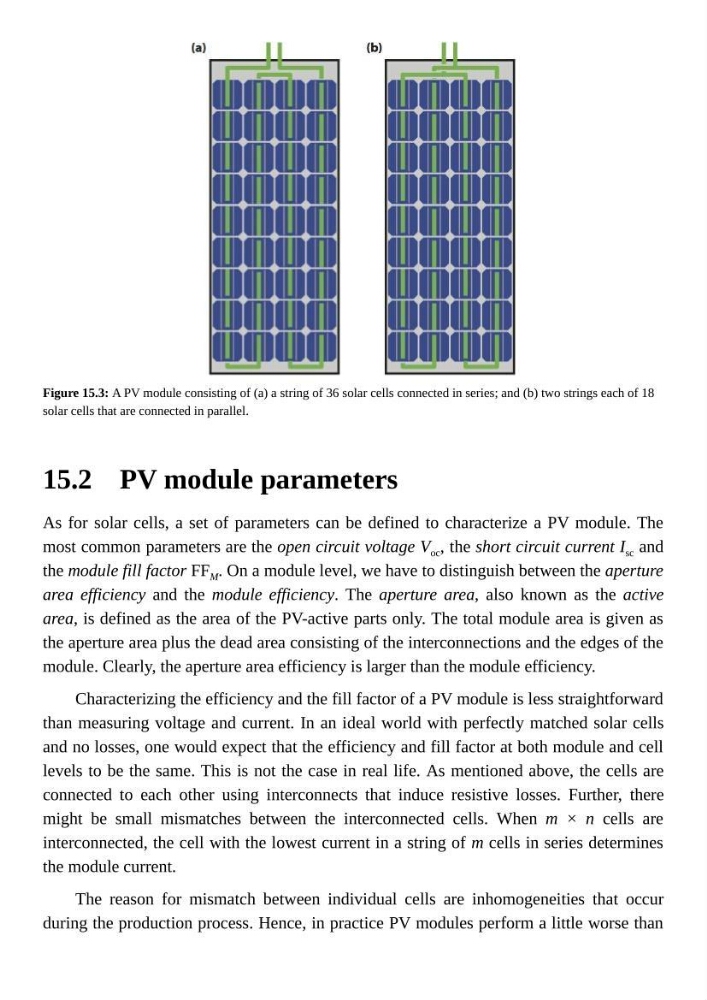
Figure 15.3: A PV module consisting of (a) a string of 36 solar cells connected in series; and (b) two strings each of 18
solar cells that are connected in parallel.
PV module parameters
As for solar cells, a set of parameters can be defined to characterize a PV module. The
most common parameters are the open circuit voltage V oc , the short circuit current I sc and
the module fill factor FF M . On a module level, we have to distinguish between the aperture
area efficiency and the module efficiency. The aperture area, also known as the active
area, is defined as the area of the PV-active parts only. The total module area is given as
the aperture area plus the dead area consisting of the interconnections and the edges of the
module. Clearly, the aperture area efficiency is larger than the module efficiency.
Characterizing the efficiency and the fill factor of a PV module is less straightforward
than measuring voltage and current. In an ideal world with perfectly matched solar cells
and no losses, one would expect that the efficiency and fill factor at both module and cell
levels to be the same. This is not the case in real life. As mentioned above, the cells are
connected to each other using interconnects that induce resistive losses. Further, there
might be small mismatches between the interconnected cells. When m × n cells are
interconnected, the cell with the lowest current in a string of m cells in series determines
the module current.
The reason for mismatch between individual cells are inhomogeneities that occur
during the production process. Hence, in practice PV modules perform a little worse than
Figure 15.3: A PV module consisting of (a) a string of 36 solar cells connected in series; and (b) two strings each of 18
solar cells that are connected in parallel.
PV module parameters
As for solar cells, a set of parameters can be defined to characterize a PV module. The
most common parameters are the open circuit voltage V oc , the short circuit current I sc and
the module fill factor FF M . On a module level, we have to distinguish between the aperture
area efficiency and the module efficiency. The aperture area, also known as the active
area, is defined as the area of the PV-active parts only. The total module area is given as
the aperture area plus the dead area consisting of the interconnections and the edges of the
module. Clearly, the aperture area efficiency is larger than the module efficiency.
Characterizing the efficiency and the fill factor of a PV module is less straightforward
than measuring voltage and current. In an ideal world with perfectly matched solar cells
and no losses, one would expect that the efficiency and fill factor at both module and cell
levels to be the same. This is not the case in real life. As mentioned above, the cells are
connected to each other using interconnects that induce resistive losses. Further, there
might be small mismatches between the interconnected cells. When m × n cells are
interconnected, the cell with the lowest current in a string of m cells in series determines
the module current.
The reason for mismatch between individual cells are inhomogeneities that occur
during the production process. Hence, in practice PV modules perform a little worse than