

delivers the smallest current. Hence, the total current in a string of solar cells is equal to
the smallest current generated by one single solar cell.
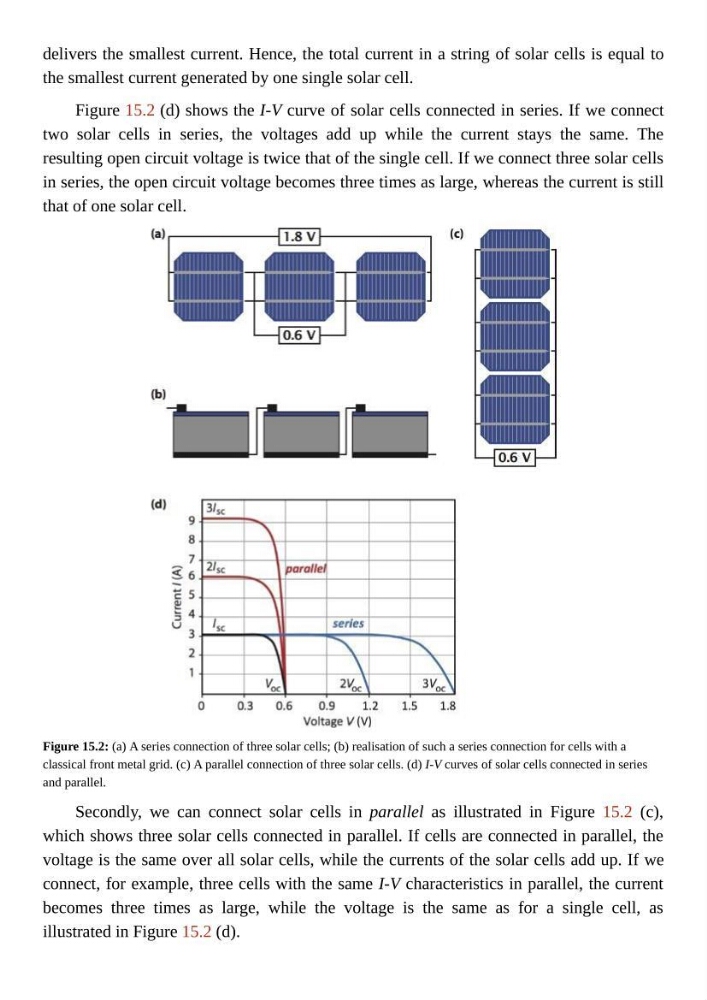
Figure 15.2 (d) shows the I-V curve of solar cells connected in series. If we connect
two solar cells in series, the voltages add up while the current stays the same. The
resulting open circuit voltage is twice that of the single cell. If we connect three solar cells
in series, the open circuit voltage becomes three times as large, whereas the current is still
that of one solar cell.
Figure 15.2: (a) A series connection of three solar cells; (b) realisation of such a series connection for cells with a
classical front metal grid. (c) A parallel connection of three solar cells. (d) I-V curves of solar cells connected in series
and parallel.
Secondly, we can connect solar cells in parallel as illustrated in Figure 15.2 (c),
which shows three solar cells connected in parallel. If cells are connected in parallel, the
voltage is the same over all solar cells, while the currents of the solar cells add up. If we
connect, for example, three cells with the same I-V characteristics in parallel, the current
becomes three times as large, while the voltage is the same as for a single cell, as
illustrated in Figure 15.2 (d).
the smallest current generated by one single solar cell.
Figure 15.2 (d) shows the I-V curve of solar cells connected in series. If we connect
two solar cells in series, the voltages add up while the current stays the same. The
resulting open circuit voltage is twice that of the single cell. If we connect three solar cells
in series, the open circuit voltage becomes three times as large, whereas the current is still
that of one solar cell.
Figure 15.2: (a) A series connection of three solar cells; (b) realisation of such a series connection for cells with a
classical front metal grid. (c) A parallel connection of three solar cells. (d) I-V curves of solar cells connected in series
and parallel.
Secondly, we can connect solar cells in parallel as illustrated in Figure 15.2 (c),
which shows three solar cells connected in parallel. If cells are connected in parallel, the
voltage is the same over all solar cells, while the currents of the solar cells add up. If we
connect, for example, three cells with the same I-V characteristics in parallel, the current
becomes three times as large, while the voltage is the same as for a single cell, as
illustrated in Figure 15.2 (d).