

contact area with a semiconductor material improves the contact qualities; however,
achieving high doping levels in CdTe is problematic. Copper-containing contacts have
been used as back contacts, however, in the long term they may face instability problems
due to diffusion of Cu through the CdTe layer up to the CdS buffer layer. Nowadays,
stable antimony telluride layers in combination with molybdenum are used.
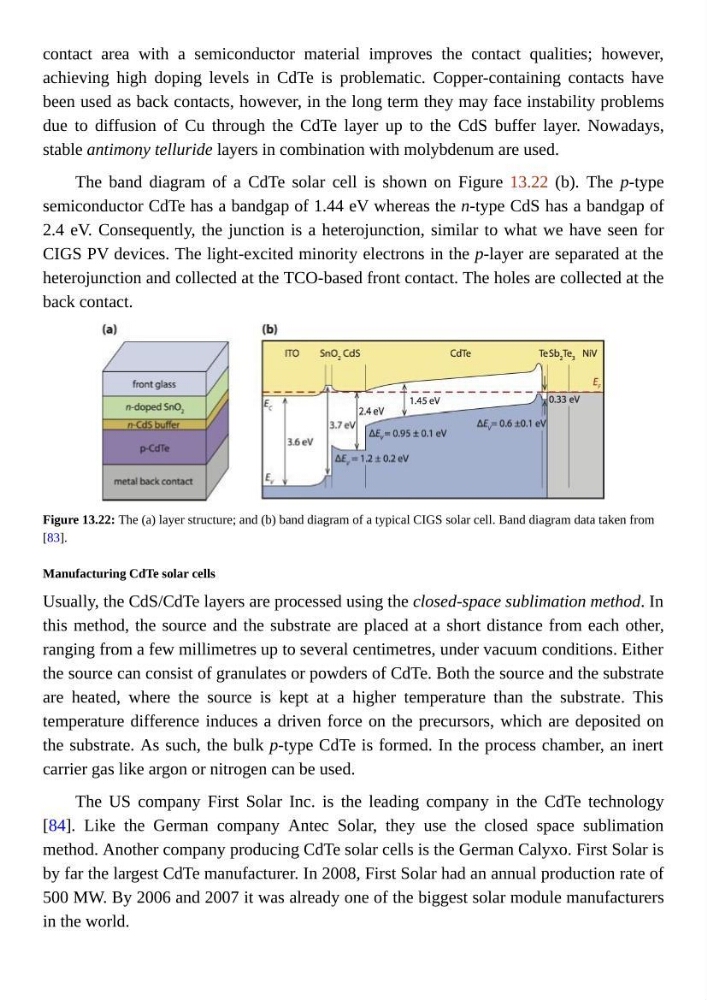
The band diagram of a CdTe solar cell is shown on Figure 13.22 (b). The p-type
semiconductor CdTe has a bandgap of 1.44 eV whereas the n-type CdS has a bandgap of
2.4 eV. Consequently, the junction is a heterojunction, similar to what we have seen for
CIGS PV devices. The light-excited minority electrons in the p-layer are separated at the
heterojunction and collected at the TCO-based front contact. The holes are collected at the
back contact.
Figure 13.22: The (a) layer structure; and (b) band diagram of a typical CIGS solar cell. Band diagram data taken from
[83].
Manufacturing CdTe solar cells
Usually, the CdS/CdTe layers are processed using the closed-space sublimation method. In
this method, the source and the substrate are placed at a short distance from each other,
ranging from a few millimetres up to several centimetres, under vacuum conditions. Either
the source can consist of granulates or powders of CdTe. Both the source and the substrate
are heated, where the source is kept at a higher temperature than the substrate. This
temperature difference induces a driven force on the precursors, which are deposited on
the substrate. As such, the bulk p-type CdTe is formed. In the process chamber, an inert
carrier gas like argon or nitrogen can be used.
The US company First Solar Inc. is the leading company in the CdTe technology
[84]. Like the German company Antec Solar, they use the closed space sublimation
method. Another company producing CdTe solar cells is the German Calyxo. First Solar is
by far the largest CdTe manufacturer. In 2008, First Solar had an annual production rate of
500 MW. By 2006 and 2007 it was already one of the biggest solar module manufacturers
in the world.
achieving high doping levels in CdTe is problematic. Copper-containing contacts have
been used as back contacts, however, in the long term they may face instability problems
due to diffusion of Cu through the CdTe layer up to the CdS buffer layer. Nowadays,
stable antimony telluride layers in combination with molybdenum are used.
The band diagram of a CdTe solar cell is shown on Figure 13.22 (b). The p-type
semiconductor CdTe has a bandgap of 1.44 eV whereas the n-type CdS has a bandgap of
2.4 eV. Consequently, the junction is a heterojunction, similar to what we have seen for
CIGS PV devices. The light-excited minority electrons in the p-layer are separated at the
heterojunction and collected at the TCO-based front contact. The holes are collected at the
back contact.
Figure 13.22: The (a) layer structure; and (b) band diagram of a typical CIGS solar cell. Band diagram data taken from
[83].
Manufacturing CdTe solar cells
Usually, the CdS/CdTe layers are processed using the closed-space sublimation method. In
this method, the source and the substrate are placed at a short distance from each other,
ranging from a few millimetres up to several centimetres, under vacuum conditions. Either
the source can consist of granulates or powders of CdTe. Both the source and the substrate
are heated, where the source is kept at a higher temperature than the substrate. This
temperature difference induces a driven force on the precursors, which are deposited on
the substrate. As such, the bulk p-type CdTe is formed. In the process chamber, an inert
carrier gas like argon or nitrogen can be used.
The US company First Solar Inc. is the leading company in the CdTe technology
[84]. Like the German company Antec Solar, they use the closed space sublimation
method. Another company producing CdTe solar cells is the German Calyxo. First Solar is
by far the largest CdTe manufacturer. In 2008, First Solar had an annual production rate of
500 MW. By 2006 and 2007 it was already one of the biggest solar module manufacturers
in the world.