

13.3
germanium substrate, the bottom cell is a Ge cell. On top it is best to place a junction that
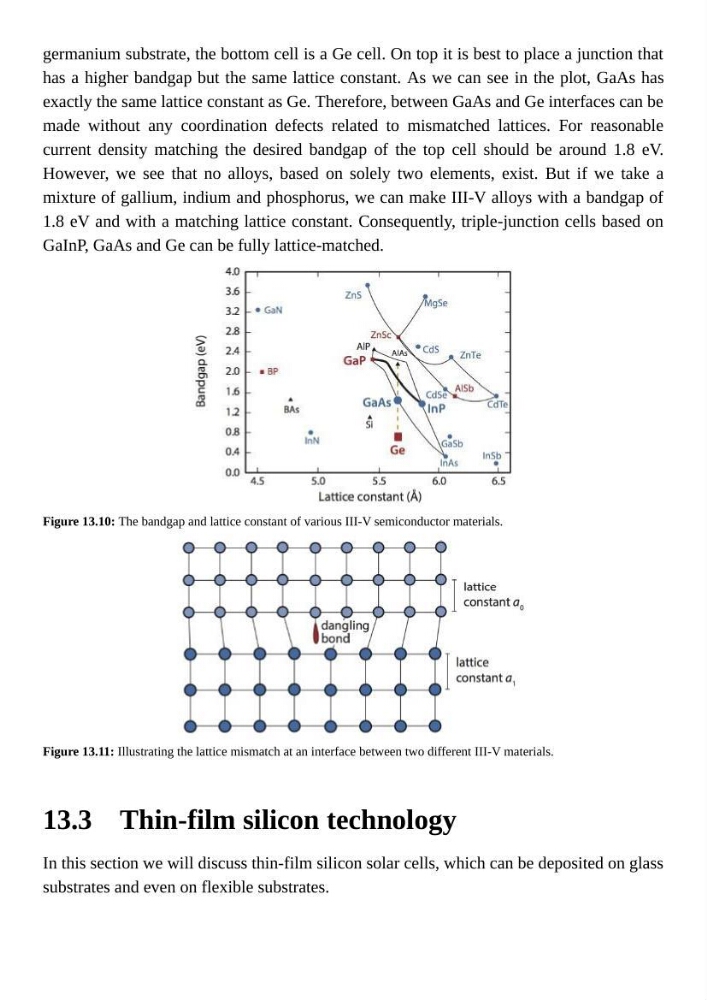
has a higher bandgap but the same lattice constant. As we can see in the plot, GaAs has
exactly the same lattice constant as Ge. Therefore, between GaAs and Ge interfaces can be
made without any coordination defects related to mismatched lattices. For reasonable
current density matching the desired bandgap of the top cell should be around 1.8 eV.
However, we see that no alloys, based on solely two elements, exist. But if we take a
mixture of gallium, indium and phosphorus, we can make III-V alloys with a bandgap of
1.8 eV and with a matching lattice constant. Consequently, triple-junction cells based on
GaInP, GaAs and Ge can be fully lattice-matched.
Figure 13.10: The bandgap and lattice constant of various III-V semiconductor materials.
Figure 13.11: Illustrating the lattice mismatch at an interface between two different III-V materials.
Thin-film silicon technology
In this section we will discuss thin-film silicon solar cells, which can be deposited on glass
substrates and even on flexible substrates.
germanium substrate, the bottom cell is a Ge cell. On top it is best to place a junction that
has a higher bandgap but the same lattice constant. As we can see in the plot, GaAs has
exactly the same lattice constant as Ge. Therefore, between GaAs and Ge interfaces can be
made without any coordination defects related to mismatched lattices. For reasonable
current density matching the desired bandgap of the top cell should be around 1.8 eV.
However, we see that no alloys, based on solely two elements, exist. But if we take a
mixture of gallium, indium and phosphorus, we can make III-V alloys with a bandgap of
1.8 eV and with a matching lattice constant. Consequently, triple-junction cells based on
GaInP, GaAs and Ge can be fully lattice-matched.
Figure 13.10: The bandgap and lattice constant of various III-V semiconductor materials.
Figure 13.11: Illustrating the lattice mismatch at an interface between two different III-V materials.
Thin-film silicon technology
In this section we will discuss thin-film silicon solar cells, which can be deposited on glass
substrates and even on flexible substrates.