

12.5.2
could be obtained.
At the rear surface of the solar cell, point contacts have been used in combination
with thermal oxide passivation layers, which passivate the non-contacted area, and hence
reduce the undesirable surface recombination. A highly doped boron region, created by
local boron diffusion, operates as a local back surface field to limit the recombination of
the minority electrons at the metal back contact.
The PERL concept includes some expensive processing steps. Therefore, the Chinese
company Suntech developed, in collaboration with University of New South Wales, a
more commercially viable crystalline silicon cell technology, which was inspired by the
PERL design.
The interdigitated back contact solar cell
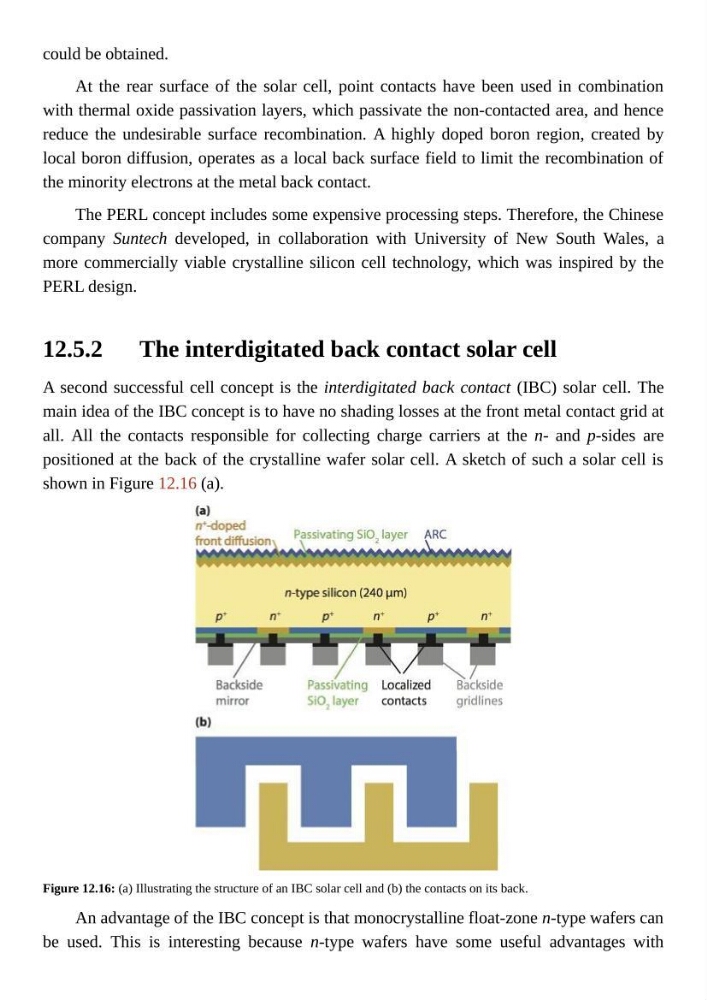
A second successful cell concept is the interdigitated back contact (IBC) solar cell. The
main idea of the IBC concept is to have no shading losses at the front metal contact grid at
all. All the contacts responsible for collecting charge carriers at the n- and p-sides are
positioned at the back of the crystalline wafer solar cell. A sketch of such a solar cell is
shown in Figure 12.16 (a).
Figure 12.16: (a) Illustrating the structure of an IBC solar cell and (b) the contacts on its back.
An advantage of the IBC concept is that monocrystalline float-zone n-type wafers can
be used. This is interesting because n-type wafers have some useful advantages with
could be obtained.
At the rear surface of the solar cell, point contacts have been used in combination
with thermal oxide passivation layers, which passivate the non-contacted area, and hence
reduce the undesirable surface recombination. A highly doped boron region, created by
local boron diffusion, operates as a local back surface field to limit the recombination of
the minority electrons at the metal back contact.
The PERL concept includes some expensive processing steps. Therefore, the Chinese
company Suntech developed, in collaboration with University of New South Wales, a
more commercially viable crystalline silicon cell technology, which was inspired by the
PERL design.
The interdigitated back contact solar cell
A second successful cell concept is the interdigitated back contact (IBC) solar cell. The
main idea of the IBC concept is to have no shading losses at the front metal contact grid at
all. All the contacts responsible for collecting charge carriers at the n- and p-sides are
positioned at the back of the crystalline wafer solar cell. A sketch of such a solar cell is
shown in Figure 12.16 (a).
Figure 12.16: (a) Illustrating the structure of an IBC solar cell and (b) the contacts on its back.
An advantage of the IBC concept is that monocrystalline float-zone n-type wafers can
be used. This is interesting because n-type wafers have some useful advantages with