

•
•
•
10.3.4
J 0 and the photo generated current J sc of the solar cell. The saturation current density
depends on the recombination in the solar cell. Recombination cannot be avoided and
depends on the doping of different regions (n-type and p-type) of the junction and the
electronic quality of materials forming the junction. The doping levels and the
recombination determine the bandgap utilization efficiency η V that we already defined in
Section 10.2.
For determining the Shockley–Queisser limit we assumed for the FF that the solar
cell behaves as an ideal diode. In a real solar cell, however, the FF is lower than the ideal
value because of the following reasons:
The voltage drop due to the series resistance R s of a solar cell, which is
introduced by the resistance of the main current path through which the photo
generated carriers arrive to the external circuit. The contributions to the series
resistance come from the bulk resistance of the junction, the contact resistance
between the junction and electrodes, and the resistance of the electrodes
themselves.
The voltage drop due to leakage currents, which is characterised by the shunt
resistance R p of a solar cell. The leakage current is caused by the current through
local defects in the junction or due to shunts at the edges of solar cells.
The recombination in a non-ideal solar cell results in a decrease of the FF.
Conversion efficiency
Again, we start with the expression for the efficiency
Using Eqs. (10.23) and (10.14) we find
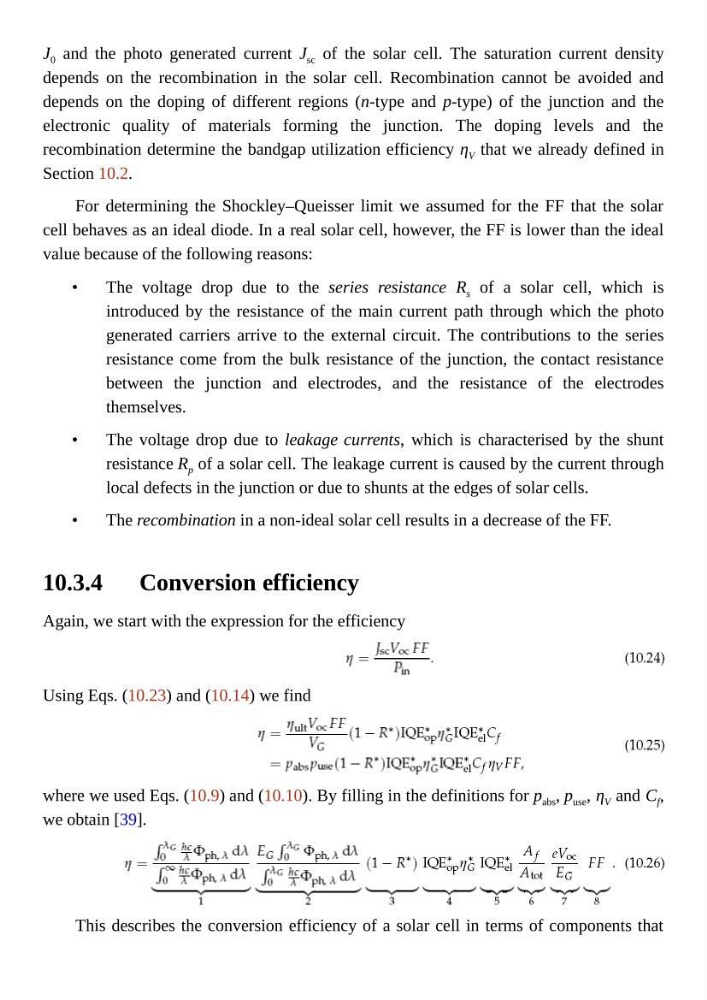
where we used Eqs. (10.9) and (10.10). By filling in the definitions for p abs , p use , η V and C f ,
we obtain [39].
This describes the conversion efficiency of a solar cell in terms of components that
•
•
10.3.4
J 0 and the photo generated current J sc of the solar cell. The saturation current density
depends on the recombination in the solar cell. Recombination cannot be avoided and
depends on the doping of different regions (n-type and p-type) of the junction and the
electronic quality of materials forming the junction. The doping levels and the
recombination determine the bandgap utilization efficiency η V that we already defined in
Section 10.2.
For determining the Shockley–Queisser limit we assumed for the FF that the solar
cell behaves as an ideal diode. In a real solar cell, however, the FF is lower than the ideal
value because of the following reasons:
The voltage drop due to the series resistance R s of a solar cell, which is
introduced by the resistance of the main current path through which the photo
generated carriers arrive to the external circuit. The contributions to the series
resistance come from the bulk resistance of the junction, the contact resistance
between the junction and electrodes, and the resistance of the electrodes
themselves.
The voltage drop due to leakage currents, which is characterised by the shunt
resistance R p of a solar cell. The leakage current is caused by the current through
local defects in the junction or due to shunts at the edges of solar cells.
The recombination in a non-ideal solar cell results in a decrease of the FF.
Conversion efficiency
Again, we start with the expression for the efficiency
Using Eqs. (10.23) and (10.14) we find
where we used Eqs. (10.9) and (10.10). By filling in the definitions for p abs , p use , η V and C f ,
we obtain [39].
This describes the conversion efficiency of a solar cell in terms of components that