

point tracking (MPPT), which is discussed in great detail in Section 19.1.
Assuming that the solar cell behaves as an ideal diode, the fill factor can be expressed
as a function of open circuit voltage V oc [35],
where
is a normalized voltage. Equation (9.3) is a good approximation of the ideal value of FF
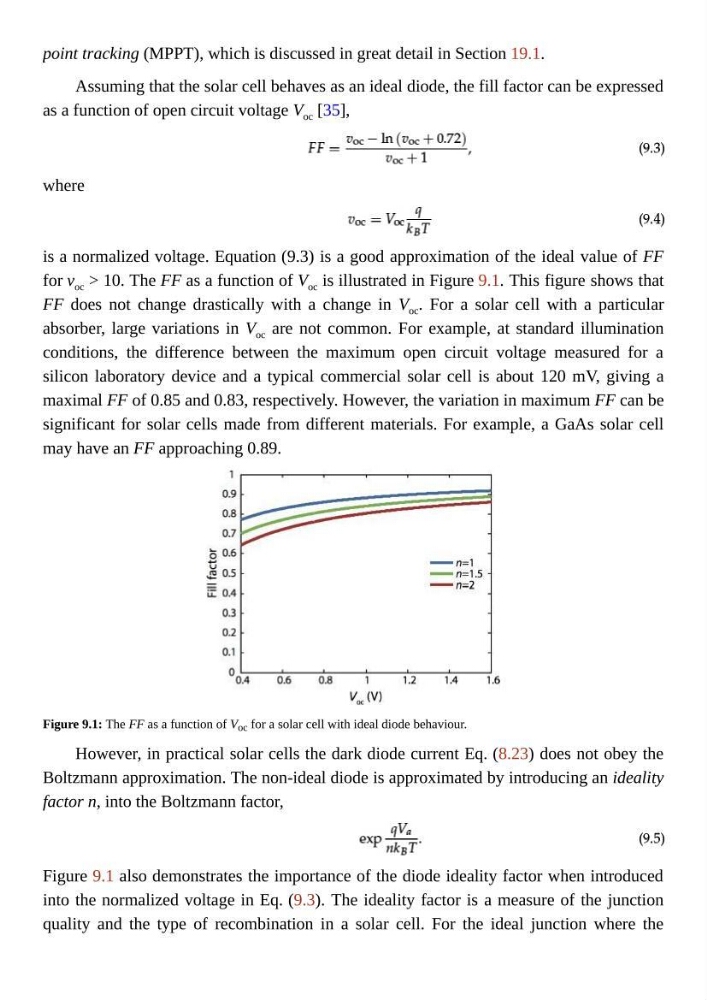
for v oc > 10. The FF as a function of V oc is illustrated in Figure 9.1. This figure shows that
FF does not change drastically with a change in V oc . For a solar cell with a particular
absorber, large variations in V oc are not common. For example, at standard illumination
conditions, the difference between the maximum open circuit voltage measured for a
silicon laboratory device and a typical commercial solar cell is about 120 mV, giving a
maximal FF of 0.85 and 0.83, respectively. However, the variation in maximum FF can be
significant for solar cells made from different materials. For example, a GaAs solar cell
may have an FF approaching 0.89.
Figure 9.1: The FF as a function of V oc for a solar cell with ideal diode behaviour.
However, in practical solar cells the dark diode current Eq. (8.23) does not obey the
Boltzmann approximation. The non-ideal diode is approximated by introducing an ideality
factor n, into the Boltzmann factor,
Figure 9.1 also demonstrates the importance of the diode ideality factor when introduced
into the normalized voltage in Eq. (9.3). The ideality factor is a measure of the junction
quality and the type of recombination in a solar cell. For the ideal junction where the
Assuming that the solar cell behaves as an ideal diode, the fill factor can be expressed
as a function of open circuit voltage V oc [35],
where
is a normalized voltage. Equation (9.3) is a good approximation of the ideal value of FF
for v oc > 10. The FF as a function of V oc is illustrated in Figure 9.1. This figure shows that
FF does not change drastically with a change in V oc . For a solar cell with a particular
absorber, large variations in V oc are not common. For example, at standard illumination
conditions, the difference between the maximum open circuit voltage measured for a
silicon laboratory device and a typical commercial solar cell is about 120 mV, giving a
maximal FF of 0.85 and 0.83, respectively. However, the variation in maximum FF can be
significant for solar cells made from different materials. For example, a GaAs solar cell
may have an FF approaching 0.89.
Figure 9.1: The FF as a function of V oc for a solar cell with ideal diode behaviour.
However, in practical solar cells the dark diode current Eq. (8.23) does not obey the
Boltzmann approximation. The non-ideal diode is approximated by introducing an ideality
factor n, into the Boltzmann factor,
Figure 9.1 also demonstrates the importance of the diode ideality factor when introduced
into the normalized voltage in Eq. (9.3). The ideality factor is a measure of the junction
quality and the type of recombination in a solar cell. For the ideal junction where the